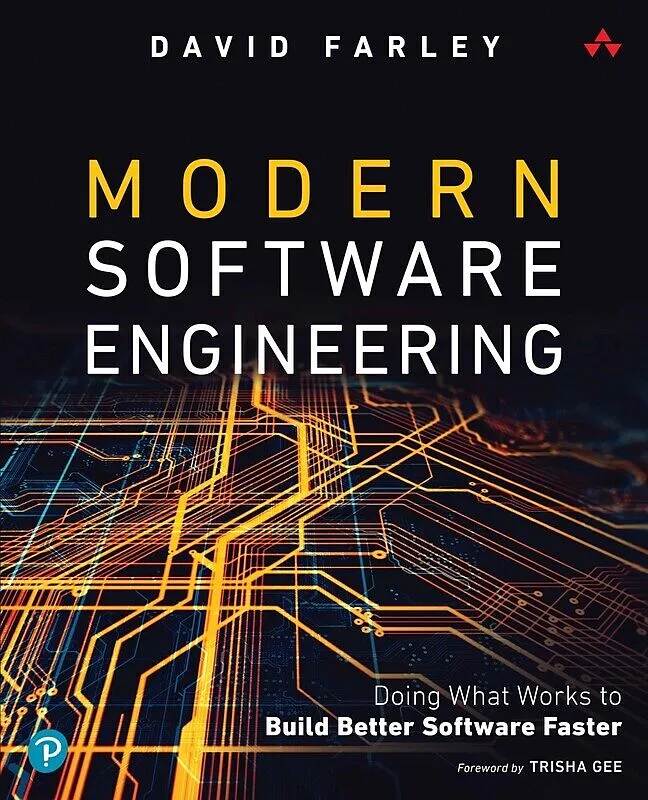
Modern Software Engineering: Doing What Works to Build Better Software Faster
Beschreibung
Writing for students at all levels of experience, Farley illuminates durable principles at the heart of effective software development. He distills the discipline into two core exercises: first, learning and exploration, and second, managing complexity. For e...
Format auswählen
- Kartonierter EinbandCHF 38.55
- E-Book (pdf)CHF 33.90
- E-Book (epub)CHF 33.90

Wird oft zusammen gekauft
Andere Kunden kauften auch
Beschreibung
Writing for students at all levels of experience, Farley illuminates durable principles at the heart of effective software development. He distills the discipline into two core exercises: first, learning and exploration, and second, managing complexity. For each, he defines principles that can help students improve everything from their mindset to the quality of their code, and describes approaches proven to promote success. Farley's ideas and techniques cohere into a unified, scientific, and foundational approach to solving practical software development problems within realistic economic constraints. This general, durable, and pervasive approach to software engineering can help students solve problems they haven't encountered yet, using today's technologies and tomorrow's. It offers students deeper insight into what they do every day, helping them create better software, faster, with more pleasure and personal fulfillment.
Improve Your Creativity, Effectiveness, and Ultimately, Your Code
In Modern Software Engineering, continuous delivery pioneer David Farley helps software professionals think about their work more effectively, manage it more successfully, and genuinely improve the quality of their applications, their lives, and the lives of their colleagues.
Writing for programmers, managers, and technical leads at all levels of experience, Farley illuminates durable principles at the heart of effective software development. He distills the discipline into two core exercises: learning and exploration and managing complexity. For each, he defines principles that can help you improve everything from your mindset to the quality of your code, and describes approaches proven to promote success.
Farley's ideas and techniques cohere into a unified, scientific, and foundational approach to solving practical software development problems within realistic economic constraints. This general, durable, and pervasive approach to software engineering can help you solve problems you haven't encountered yet, using today's technologies and tomorrow's. It offers you deeper insight into what you do every day, helping you create better software, faster, with more pleasure and personal fulfillment.
- Clarify what you're trying to accomplish
- Choose your tools based on sensible criteria
- Organize work and systems to facilitate continuing incremental progress
- Evaluate your progress toward thriving systems, not just more "legacy code"
- Gain more value from experimentation and empiricism
- Stay in control as systems grow more complex
- Achieve rigor without too much rigidity
- Learn from history and experience
- Distinguish "good" new software development ideas from "bad" ones Register your book for convenient access to downloads, updates, and/or corrections as they become available. See inside book for details.
Autorentext
David Farley, founder and consultant for Continuous Delivery Ltd., has been a programmer, software engineer, and systems architect since the early days of modern computing. He has shaped ground-breaking approaches that have transformed how developers and teams work. With Jez Humble, Farley coauthored the best-seller Continuous Delivery. As Head of Software Development for the London Multi Asset Exchange (LMAX), he built one of the world's fastest financial exchanges. One of the earliest adopters of agile techniques employing iterative development, continuous integration, and high levels of automated testing, he also coauthored the Reactive Manifesto. Dave also runs the popular and highly successful "Continuous Delivery" YouTube channel.
Zusammenfassung
Improve Your Creativity, Effectiveness, and Ultimately, Your Code
In Modern Software Engineering, continuous delivery pioneer David Farley helps software professionals think about their work more effectively, manage it more successfully, and genuinely improve the quality of their applications, their lives, and the lives of their colleagues.
Writing for programmers, managers, and technical leads at all levels of experience, Farley illuminates durable principles at the heart of effective software development. He distills the discipline into two core exercises: learning and exploration and managing complexity. For each, he defines principles that can help you improve everything from your mindset to the quality of your code, and describes approaches proven to promote success.
Farley's ideas and techniques cohere into a unified, scientific, and foundational approach to solving practical software development problems within realistic economic constraints. This general, durable, and pervasive approach to software engineering can help you solve problems you haven't encountered yet, using today's technologies and tomorrow's. It offers you deeper insight into what you do every day, helping you create better software, faster, with more pleasure and personal fulfillment.
- Clarify what you're trying to accomplish
- Choose your tools based on sensible criteria
- Organize work and systems to facilitate continuing incremental progress
- Evaluate your progress toward thriving systems, not just more "legacy code"
- Gain more value from experimentation and empiricism
- Stay in control as systems grow more complex
- Achieve rigor without too much rigidity
- Learn from history and experience
- Distinguish "good" new software development ideas from "bad" onesRegister your book for convenient access to downloads, updates, and/or corrections as they become available. See inside book for details.
Inhalt
Foreword xvii
Preface xxi
Acknowledgments xxv
About the Author xxvii
Part I: What Is Software Engineering? 1
Chapter 1: Introduction 3
Engineering--The Practical Application of Science 3
What Is Software Engineering? 4
Reclaiming "Software Engineering" 5
The Birth of Software Engineering 7
Shifting the Paradigm 8
Summary 9
Chapter 2: What Is Engineering? 11
Production Is Not Our Problem 11
Design Engineering, Not Production Engineering 12
A Working Definition of Engineering 17
Engineering != Code 17
Why Does Engineering Matter? 19
The Limits of "Craft" 19
Precision and Scalability 20
Managing Complexity 21
Repeatability and Accuracy of Measurement 22
Engineering, Creativity, and Craft 24
Why What We Do Is Not Software Engineering 25
Trade-Offs 26
The Illusion of Progress 26
The Journey from Craft to Engineering 27
Craft Is Not Enough 28
Time for a Rethink? 28
Summary 30
Chapter 3: Fundamentals of an Engineering Approach 31
An Industry of Change? 31
The Importance of Measurement 32
Applying Stability and Throughput 34
The Foundations of a Software Engineering Discipline 36
Experts at Learning 36
Experts at Managing Complexity 37
Summary 38
Part II: Optimize for Learning 41
Chapter 4: Working Iteratively 43
Practical Advantages of Working Iteratively 45
Iteration as a Defensive Design Strategy 46
The Lure of the Plan 48
Practicalities of Working Iteratively 54
Summary 55
Chapter 5: Feedback 57
A Practical Example of the Importance of Feedback 58
Feedback in Coding 60
Feedback in Integration 61
Feedback in Design 63
Feedback in Architecture 65
Prefer Early Feedback 67
Feedback in Product Design 68
Feedback in Organization and Culture 68
Summary 70
Chapter 6: Incrementalism 71
Importance of Modularity 72
Organizational Incrementalism 73
Tools of Incrementalism 74
Limiting the Impact of Change 76
Incremental Design 77
Summary 79
Chapter 7: Empiricism 81
Grounded in Reality 82
Separating Empirical from Experimental 82
"I Know That B…