
IHR WARENKORB IST AKTUELL LEER.
Haben Sie noch nichts passendes gefunden? Stöbern Sie durch unser komplettes Sortiment.
Oder melden Sie sich an bzw. registrieren Sie sich.
- Kostenlose Lieferung
- Kauf auf Rechnung
- Ex Libris Tiefpreis
- Filiallieferung und 650+ Abholorte
- Rabatt-Bons als Club-Mitglied
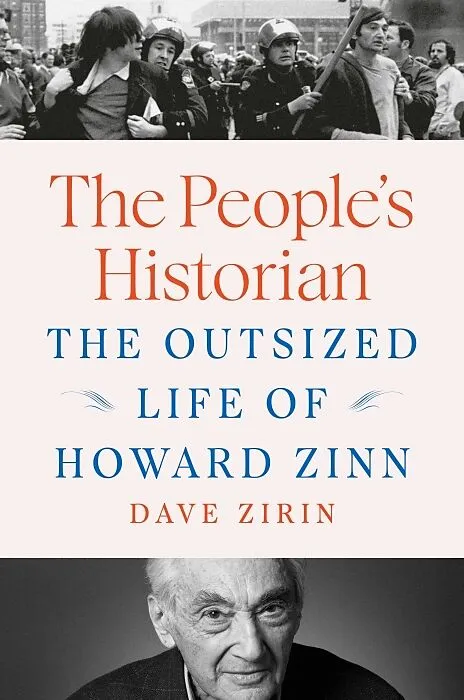
The People's Historian
Beschreibung
A biography of iconic radical historian Howard Zinn, examining his life and work as a progressive icon and thought leader through the story of the times that shaped him as well as the United States of America. From With input from family and access to Zinn''s ...Format auswählen
- Fester EinbandCHF 36.70
Wird oft zusammen gekauft
Andere Kunden kauften auch
Beschreibung
A biography of iconic radical historian Howard Zinn, examining his life and work as a progressive icon and thought leader through the story of the times that shaped him as well as the United States of America. From With input from family and access to Zinn''s personal papers, <The People''s Historian< paints a picture of the man behind <A People''s History,< examining his work and legacy in the broader context of the United States.
Autorentext
Dave Zirin
Leseprobe
Chapter 1
"A Jungle of Terrible Odors"
The Brooklyn of Howard Zinn's youth was a place of hardscrabble poverty, crowded tenements, rats, and roaches. Zinn was never nostalgic about being raised poor. With a faraway look, his trademark smile falling, he once said, "The roaches. Never absent, where we lived. We'd come home and they'd be all over the kitchen table and scatter when we turned on the light. I never got used to them." The poverty of his youth was always there in the back of his mind, especially when he was confronted with narratives about how just "working harder" would have solved all the problems his family faced. He once wrote, "I always feel some rage when I hear the voice of the arrogant and affluent: we have a wonderful system; if you work hard, you will make it. How hard my parents worked. How brave they were just to keep four sons alive in the cold-water tenements of Brooklyn."
Watercolored memories were also difficult to conjure because the Brooklyn of Zinn's 1922 birth was in a state of dirty, cacophonous, rapidly changing industrialization. By the early 1920s, it had recently transformed into one of the top manufacturing hubs in the country. Brooklyn's largest industry, sugar refining, produced more than half the sugar consumed in the United States. In addition, the borough had shipyards, slaughterhouses, and an archipelago of sweatshops. For countless waves of Jewish and Eastern European immigrants, this made Brooklyn a place where they could speak the language and be brought in by people from their villages or shtetls. The growth of jobs and absence of an explicitly legal Jim Crow also made it a stop on the Great Migration north by Black laborers and an early destination for the people of Puerto Rico ready to leave an indelible imprint on the city. Almost half of the people in Brooklyn had not in fact been born there. The work available in Brooklyn might have been arduous, but there was at this time, until the 1929 Great Depression, ample work to be found.
Then, when Zinn was two years old, a law was passed that would have kept his parents from even entering the United States, the 1924 Immigration Restriction Act. This bill was lobbied for by an increasingly vocal and visible Ku Klux Klan, and when President Coolidge signed it, he used a widely known Klan phrase, "America for Americans." It was passed with more than 80 percent of Congress fulsomely voting in the affirmative. The foundations of today's barbaric immigration system, from ICE raids to the label "illegal alien," come from this bill. The bill was also supported by the segregated American Federation of Labor making common cause with the Klan. It was most of all a naked attack on the people of Asian descent already in the United States who had for decades played a critical role in constructing the nation's infrastructure, often paying with their lives (think of the racist phrase "not a Chinaman's chance," which originated in the idea that their high rates of deaths while building the railroads was a mockable inevitability). Not only was their path to citizenship stymied, but the bill invoked a total barring of Chinese immigration. It also dramatically prioritized Western and Northern European Christian immigrants, shutting out the Jews of Southern and Eastern Europe, along with people from Italy. The Jews turned away after 1924 either entered the country illegally or were sent back. In the Jewish community, this law was applied most infamously in 1939 when a boatload of Jewish political refugees on the SS St. Louis was turned away and returned home, where they were killed in Nazi concentration camps. They were described by one congressman as "hordes of inferior stock." Jews were "filthy, un-American, and often dangerous in their habits." Today's rhetoric of immigrants "poisoning our blood" and the way that white Afrikaners have been welcomed to emigrate while non-white immigrants have been criminalized have roots in the law and rhetoric of 1920s America.
The Zinns were part of a massive wave of those early Jewish immigrants who were able to enter legally before 1924. The family on his mother's side, like so many Eastern European Jewish families came over in stages. In 1909 at the age of fifteen, Zinn's mother, Jenny Rabinowitz, traveled from the Siberian shtetl of Irkutsk to join her father and grandmother. They lived in the back of a barbershop in what was then the decidedly untrendy land of Williamsburg, Brooklyn. Jenny couldn't go to school because she had to support her family by working as a seamstress, sewing eleven hours a day and six days a week before she met Eddie Zinn and they started a family. Even with four sons, she never stopped working. It was a hard life, but both Jenny and Eddie made Brooklyn their new home, claiming the mantle of "American" from a country that did not want them there.
Quickly, that Dutch word "Brooklyn" and Jews became practically synonymous. By 1920, almost one-third of New York City was Jewish, the majority calling Brooklyn home. The opening of the Brooklyn Bridge in 1883 had made the area a magnet for immigrants who could live in Brooklyn tenements, but-if employment was scarce in the sugar factories and sweatshops-find work in Manhattan. In 1920, the establishment of a new Brooklyn-Manhattan subway line made the borough even more attractive. Brooklyn became less the new-world shtetl and more a jumping-off point to the wonders of "the city." Howard Zinn's family fit this narrative: arriving with next to nothing, working hard, and, if nothing else, relieved that there was work to be done and an unleaking roof over their heads.
Fittingly, as Brooklyn immigrant labor, Eddie Zinn and Jenny Rabinowitz met while working at the same factory and married, creating a life that had them hopping from cramped apartment to apartment, one step ahead of angry landlords and bill collectors. As Zinn remembered. "I lived in all of Brooklyn's best slums." When the Depression hit, Eddie, a long way from the Austria-Hungary of his youth, worked as a ditchdigger and window cleaner. Jenny, never looking backward after a childhood in Siberia, took odd jobs and did piecework whenever possible. Later, Eddie Zinn found more stability in the waiters' union, working banquets, weddings, and Bar Mitzvahs. Sometimes he'd bring his impossibly tall eldest son to take some shifts with him, although finding a uniform that could make it to his ankles and wrists was never an easy task. "I hated every moment of it," recalled Zinn. "The ill-fitting waiters' tuxedo borrowed from my father on my lanky body; the sleeves absurdly short. My father was five-foot-five and I was already a six footer."
Howard held an early interest in reading despite growing up without books. It started when he saw a torn volume littering the street like trash and officially started the Zinn family library. It was Tarzan and the Jewels of Opal. "There were no books in our house," Zinn recalled. "[My parents] knew little about politics, except that Franklin Roosevelt was a good man because he helped the poor."
Jenny and Eddie, however, seeing that thirst for learning, aimed to quench it. Although they had never heard of Charles Dickens, the Zinns would mail a coupon with a dime each month to the New York Post so their son could read one of what would ultimately be twenty volumes of Dickens' complete works. The family library required an expansion. Reading Dickens…