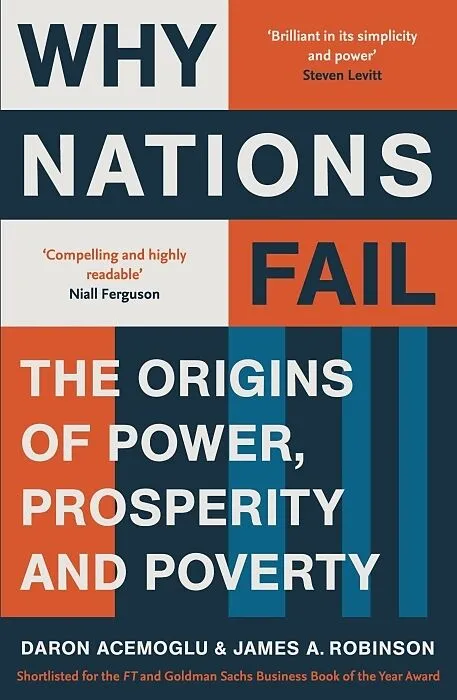
Why Nations Fail
Beschreibung
A provocative bestseller that explains why the world is divided into nations with wildly differing levels of prosperity Informationen zum Autor Daron Acemoglu is an Institute Professor at MIT, Faculty Co-Director of MIT's Shaping the Future of Work Initiative,...Format auswählen
- Kartonierter EinbandCHF 20.30

Wird oft zusammen gekauft
Andere Kunden kauften auch
Beschreibung
A provocative bestseller that explains why the world is divided into nations with wildly differing levels of prosperity
Informationen zum Autor Daron Acemoglu is an Institute Professor at MIT, Faculty Co-Director of MIT's Shaping the Future of Work Initiative, and a Research Affiliate at MIT's newly established Blueprint Labs. He has been awarded several prizes for this work, including the John Bates Clark Medal, the Nemmers Prize, the BBVA Frontiers Award, and the Global Economy Prize. Most recently, he was awarded the Nobel Prize in Economics in 2024. Acemoglu's work and writing has been featured in leading publications, including, among others, the New York Times , Financial Times , Wall Street Journal , Los Angeles Times , Washington Post , and Prospect , TIME , and WIRED magazines. Acemoglu is the author of six books, including Why Nations Fail with James A. Robinson, for which they were jointly awarded the 2024 Nobel Economics Prize. James A. Robinson is a political scientist and economist and the Florence Professor of Government at Harvard University, and a world-renowned expert on Latin America and Africa. He received the Nobel Prize in Economics in 2024 for his work on global inequality. Klappentext Why are some nations more prosperous than others? Why Nations Fail sets out to answer this question! with a compelling and elegantly argued new theory: that it is not down to climate! geography or culture! but because of institutions. Drawing on an extraordinary range of contemporary and historical examples! from ancient Rome through the Tudors to modern-day China! leading academics Daron Acemoglu and James A. Robinson show that to invest and prosper! people need to know that if they work hard! they can make money and actually keep it - and this means sound institutions that allow virtuous circles of innovation! expansion and peace. Based on fifteen years of research! and answering the competing arguments of authors ranging from Max Weber to Jeffrey Sachs and Jared Diamond! Acemoglu and Robinson step boldly into the territory of Francis Fukuyama and Ian Morris. They blend economics! politics! history and current affairs to provide a new! powerful and persuasive way of understanding wealth and poverty. Vorwort A provocative bestseller that explains why the world is divided into nations with wildly differing levels of prosperity Zusammenfassung Why are some nations more prosperous than others? This book sets out to answer this question, with a compelling and elegantly argued new theory: that it is not down to climate, geography or culture, but because of institutions. It explains why the world is divided into nations with wildly differing levels of prosperity....
Autorentext
Daron Acemoglu is an Institute Professor at MIT, Faculty Co-Director of MIT's Shaping the Future of Work Initiative, and a Research Affiliate at MIT's newly established Blueprint Labs.
He has been awarded several prizes for this work, including the John Bates Clark Medal, the Nemmers Prize, the BBVA Frontiers Award, and the Global Economy Prize. Most recently, he was awarded the Nobel Prize in Economics in 2024.
Acemoglu's work and writing has been featured in leading publications, including, among others, the New York Times, Financial Times, Wall Street Journal, Los Angeles Times, Washington Post, and Prospect, TIME, and WIRED magazines.
Acemoglu is the author of six books, including Why Nations Fail with James A. Robinson, for which they were jointly awarded the 2024 Nobel Economics Prize.
James A. Robinson is a political scientist and economist and the Florence Professor of Government at Harvard University, and a world-renowned expert on Latin America and Africa. He received the Nobel Prize in Economics in 2024 for his work on global inequality.
Klappentext
Why are some nations more prosperous than others? Why Nations Fail sets out to answer this question, with a compelling and elegantly argued new theory: that it is not down to climate, geography or culture, but because of institutions. Drawing on an extraordinary range of contemporary and historical examples, from ancient Rome through the Tudors to modern-day China, leading academics Daron Acemoglu and James A. Robinson show that to invest and prosper, people need to know that if they work hard, they can make money and actually keep it - and this means sound institutions that allow virtuous circles of innovation, expansion and peace.
Based on fifteen years of research, and answering the competing arguments of authors ranging from Max Weber to Jeffrey Sachs and Jared Diamond, Acemoglu and Robinson step boldly into the territory of Francis Fukuyama and Ian Morris. They blend economics, politics, history and current affairs to provide a new, powerful and persuasive way of understanding wealth and poverty.
Zusammenfassung
Why are some nations more prosperous than others? This book sets out to answer this question, with a compelling and elegantly argued new theory: that it is not down to climate, geography or culture, but because of institutions. It explains why the world is divided into nations with wildly differing levels of prosperity.