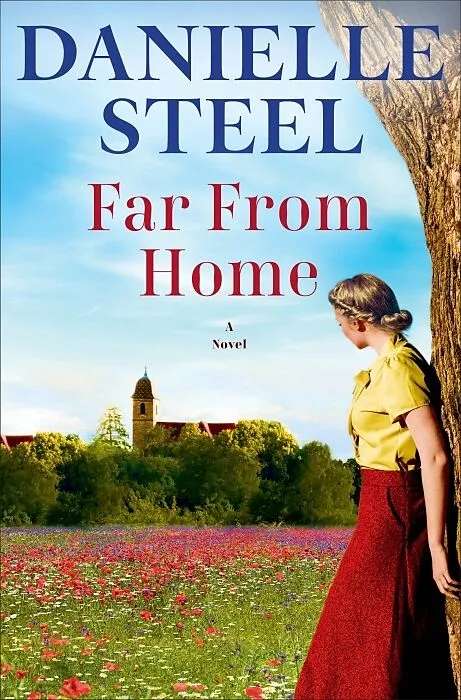

Far From Home
Beschreibung
#1 In July 1944, Arielle von Auspeck arrives at the glamorous Hotel Ritz in occupied Paris.; Half-French, half-German, she is happy to be back in France, where she her husband, Gregor, a retired colonel, will join her soon from Germany.; Arielle and Gregor hav...Format auswählen
- Fester EinbandCHF 31.90

Wird oft zusammen gekauft
Andere Kunden kauften auch
Beschreibung
#1 In July 1944, Arielle von Auspeck arrives at the glamorous Hotel Ritz in occupied Paris.; Half-French, half-German, she is happy to be back in France, where she her husband, Gregor, a retired colonel, will join her soon from Germany.; Arielle and Gregor have thus far been able to hide their private opposition to Hitler. Then her world falls apart. She receives word that Gregor was part of Operation Valkyrie and a failed attempt to assassinate Hitler in Poland, and has been shot as a traitor.; Now--holding a French passport handed to her by another high-level collaborator, she is whisked away from Paris under cover of darkness for her own safety. As the Allies storm the beaches, she goes into hiding in a small village in Normandy under an assumed name, unable to contact her adult children. There, she forms a friendship with Sebastien Renaud, whose wife and daughter were deported in 1941, and who eventually reveals himself as a forger in the Resistance. As war rages on, Arielle and Sebastien work for the Resistance and hold out for the time when they can search for their loved ones. In <Far from Home, <Danielle Steel captures the devastation of World War II with a sweeping story of family love transcending impossible odds.
Autorentext
Danielle Steel has been hailed as one of the world’s bestselling authors, with a billion copies of her novels sold. Her many international bestsellers include Upside Down, The Ball at Versailles, Second Act, Happiness, Palazzo, The Wedding Planner, Worthy Opponents, and other highly acclaimed novels. She is also the author of His Bright Light, the story of her son Nick Traina’s life and death; A Gift of Hope, a memoir of her work with the homeless; Expect a Miracle, a book of her favorite quotations for inspiration and comfort; Pure Joy, about the dogs she and her family have loved; and the children’s books Pretty Minnie in Paris and Pretty Minnie in Hollywood.
Zusammenfassung
NEW YORK TIMES BESTSELLER • Danielle Steel delivers an exciting and moving historical novel about a courageous wife and mother hiding in occupied France.
In July 1944, Arielle von Auspeck arrives at the glamorous Hotel Ritz in occupied Paris. Half French, half German, she is happy to be back in France, where her husband, Gregor, a retired colonel, will join her soon from Germany. Arielle and Gregor have thus far been able to hide their private opposition to Hitler.
Then her world falls apart. She receives word that Gregor was part of Operation Valkyrie, a failed attempt to assassinate Hitler in Poland, and has been shot as a traitor. Now, holding a French passport handed to her by another high-level collaborator, she is whisked away from Paris under cover of darkness for her own safety.
As the Allies storm the beaches, she goes into hiding in a small village in Normandy under an assumed name, unable to contact her adult children. There, she forms a friendship with Sebastien Renaud, whose wife and daughter were deported in 1941, and who eventually reveals himself as a forger in the Resistance. As war rages on, Arielle and Sebastien work for the Resistance and hold out for the time when they can search for their loved ones.
In Far From Home, Danielle Steel captures the devastation of World War II with a sweeping story of family love that transcends impossible odds.
Leseprobe
Chapter 1
It was a glorious, warm, sunny day in July 1944, driving back to Berlin from Brandenburg, where Arielle von Auspeck’s husband’s family schloss was located. It was a sixteenth-century castle, large, drafty in the winter, and expensive to maintain. But Gregor von Auspeck was deeply attached to it. As an only son, he had inherited it when his parents died. Gregor and Arielle spent weekends there year-round, and part of every summer. They usually had gone to the south of France for a few weeks in the summer too, in honor of Arielle’s roots. Her father was German, and her mother French. Arielle was also an only child. She had grown up in Germany, but had strong ties to France. Her mother had moved to Berlin from Paris when she married Arielle’s father. Arielle’s parents were aristocrats too. Her mother spoke to her in French, so she was fluent. Both Arielle’s family and Gregor’s were from Berlin.
Arielle was a slim, blond, blue-eyed beauty with a great figure. She was forty-four years old. Gregor was five years older, tall, athletic, with dark hair and blue eyes. Their families had been friends, and Gregor was the dashing “older man” when she fell in love with him at twenty and married him at twenty-one. They had been married for twenty-three very happy years. Their daughter, Marianna, was twenty-two, and had recently become the wife of Jürgen Springer, a young lieutenant in the Luftwaffe, an ace pilot, and a delightful boy Arielle and Gregor both approved of. The wedding had been lavish, held in their Berlin home in the Zehlendorf district. It was one of the largest, most beautiful homes in the city. They had a ballroom, and there were three hundred guests at Marianna’s wedding, many of the men in military uniform and the women in exquisite ballgowns.
Gregor was a colonel, retired from the German army, after an incident at the beginning of the war. He had been accidentally shot and his left arm remained stiff and his shoulder permanently damaged. It had spared him the agonizing decision of resigning from the army, which he’d been considering at the time. He was fiercely opposed to Hitler’s policies and his anti-Semitic programs. The accident had given him the perfect excuse to retire, and had spared him from taking an overt position in opposition to the Führer, which would have been dangerous. Instead he was able to remove himself gracefully from Hitler’s army.
Arielle and Gregor had a son as well, Viktor. He was nineteen now and had been an earnest and eager member of the Hitlerjugend, the Hitler Youth, since he was fourteen, just before the war began. He had finally been able to enlist at eighteen. He was fighting for the Fatherland in Poland, and his parents hadn’t seen him in several months. Both their children were loyal supporters of the Third Reich, Marianna as the wife of a young ace pilot in the air force, and Viktor thrilled to be in the army at last. Much to his father’s chagrin, Viktor had been exposed to Nazi propaganda throughout his teens. They had had many heated arguments before Viktor enlisted. He was young and naïve, and swept up by the policies of the Nazi party that he’d grown up with.
Arielle had lost her parents young. Her mother had died in the Spanish flu pandemic when Arielle was eighteen. Gregor didn’t know Arielle well then, although he’d met her and his parents always said what a lovely, elegant, kind woman her mother was, and that Arielle was a great deal like her. She said that her father had died of a broken heart after her mother’s death. He was more than twenty years older than his wife, and died a few years after Arielle and Gregor were married.
Gregor soon became the center of Arielle’s universe, even more so after she lost her father, and she was a devoted mother from the moment Marianna was born. Gregor and Arielle both adored their children. He had never had a profession. He oversaw his investments and ran the extensive property around the schloss, with many tenant farmers. He was a nobleman through and through, a famously skilled rider, and attended many hunts on horseback. His injured shoulder didn’t interfere with his riding, but he couldn’t shoot anymore. He joined his friends anyway at their hunts for the fun of it and the pleasure of being with his fellow sportsmen and social circle.
He…