
IHR WARENKORB IST AKTUELL LEER.
Haben Sie noch nichts passendes gefunden? Stöbern Sie durch unser komplettes Sortiment.
Oder melden Sie sich an bzw. registrieren Sie sich.
- Kostenlose Lieferung
- Kauf auf Rechnung
- Ex Libris Tiefpreis
- Filiallieferung und 650+ Abholorte
- Rabatt-Bons als Club-Mitglied
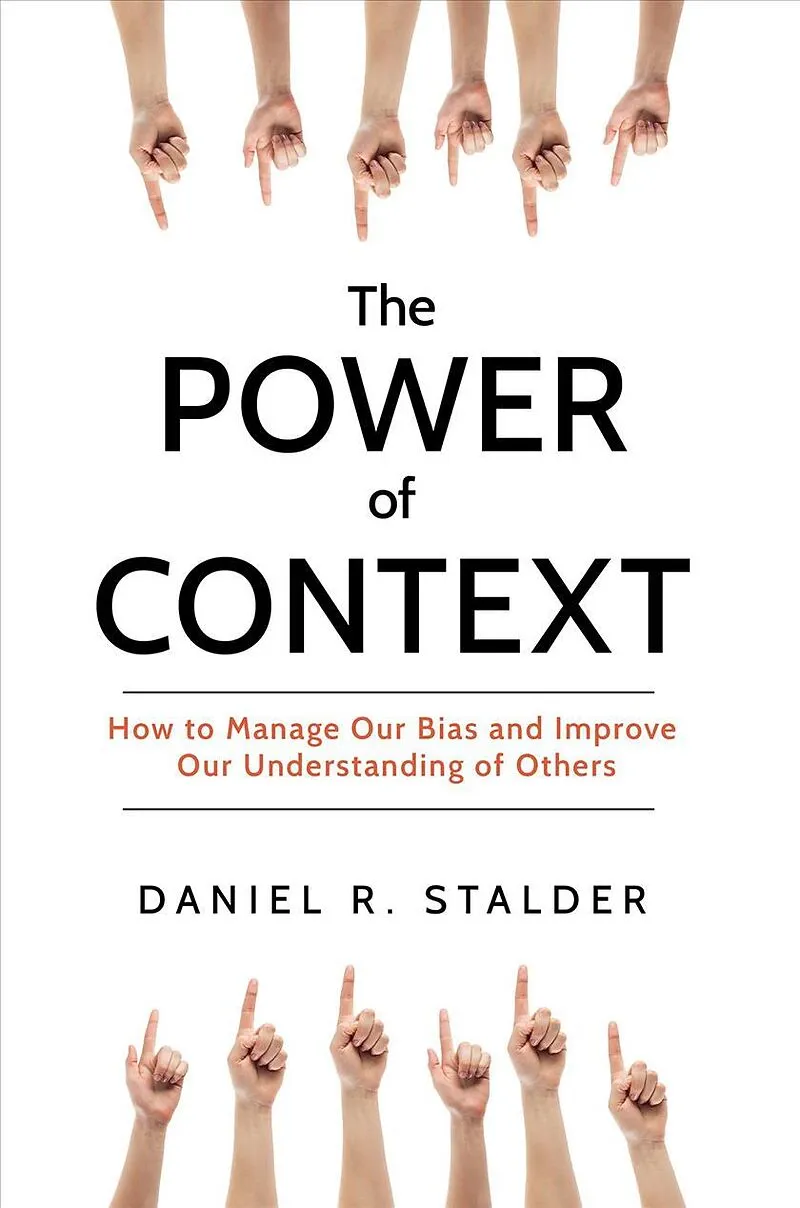
The Power of Context
Beschreibung
Zusatztext 76548251 Informationen zum Autor By Daniel R. Stalder Klappentext A social psychologist focuses on a very common yet rarely discussed bias called the "fundamental attribution error," showing how being aware of this bias can improve our day-to-day un...Format auswählen
- Fester EinbandCHF 31.60
Wird oft zusammen gekauft
Andere Kunden kauften auch
Beschreibung
Zusatztext 76548251 Informationen zum Autor By Daniel R. Stalder Klappentext A social psychologist focuses on a very common yet rarely discussed bias called the "fundamental attribution error," showing how being aware of this bias can improve our day-to-day understanding of others. Social life involves making judgments about other people. Often these snap judgments turn out to be wrong when we overlook context. Social psychologists call this pervasive bias the "fundamental attribution error." This book explores the many ways in which this error creeps into our social interactions, frequently causing misunderstanding, hurt feelings, and negative treatment of others. Psychologist Daniel R. Stalder examines common examples of this error, from road rage and misinterpreting facial expressions to "gaydar," victim blaming, and prejudice. The common denominator in these diverse examples is that we falsely assume inherent traits or intentions while overlooking situational factors that might explain a person's behavior. Conversely in the actor-observer bias, we explain our own sometimes questionable behaviors by appealing to situational factors. For example, when you tailgate others, there's always a good reason, but when others tailgate you, they are obviously in the wrong. Stalder also reveals little-known information about classic studies of context, considers both the upsides and downsides to bias, and shares numerous strategies to reduce bias. Filled with interesting examples, new insights, and an abundance of research, this informative and entertaining book will help us understand each other and reduce conflict.From the Introduction In our lives with other people, we judge each other. We make social judgments. Judging might be considered a dirty word, but sometimes we have to do it. If someone likes you and asks you out on a date to have coffee or to see a movie, and if you're available, then you have to decide what you think of this person. You have to judge this person. You have to say yes or no or a diplomatic version of no or convey some opinion at some point. You're not a bad person for judging. A social judgment need not be negative or certain. Maybe give this person a trygo on one date and see what happens. It's not a marriage proposal. But if someone does propose marriage to you, then you do really have to decide what you think. Certainty in judgment may be more desirable for a marriage proposal compared to a first date. If you decide to exercise a right to vote, then you have to make a judgment about those who are running for office. You can watch the news and speeches and read articles about the candidates to try to make an informed decision, or you can go with your gut. Most of us think we're making an informed decision when we're actually doing the gut thing. Jury members have to judge defendants. Interviewers have to judge job applicants. Teachers have to judge students. On Project Runway , celebrities have to judge designers. And so on. Of course, these judgments do not have to cover every facet of the people being judged. Jury members need not judge whether the defendant would be a fun date but rather whether the defendant had motive to commit a crime. A teacher need not judge how extroverted a student is but rather how much the student has learned in a course. Often we can't help ourselves and we judge outside the required domain. Teachers have a variety of opinions about students (and vice versa). Whatever the judgment domain, one message of this book is that we do judge each other. Sometimes we have to. The rest of the times, we just do. I am not writing this book to tell you to stop judging. Judging is part of being human, although some of us judge more often than others, and some judgments are more consequential than others. One area of social psychology that falls under...
ldquo;Stalder’s book is an invaluable bundle of intriguing insights, fascinating science, and practical advice on how we can all be more rational. Anyone who happens to be in possession of a human brain will benefit from reading this brilliant book immediately!”
—Guy P. Harrison, author of At Least Know This: Essential Science to Enhance Your Life
“We all make snap judgments and faulty assumptions. In this book, Daniel Stalder gives a fascinating and detailed take on our biases, judgments, and misconceptions. He advises us to be careful about overgeneralizing and to be open to the possibility of our own biases. He also demonstrates how reducing the fundamental attribution error can reduce anger, stress, misguided retaliation, and conflict with others. Emphasizing the power of context, Stalder argues that we can improve on the initial assumptions we make about people. This is a well-written and well-researched book.”
—Larry Atkins, author of Skewed: A Critical Thinker's Guide to Media Bias, teaches journalism at Temple University and Arcadia University
“Anyone who embraces opportunities to think in more discerning and unbiased ways will find that this absorbing book will stimulate their ‘thinking about their thinking.’ Daniel Stalder encourages readers to reflect on and question their attitudes and their tendencies to judge themselves and others. The book shows how adopting greater precision and compassion in our cognition and interpretation of events consequently results in more productive actions and life-enhancing emotions.”
—Dr. Debbie Joffe Ellis, psychologist, adjunct professor at Columbia University, and coauthor of Rational Emotive Behavior Therapy with her late husband, Albert Ellis
"Fascinating. . . . The book is quite timely, coming in a period of great political and social division. In its careful analysis of common human judgmental tendencies and its broad-reaching implications, this book offers a thoughtful antidote to the rampant bias and irrationality in much of today’s social discourse.”
—John H. Harvey, Professor Emeritus, Department of Psychology, University of Iowa, and author and editor of several books on attribution theory in social psychology, including the three-volume series *New Directions in Attribution Research
*“Stalder makes a strong case for the important implications that research findings on judgmental bias have for everyday behavior, and he does so without overselling the results. For readers unfamiliar with the fundamental attribution error and related phenomena, this will be an interesting and accessible introduction; for social psychologists, the draw will be the many critical discussions of the field’s classic ideas.”
—Leonard S. Newman, PhD, Area Director, Social Psychology Program, Syracuse University
“This book is a gem, and a unique gift to social psychology. Aside from being a first-rate scholarly analysis of the fundamental attribution error, one of the field’s guiding (and not totally noncontroversial) principles for over fifty years, the book is beautifully written and superbly communicated. The author is passionately devoted to his bias of choice but also extraordinarily judicious in not going for the ‘hard sell.’ One is constantly encouraged to think, to reflect, to recognize the uncertainties and exceptions to the rules at issue. Stalder’s seamless blend of research analyses and generalizations to everyday life is a model of its kind, displaying the author’s diligence and expertise. The book’s chapters read as a series of elegantly crafted essays, as Stalder presents a remarkably inclusive panorama of studies and examples, frequently in the context of his own life as a brilliant and compelling teacher.”*
- —Arthur G. Miller, Professor Emeritus, Department of Psychology, Miami University*
“Stalder and his sources pin the res…