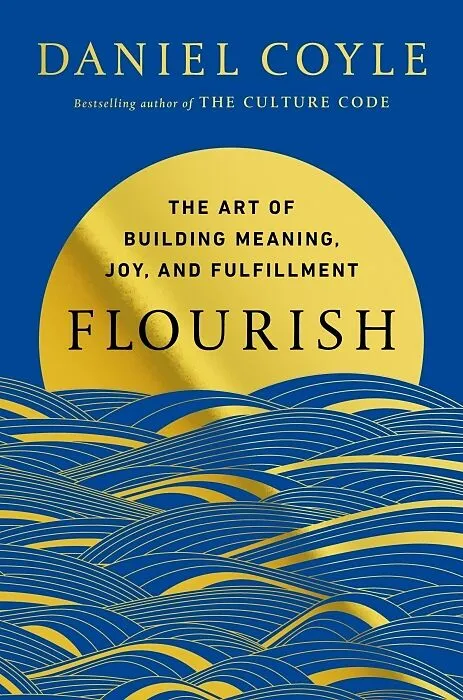
Flourish
Beschreibung
A science-based, practical blueprint for cultivating a life--at work and at home--full of belonging, joy, and vitality, from the What is a meaningful life, and how do we make one? How do certain communities foster closeness, fulfillment, happiness, and energy?...Format auswählen
- Fester EinbandCHF 33.20
Wird oft zusammen gekauft
Andere Kunden kauften auch
Beschreibung
A science-based, practical blueprint for cultivating a life--at work and at home--full of belonging, joy, and vitality, from the What is a meaningful life, and how do we make one? How do certain communities foster closeness, fulfillment, happiness, and energy? What makes us flourish?; In presence (open, responsive awareness) and practice group flow (generative exploration). Through captivating real-world stories, reporting, and firsthand accounts, Coyle explores what sets some groups apart--and unlocks the door to allow you to flourish in your life.
Autorentext
Daniel Coyle is the New York Times bestselling author of The Culture Code, which was named Best Business Book of the Year by Bloomberg, BookPal, and Business Insider. Coyle has served as an advisor to many high-performing organizations, including the Navy SEALs, Microsoft, Google, and the Cleveland Guardians. His other books include The Talent Code, The Secret Race, The Little Book of Talent, and Hardball: A Season in the Projects, which was made into a movie starring Keanu Reeves. Coyle was raised in Anchorage, Alaska, and now lives in Cleveland Heights, Ohio, during the school year and in Homer, Alaska, during the summer with his wife, Jenny, and their four children.
Klappentext
A science-based, practical blueprint for cultivating a life—at work and at home—full of belonging, joy, and vitality, from the New York Times bestselling author of The Culture Code
What is a meaningful life, and how do we make one? How do certain communities foster closeness, fulfillment, happiness, and energy?
In Flourish, bestselling author and leading culture expert Daniel Coyle trains his eye on the groups and people who demonstrate exceptional connectivity, presence, and dynamism. He draws on research and original reporting—taking us inside an unlikely brotherhood of thirty-three men who were trapped in a Chilean mine, a tiny Michigan deli that blossomed into a $90 million ecosystem of businesses, an inventive Dutch soccer team that revolutionized the sport as we know it, and a disconnected Paris district that remade itself into a tight-knit neighborhood—to reveal the principles and practices that ignite and sustain thriving. He finds that flourishing groups do two things: They make meaning (creating deep connections) and build community (forging a common good).
Through captivating real-world stories, rigorous scientific studies, and firsthand accounts, Coyle reveals what sets some groups apart—and offers you the tools and insights to flourish in your own life.
Leseprobe
Chapter 1
The Singers
At 2:05 p.m. on August 5, 2010, in the San José Mine in northern Chile, the mountain began to make a strange, low-pitched groan. Working in the tunnels hundreds of feet below the surface, thirty-three miners stopped and listened as the groan morphed into a monstrous roar. Seven hundred and seventy million tons of mountainside, honeycombed by decades of drilling, began to collapse onto itself. As the mountain fell around them, the miners ran downward, escaping into the intact tunnels below.
Hours later, at the surface, a rescue team gathered to assess the situation. The good news: Based on the cave-in’s location, the miners had likely been able to reach a refugio, a bunker-like shelter two thousand feet below. The bad news: Drilling a borehole to deliver food and water to the refugio could take days or weeks; drilling a passage wide enough to rescue them could take months.
“Bad news” was putting it mildly. Everyone knew the refugio contained scant provisions—a couple days’ worth of canned food at most. Everyone knew the conditions down below were nightmarish, with ninety-plus-degree temperatures and 98 percent humidity that would wreak havoc with any injuries the miners had sustained. And everybody knew that the miners were a hard-bitten crew, products of a high-risk, Darwinian culture governed by an unwritten rule: every man for himself.
For sixteen days, six rescue drills inched toward the refugio. With every hour, the odds of survival diminished. The rescue team psychologist, Alberto Iturra, advised against holding out too much hope. He was all too aware of what had happened in similar disasters: rescuers arriving only to find scenes of unspeakable horror.
On day 17, one drill punched through the refugio’s ceiling. Rescuers detected a faint pounding; when they retrieved the drill, they found a note that said all thirty-three miners were alive. As the team lowered a makeshift telephone line to establish voice contact, Iturra kept the miners’ families well away. The miners will be in a state of altered consciousness, severe malnutrition, and mental instability, he said. We don’t know what we are going to find.
A handset was lowered. Up top, the rescue team huddled around a speakerphone, prepared for fear, desperation, and delirium. But what they got was far stranger: a normal conversation.
They exchanged polite, slightly formal greetings. Yes, they were alive, and, yes, they were in a state of starvation, eating one teaspoon of tuna each per forty-eight hours. Yet the miners didn’t want to talk about themselves. They wanted to know about someone else.
“We had a colleague who was headed outside, a driver,” they said. “We don’t know if he made it out.”
Yes, the rescue team informed them, the driver had made it out.
The miners shouted for joy. The conversation continued with updates and information. Then, toward the end of the call, the miners started to sing the national anthem.
Puro, Chile, es tu cielo azulado.
Puras brisas te cruzan también
(How pure, Chile, is your blue sky
And how pure the breezes that blow across you)
Up top, Iturra and the rescue team stared at each other, faces slack with wonder. How do thirty-three roughnecks spend seventeen days suffering through darkness, starvation, and the near-certain prospect of death—and the first things they do are ask if their friend is okay and then sing together?
The rescue took fifty-two days, but eventually all thirty-three miners were safely brought to the surface. In the days after, experts sought to explain the source of their extraordinary energy, cohesion, and morale. Most theories focused on the leadership qualities of certain individuals and how those individuals took charge to create a plan that gave the group a sense of stability and purpose.
But it turned out that those theories weren’t accurate. The group didn’t have one or two leaders; it had many. What’s more, no one person took charge or executed a plan. In fact, according to studies by Matías Sanfuentes of the University of Chile, the cohesive energy didn’t emerge from the actions of individuals but from moments that allowed the miners to “emotionally link” in ways that “activated the resilience pathway.” The strange thing was, these moments mostly consisted of pauses.
The first pause happened in the chaotic hours just after the cave-in. The miners were scattered, frenetically searching for escape routes. “I screamed like a madman,” recalled Mario Sepúlveda. “I ran without stopping, looking for mates, trying to find them all. The more I ran, the more anxious I got, and the more anxious I got, the more I ran.” The shift supervisor, a stern man named Luis Urzúa, repeatedly tried and failed to maintain order.
The group eventually tired and quieted, gathering in a circle at the foot of the cave-in. Sepúlveda sketched a diagram in the dust, showing the blocked tunnels above. “In other words, chiquillos, even if we’re superoptimistic about things, the best yo…