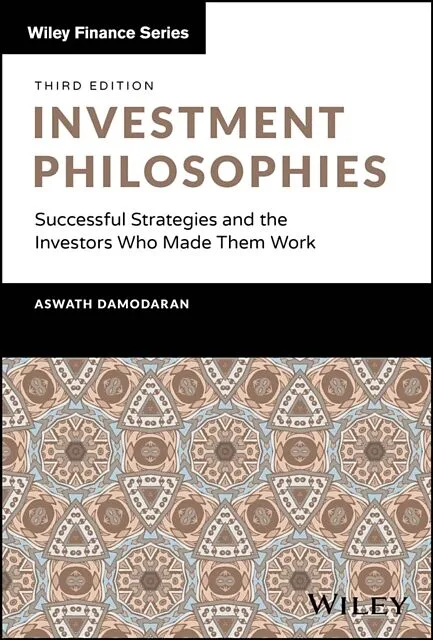
Investment Philosophies
Beschreibung
Autorentext ASWATH DAMODARAN is a Professor of Finance at New York University's Leonard N. Stern School of Business. He has received numerous awards for outstanding teaching, including the NYU university-wide Distinguished Teaching Award, was named one of the ...Format auswählen
- Fester EinbandCHF 98.00

Wird oft zusammen gekauft
Andere Kunden kauften auch
Beschreibung
Autorentext
ASWATH DAMODARAN is a Professor of Finance at New York University's Leonard N. Stern School of Business. He has received numerous awards for outstanding teaching, including the NYU university-wide Distinguished Teaching Award, was named one of the nation's top business teachers by BusinessWeek in 1994, and teaches training courses in corporate finance and valuation at many leading investment banks.
Klappentext
PRAISE FOR INVESTMENT PHILOSOPHIES "Damodaran is a well-informed scholar with a gift for organized, clearly written syntheses of complex topics in modern finance. With Investment Philosophies he provides the uncensored facts about winning in the marketplace. If you are a fund manager, an investor, or simply a student of finance you will want to read this book."
-Tom Copeland,** CEO, Copeland Valuation Consultants "Professor Damodaran has zeroed in on the most important missing element of many investment management processes: a clearly defined investment philosophy which can serve as a beacon in difficult markets. He offers a cornucopia of philosophies and strategies that have worked for many of the most successful investors, and which have stood the test of time."
**-Rob Arnott,** Founder and Chairman, Research Affiliates, LLC "As an investor, I always have to look back to my philosophy and strategy for taking risk and making money. This book is an invaluable aid for 'taking stock' before buying stock. It lays out the concepts and tools for understanding the basics of risk and return in the stock market, and presents a framework for any investor to construct his or her own investment philosophy."
**-Mitch Julis,** Co-Founder, Co-Chairman, Co-CEO of Canyon Partners, LLC MASTER PROVEN INVESTMENT STRATEGIES THAT HAVE CONSISTENTLY DELIVERED RESULTS ACROSS MARKET CYCLES In the third edition of Investment Philosophies: Successful Strategies and the Investors Who Made Them Work, veteran investor and NYU finance professor Aswath Damodaran delivers an authoritative guide to understanding and implementing investment strategies that have stood the test of time. Few investors beat the market consistently, and this book reveals why successful investors use very different approaches and what makes each philosophy work. This comprehensive resource examines indexing, passive and activist value investing, growth investing, technical analysis, market timing, arbitrage, and more. Each chapter explores the beliefs underlying a particular philosophy, presents evidence on whether strategies actually produce results, and identifies what you need to bring to the table to make it work. The book's modular structure with enhanced online resources lets you drill down on the strategies most relevant to your investment goals. Investment Philosophies is an essential resource for investors, portfolio managers, financial professionals, and anyone seeking to select a practical, effective approach to investing. Whether you're a CFA practitioner, finance student, or serious individual investor, this book provides the framework and tools you need to assess which investment philosophy aligns with your skills and market circumstances.
Inhalt
CHAPTER 1
Introduction 1
What Is an Investment Philosophy? 2
Why Do You Need an Investment Philosophy? 3
The Big Picture of Investing 4
Categorizing Investment Philosophies 7
Developing an Investment Philosophy 10
CHAPTER 2
Upside and Downside-Understanding Risk 15
What Is Risk? 16
Risk Aversion: Measurement and Consequences 16
Equity Risk: Theory-based Models 17
Assessing Conventional Risk-and-return Models 33
Equity Risk: Alternative Measures 35
Equity Risk: Assessing the Field 46
Default Risk 48
CHAPTER 3
Numbers Don't Lie-or Do They? 55
The Basic Accounting Statements 56
Asset Measurement and Valuation 56
Measuring Financing Mix 65
Measuring Earnings and Profitability 73
Measuring Risk 81
Differences in Accounting Standards and Practices 88
CHAPTER 4
Show Me the Money: The Basics of Valuation and Pricing 93
Intrinsic Value 94
Pricing or Relative Valuation 119
Valuing an Asset with Contingent Cash Flows (Options) 129
CHAPTER 5
Many a Slip: Trading, Execution, and Taxes 135
The Trading Cost Drag 135
The Components of Trading Costs: Traded Financial Assets 137
Trading Costs with Nontraded Assets 156
Management of Trading Costs 158
Taxes 161
CHAPTER 6
Too Good to Be True? Testing Investment Strategies 173
Why Does Market Efficiency Matter? 173
Efficient Markets: Definition and Implications 174
Behavioral Finance: The Challenge to Efficient Markets 181
A Skeptic's Guide to Investment Strategies 214
CHAPTER 7
Smoke and Mirrors? Price Patterns, Volume Charts, and Technical Analysis 219
Random Walks and Price Patterns 219
Empirical Evidence on Pricing Patterns 221
The Foundations of Technical Analysis 250
Technical Indicators and Charting Patterns 252
Social Media and Markets 265
Determinants of Success at Charting and Technical Analysis 269
CHAPTER 8
From Graham to Private Equity: Value Investing 273
Who Is a Value Investor? 273
The Passive Screener 275
The Contrarian Value Investor 304
Activist Value Investing 312
CHAPTER 9
The Allure of Growth: Small Cap and Growth Investing 337
Who Is a Growth Investor? 337
Proxy Growth Investing 338
Passive Growth Investing 358
Activist Growth Investing 379
CHAPTER 10
Information Pays: Trading on News 395
Information and Prices 396
Trading on Private Information 398
Trading on Public Information 418
Implementing an Information-based Investment Strategy 440
CHAPTER 11
A Sure Profit: The Essence of Arbitrage 445
The Essence of Arbitrage 445
Pure Arbitrage 447
Near Arbitrage 471
Speculative Arbitrage 485
Long/short Strategies-Hedge Funds 490
CHAPTER 12
The Impossible Dream? Timing the Market 499
Market Timing: Payoff and Costs 499
Market timing Approaches 503
The Evidence on Market Timing 533
Market-timing Strategies 542
Market-timing Instruments 546
Connecting Market Timing to Security Selection 549
CHAPTER 13
The Allure of Indexing 553
The Mechanics of Indexing 553
A History of Indexing 557
The Case for Indexing 560
Why Do Active Investors Not Perform Better? 584
Enhanced Index Funds 591
CHAPTER 14
Investing in Alternatives 603
The Alternative Investment Universe 603
The Sales Pitch for Alternatives 607
Price and Value with Alternative Investments 611
Real Estate: The Underfollowed Investment Class 613
Collectibles 620
The Rise of Alternative Investing 648
Alternative Investment Philosophies 655
CHAPTER 15
A Road Map to Choosing an Investment Philosophy 661
A Self-assessment 659
Finding an Investment Philosophy 665
The Right Investment Philosophy (Philosophies) 667
Conclusion 674
Exercises 675
Index 677