Haben Sie noch nichts passendes gefunden? Stöbern Sie durch unser komplettes Sortiment.
Oder melden Sie sich an bzw. registrieren Sie sich.


Beschreibung
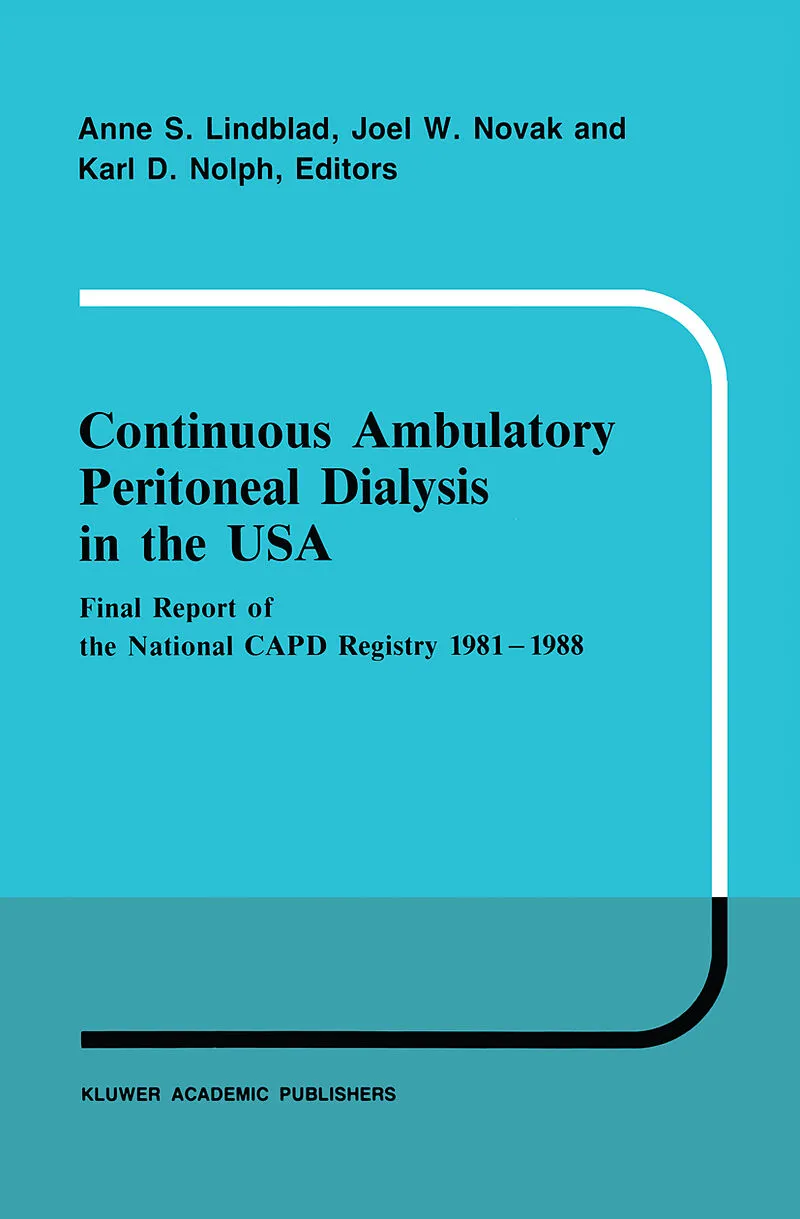
The Final Report of the USA CAPO Registry summarizes eight years of observation and analysis that reflects the experiences of 485 clinical centers and over 25,000 CAPO patients. As such, it offers a wealth of information, available here for the first time to i...The Final Report of the USA CAPO Registry summarizes eight years of observation and analysis that reflects the experiences of 485 clinical centers and over 25,000 CAPO patients. As such, it offers a wealth of information, available here for the first time to interested parties around the world. Because the National Institutes of Health was quick to see the potential of CAPO as a promising therapy for patients with end stage renal disease, the Registry project was begun soon after its introduction into clinical practice in the USA. Accordingly, the Registry offered the nephrology community in the United States a special opportunity to study this emerging new therapy in some detail, an opportunity not previously available for any other form of dialysis. As will be seen in this report, the result of this early and intensive research effort has been the development of a vast amount of clinically important information regarding the utilization, safety, and efficacy of this important dialytic therapy.
Inhalt
Section 1 Introduction.- 1.1 An Overview of Peritoneal Dialysis.- 1.2 The National CAPD Registry and the Registry Report.- 1.3 References.- Section 2 Registry Patient Population.- 2.1 Classification of Patients.- 2.2 Registration by Class.- 2.3 Registration by Class and Year.- 2.4 Patient Follow-up and Data Currency.- 2.5 Registry Coverage.- 2.6 Census and Flow of CAPD Patients.- Section 3 Patient Characteristics.- 3.1 Sex and Age Distributions.- 3.2 Race and Age Distribution.- 3.3 Primary Renal DiseaseCAPD.- 3.4 References.- Section 4 Complications of Treatment.- 4.1 PeritonitisCAPD.- 4.2 Exit Site/Tunnel InfectionsCAPD.- 4.3 Catheter ReplacementsCAPD.- 4.4 Any ComplicationsCAPD.- 4.5 CCPD Complications.- 4.6 HospitalizationsCAPD/CCPD.- 4.7 References.- Section 5 Termination of Continuous Peritoneal Dialysis.- 5.1 Probability of Transferring to an Alternate Dialysis ModalityCAPD.- 5.2 Probability of TransplantationCAPD.- 5.3 Probability of Death While on CAPD.- 5.4 Probability of Discontinuing CAPD for any Reason.- 5.5 Probability of Discontinuing CCPD.- 5.6 Outcomes by Patient TypeCAPD/CCPD.- 5.7 Follow-up of Transfers to HemodialysisCAPD/CCPD.- 5.8 Follow-up of Kidney TransplantsCAPD/CCPD.- 5.9 Follow-up of Patient DeathsCAPD/CCPD.- 5.10 References.- Section 6 Special Reports1988.- A. A Survey of Diabetics in the CAPD/CCPD Population.- B. Hematocrit Values in the CAPD/CCPD Population.- C. Timing and Characteristics of Multiple Peritonitis Episodes.- D. Geographical Distribution of Registry Coverage.- E. Characteristics and Treatment Course of Long-term CAPD/CCPD Patients.- Section 7 Special Reports1987.- A. Update on Children Who Use CAPD/CCPD.- B. First Exchange Device and Peritonitis among CAPD Patients.- C. Follow-up of Transfer from CAPD/CCPD.- D. Pediatric Population Evaluation.- E. Complications of Peritoneal Catheters.- F. The Effects of CAPD on Hypertension Control.- Section 8 Special Reports1986.- A. Factors Associated with First Hospitalization for CAPD-Related Complications.- B. Factors Associated with Transfer off CAPD.- C. Factors Associated with Death While on CAPD.- D. Trends in the Occurrence of Complications and of Treatment Outcomes.- E. Variation in Treatment Outcome According to Center Size.- F. Variation in Treatment Outcome According to Treatment and Patient Characteristics.- G. Some Additional Factors Associated with Transfer off CAPD.- H. Characteristics of Patients Who Received a Kidney Transplant, Whose Kidney Function Returned, or Who Discontinued CAPD without Return of Kidney Function.- I. Comparison of Outcomes for Patients with and without prior ESRD Therapy.- Section 9 Special Report1985.- A. Prognostic Factors Associated with the First Episode of Peritonitis.- Section 10 Special Report1984.- A. Considerations in Analysis of Complications.- Appendices.- I. Executive Advisory Committee of the National CAPD Registry of the National Institutes of Health.- II. Participating Centers of the National CAPD Registry of the National Institutes of Health.- III. Bibliography of the National CAPD Registry of the National Institutes of Health.- Table of Exhibits.- Section 2 Registry Patient Population.- Exhibit 2-1 Number of Patients Registered by Class and Type of Dialysis.- 2-2 Number of Patients Registered by Class and Year of Registration.- 2-3 Number of Patients with Follow-up by Class and Type of Dialysis.- 2-4 Last Contact and Status According to Activity Classification of Center for Patients Last Reported to be on CAPD/CCPD.- 2-5 Currency of The National CAPD Registry Database by Class of Patient.- 2-6 Number of Patients Receiving CAPD at Year End.- 2-7 Census and Flow of The National CAPD Registry by Year.- Section 3 Patient Characteristics.- Exhibit 3-1 Percent of Patients with Selected Characteristics by Type of Therapy.- 3-2 CAPDAge Distribution by Sex.- 3-3 CCPDAge Distribution by Sex.- 3-4 CAPDAge Distribution by Race.- 3-5 CCPDAge Distribution by Race.- 3-6 CAPDDistribution of Patients by Primary Renal Disease Type According to Year of Registration.- Section 4 Complications.- Exhibit 4-1 CAPDOccurrence of Selected Complications by Class of Patients.- 4-2 CAPDCumulative Probability of Experiencing First Episode of Peritonitis (Class 1 Patients Only).- 4-3 CAPDComplication Rates by Year of Registration.- 4-4 CAPDCumulative Probabilities and 95% Confidence Intervals (C.I.) of Experiencing Selected Events for the First Time by Year Registered (Class 1 Patients Only).- 4-5 CAPDCumulative Probability of Experiencing First Exit Site/Tunnel Infection (Class 1 Patients Only).- 4-6 CAPDCumulative Probability of First Catheter.- Replacement (Class 1 Patients Only).- 4-7 CAPDCumulative Probability of First Complication (Class 1 Patients Only).- 4-8 CCPDOccurrence of Selected Complications by.- Class of Patient.- 4-9 CCPDCumulative Probabilities and 95% Confidence Intervals (C.I.) of Experiencing Selected Events for the First Time by Number of Months on CCPD (Class 1 Patients Only).- Section 5 Termination of Continuous Peritoneal Dialysis.- Exhibit 5-1 CAPDCumulative Probability of Transfer (Class 1 Patients Only).- 5-2 CAPDCumulative Probability of Receiving a Kidney Transplant (Class 1 Patients Only).- 5-3 CAPDCumulative Probability of Death (Class 1 Patients Only).- 5-4 CAPDCumulative Probability of Discontinuing CAPD Therapy for any Reason (Class 1 Patients Only).- 5-5 CCPDCumulative Probability of Transfer (Class 1 Patients Only).- 5-6 CCPDCumulative Probability of Receiving a Kidney Transplant (Class 1 Patients Only).- 5-7 CAPDCumulative Probability of Death (Class 1 Patients Only).- 5-8 CCPDCumulative Probability of Discontinuing CCPD Therapy for Any Reason (Class 1 Patients Only).- 5-9 CAPD or CCPDCumulative Probability of Transplantation: Pediatrics vs. 'Standard' vs. 'Other'.- 5-10 CAPD or CCPDCumulative Probability of.- Death: Pediatrics vs. 'Standard' vs. 'Other'.- 5-11 CAPD or CCPDCumulative Probability of 'Technique Failure': Pediatrics vs. 'Standard' vs. 'Other'.- 5-12 Follow-up of Transfers to Hemodialysis Summary.- 5-13 Primary Reason for Leaving CAPD in Patients who Transferred from CAPD to Hemodialysis and Subsequently Returned to CAPD.- 5-14 Follow-up of Kidney Transplant Summary.- 5-15 Death Summary.