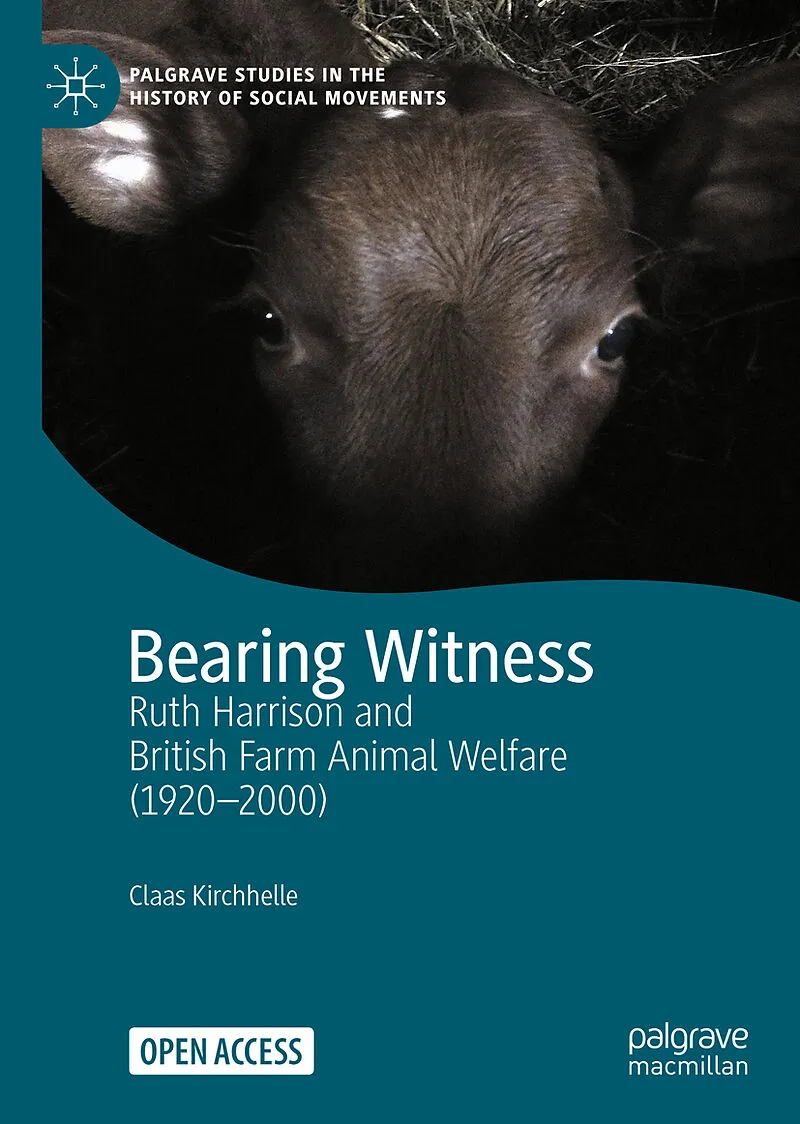
Bearing Witness
Beschreibung
This open access book is the biography of one of Britain's foremost animal welfare campaigners and of the world of activism, science, and politics she inhabited. In 1964, Ruth Harrison's bestseller Animal Machines triggered a gear change in modern animal prote...Format auswählen
- Fester EinbandCHF 60.80
- Kartonierter EinbandCHF 50.30
Wird oft zusammen gekauft
Andere Kunden kauften auch
Beschreibung
This open access book is the biography of one of Britain's foremost animal welfare campaigners and of the world of activism, science, and politics she inhabited. In 1964, Ruth Harrison's bestseller Animal Machines triggered a gear change in modern animal protection by popularising the term 'factory farming' alongside a new way of thinking about animal welfare. Here, historian Claas Kirchhelle explores Harrison's avant-garde upbringing, Quakerism, and how animal welfare debates were linked to concerns about the wider ethical and environmental trajectories of post-war Britain. Breaking the myth of Harrison as a one-hit wonder, Kirchhelle reconstructs Harrison's 46 years of campaigning and the rapid transformation of welfare politics and science during this time. Exacerbated by Harrison's own actions, the decades after 1964 saw a polarisation of animalpolitics, a professionalisation of British activism, and the rise of a new animal welfare science. Harrison's belief in incremental reform allowed her to form ties to leading scientists but alienated her from more radical campaigners. Many of her 1964 demands gradually became part of mainstream politics. However, farm animal welfare's increasing marketisation has also led to a relative divorce from the wider agenda of social improvement that Harrison once bore witness to. This is the first book to cast light on the interlinked histories of British farm animal welfare activism, science, and legislation. Its unique scope allows it to go beyond existing accounts of modern British animal welfare and will be of interest to those interested in animal welfare, environmentalism, and the behavioural sciences.
Shortlisted for the HSS Margaret W. Rossiter History of Women in Science 2023 Prize Funded by the Wellcome Trust, this book is open access under a CC BY 4.0 license Explores the interconnected rise of British animal welfare politics, science and activism from the mid-1960s onwards Examines the life and work of one of Britain's most prominent animal welfare activists, drawing on research from the previously restricted papers of Harrison's charity (Farm Animal Care Trust)
Autorentext
Claas Kirchhelle (DPhil, Oxon 2015) is a medical historian and Lecturer at University College Dublin, with a Wellcome Trust University Award. His award-winning research and public engagement (Back from the Dead - Demystifying Antibiotics 2016-2017; Typhoidland 2020-2022) explore the interconnected evolution of modern science, politics, and the environment. His previous publications include Pyrrhic Progress. The History of Antibiotics in Anglo-American Food Production, which won the 2020 Turriano Prize.
Klappentext
This open access book is the biography of one of Britain s foremost animal welfare campaigners and of the world of activism, science, and politics she inhabited. In 1964, Ruth Harrison s bestseller Animal Machines triggered a gear change in modern animal protection by popularising the term factory farming alongside a new way of thinking about animal welfare. Here, historian Claas Kirchhelle explores Harrison s avant-garde upbringing, Quakerism, and how animal welfare debates were linked to concerns about the wider ethical and environmental trajectories of post-war Britain. Breaking the myth of Harrison as a one-hit wonder, Kirchhelle reconstructs Harrison s 46 years of campaigning and the rapid transformation of welfare politics and science during this time. Exacerbated by Harrison s own actions, the decades after 1964 saw a polarisation of animalpolitics, a professionalisation of British activism, and the rise of a new animal welfare science. Harrison s belief in incremental reform allowed her to form ties to leading scientists but alienated her from more radical campaigners. Many of her 1964 demands gradually became part of mainstream politics. However, farm animal welfare s increasing marketisation has also led to a relative divorce from the wider agenda of social improvement that Harrison once bore witness to. This is the first book to cast light on the interlinked histories of British farm animal welfare activism, science, and legislation. Its unique scope allows it to go beyond existing accounts of modern British animal welfare and will be of interest to those interested in animal welfare, environmentalism, and the behavioural sciences.
Inhalt
- Introduction.- Part One: Radical Roots (19201961).- 2. Meet the Winstens: A 'Downstart' Anglo-Jewish family.- 3. Becoming an Activist: Ruth Harrison's Turn to Animal Welfare.- Part Two: Synthesis - The Post-war Landscape of Welfare Science and Activism (1945-1964).- 4: Between Physiology and Psychology: Ethology and Animal Feelings.- 5. Ideals and Intensification: Welfare Campaigns in a Nation of Animal Lovers.- 6. Staging Welfare: Writing Animal Machines.- Part Three: Impact (1964-68).- 7. From Author to Adviser: Ruth Harrison and the Animal Machines Moment.- Part Four: Defining Welfare (1967-1979).- 8. A 'Minority of One': Harrison and the FAWAC.- 9. Ruth the Ruthless: Activism, Welfare, and Generational Change.- 10. Slippery FACTs: The Rise of a "Mandated" Animal Welfare Science.- Part Five: From Eclat to Consensus (1979-2000).- 11. From Protest to 'Holy Writ': The Mainstreaming of Welfare Politics.- 12. Non-conform Evidence:The Impasse of 1990s Welfare Research.- 13. Conclusion.
Produktinformationen
Weitere Produkte aus der Reihe "Palgrave Studies in the History of Social Movements"


Tief- preis
- Bearing Witness
- Claas Kirchhelle
