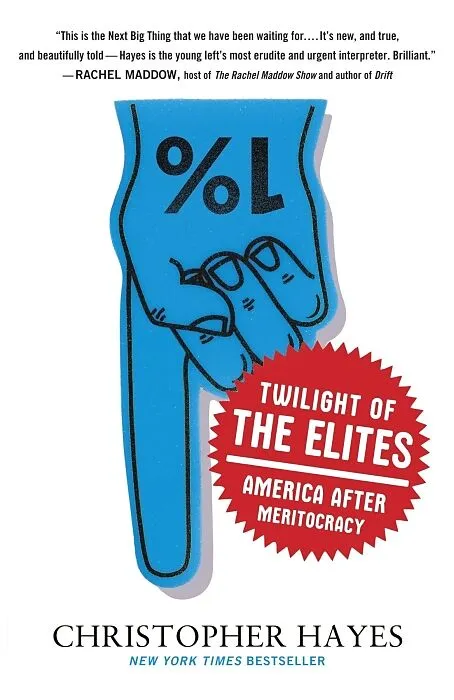
Twilight of the Elites
Beschreibung
Zusatztext 42466558 Informationen zum Autor Chris Hayes Klappentext A powerful and original argument that traces the roots of our present crisis of authority to an unlikely source: the meritocracy. Over the past decade, Americans watched in bafflement and rage...Format auswählen
- Kartonierter EinbandCHF 29.50
Wird oft zusammen gekauft
Andere Kunden kauften auch
Beschreibung
Zusatztext 42466558 Informationen zum Autor Chris Hayes Klappentext A powerful and original argument that traces the roots of our present crisis of authority to an unlikely source: the meritocracy. Over the past decade, Americans watched in bafflement and rage as one institution after another - from Wall Street to Congress, the Catholic Church to corporate America, even Major League Baseball - imploded under the weight of corruption and incompetence. In the wake of the Fail Decade, Americans have historically low levels of trust in their institutions; the social contract between ordinary citizens and elites lies in tatters. How did we get here? With Twilight of the Elites, Christopher Hayes offers a radically novel answer. Since the 1960s, as the meritocracy elevated a more diverse group of men and women into power, they learned to embrace the accelerating inequality that had placed them near the very top. Their ascension heightened social distance and spawned a new American elite--one more prone to failure and corruption than any that came before it. Mixing deft political analysis, timely social commentary, and deep historical understanding, Twilight of the Elites describes how the society we have come to inhabit - utterly forgiving at the top and relentlessly punitive at the bottom - produces leaders who are out of touch with the people they have been trusted to govern. Hayes argues that the public's failure to trust the federal government, corporate America, and the media has led to a crisis of authority that threatens to engulf not just our politics but our day-to-day lives. Upending well-worn ideological and partisan categories, Hayes entirely reorients our perspective on our times. Twilight of the Elites is the defining work of social criticism for the post-bailout age.Chapter 1 The Naked Emperors Now see the sad fruits your faults produced, Feel the blows you have yourselves induced. -- Racine America feels broken. Over the last decade, a nation accustomed to greatness and progress has had to reconcile itself to an economy that seems to be lurching backward. From 1999 to 2010, median household income in real dollars fell by 7 percent. More Americans are downwardly mobile than at any time in recent memory. In poll after poll, overwhelming majorities of Americans say the country is on the wrong track. And optimism that today's young people will have a better life than their parents is at the lowest level since pollsters started asking that question in the early 1980s. It is possible that by the time this book is in your hands, these trends will have reversed themselves. But given the arc of the past decade and the institutional dysfunction that underlies our current extended crisis, even a welcome bout of economic growth won't undo the deep unease that now grips the nation. The effects of our great disillusionment are typically measured within the cramped confines of the news cycle: how they impact the President's approval rating, which political party they benefit and which they hurt. Most of us come to see the nation's problems either as the result of the policies favored by those who occupy the opposite end of the ideological spectrum, or as an outgrowth of political dysfunction: of gridlock, bickering, and the increasing polarization among both the electorate and the representatives it elects. But the core experience of the last decade isn't just political dysfunction. It's something much deeper and more existentially disruptive: the near total failure of each pillar institution of our society. The financial crisis and the grinding, prolonged economic immiseration it has precipitated are just the most recent instances of elite failure, the latest in an uninterrupted cascade of corruption and incompetence. If that sounds excessively bleak, take a moment to consider America's trajectory ...
A Foreign Policy Favorite Read of 2012
A Mother Jones Staff Pick for Best Nonfiction of 2012
An Inc.com Top Five Business Book of 2012
A Kirkus Reviews Best Nonfiction Book of 2012
“Excellent”
***—Rolling Stone
***“Hayes, an editor-at-large of The Nation and host of the MSNBC talk show Up With Chris Hayes, has written a perceptive and searching analysis of the problems of meritocracy.” —***Foreign Affairs
*“[A] stunning polemic….Hayes' book is the rare tome that originates from a political home (the left) and yet actually challenges assumptions that undergird the dominant logic in both political parties. This is not mealy-mouthed centrism. It is a substantive critique of the underlying logic of both Barack Obama and Mitt Romney – the logic of meritocracy.”
—Ta-Nehisi Coates, *Baltimore Sun
“In a very good new book titled Twilight of the Elites: America After Meritocracy, Chris Hayes offers one of the most compelling assessments of how soaring inequality is changing American society.”
**—The Economist.com
“Let's just say that if you like politics and big ideas, you want to buy this book. It's a lot more intellectually ambitious than your typical pundit book and offers a really great blend of writing chops and social theory synthesis.”
—Matthew Yglesias, Slate.com
“In his new book, The Twilight of the Elites: America After Meritocracy, Chris Hayes manages the impossible trifecta: the book is compellingly readable, impossibly erudite, and—most stunningly of all—correct.”
—Aaron Swartz, Crookedtimber.org**
“Engrossing….thoughtful critiques of what's gone wrong with America's ruling class.”
**—The Atlantic.com
“I was myself very impressed by the level of execution in this book.”
—Tyler Cowen, Marginalrevolution.com
“Hayes’s book makes for a great read….Twilight uses a wide variety of academic and journalistic work, balancing a deep, systemic critique of society with detailed and empathetic reporting about those most affected by elite failure.”
—Mike Konczal, *Dissent
“Twilight of the Elites offers an elegant, original argument that will make both cynics and idealists reconsider their views of how, and whether, our society works. If Americans believe in anything, it’s our meritocracy. Hayes is brave to question it so forcefully.”
—Commonweal
“A potent articulation of a society’s free-floating angst, Twilight of the Elites stakes its claim as the jeremiad by which these days will be remembered.”
**—Washington Monthly.com
“I read Chris Hayes' Twilight of the Elites last month and will suggest that you read it too – it's an engaging read that addresses the question of whether a meritocratic elite can really stay meritocratic over extended periods of time.”
—Daniel W. Drezner, Foreign Policy.com
“This was a book I found so stimulating and immersive that I cannot wait to be able to discuss it with a larger audience….Even if you think you are aware of the depth of the rot plaguing the highest levels of our society, you will likely earn a new level of outrage by reading this book.”
—Alexis Goldstein, Livetotry.com
“Make[s] you think in new ways about why we tolerate such vast and growing income inequality….an extended meditation on why the great hope and change revolution of 2008 has so far left the inequitable status quo a little bit too intact.”
—Salon.com
**“*Twilight of the Elites *by Chris Hayes may change the way you look at the world….[It] almost single-handily undermines virtually every precept we’ve come to accept about life in the modern age. It also may well turn out to be the seminal treatise for the so-called &l…