
IHR WARENKORB IST AKTUELL LEER.
Haben Sie noch nichts passendes gefunden? Stöbern Sie durch unser komplettes Sortiment.
Oder melden Sie sich an bzw. registrieren Sie sich.
- Kostenlose Lieferung
- Kauf auf Rechnung
- Ex Libris Tiefpreis
- Filiallieferung und 650+ Abholorte
- Rabatt-Bons als Club-Mitglied
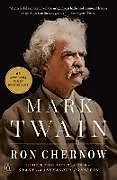
Mark Twain
Beschreibung
The #1 “Comprehensive, enthralling . . . “Chernow writes with such ease and clarity . . . For all its length and detail, [ Pulitzer Prize-winning biographer Ron Chernow illuminates the full, fascinating, and complex life of the writer long celebrat...Format auswählen
- Kartonierter EinbandCHF 26.80

Wird oft zusammen gekauft
Andere Kunden kauften auch
Beschreibung
The #1 “Comprehensive, enthralling . . . “Chernow writes with such ease and clarity . . . For all its length and detail, [ Pulitzer Prize-winning biographer Ron Chernow illuminates the full, fascinating, and complex life of the writer long celebrated as the father of American literature, Mark Twain Before he was Mark Twain, he was Samuel Langhorne Clemens. Born in 1835, the man who would become America’s first, and most influential, literary celebrity spent his childhood dreaming of piloting steamboats on the Mississippi. But when the Civil War interrupted his career on the river, the young Twain went west to the Nevada Territory and accepted a job at a local newspaper, writing dispatches that attracted attention for their brashness and humor. It wasn’t long before the former steamboat pilot from Missouri was recognized across the country for his literary brilliance, writing under a pen name that he would immortalize. In this richly nuanced portrait of Mark Twain, acclaimed biographer Ron Chernow brings his considerable powers to bear on a man who shamelessly sought fame and fortune, and crafted his persona with meticulous care. After establishing himself as a journalist, satirist, and lecturer, he eventually settled in Hartford with his wife and three daughters, where he went on to write Drawing on Twain’s bountiful archives, including thousands of letters and hundreds of unpublished manuscripts, Chernow masterfully captures the man whose career reflected the country’s westward expansion, industrialization, and foreign wars, and who was the most important white author of his generation to grapple so fully with the legacy of slavery. Today, more than one hundred years after his death, Twain’s writing continues to be read, debated, and quoted. In this brilliant work of scholarship, a moving tribute to the writer’s talent and humanity, Chernow reveals the magnificent and often maddening life of one of the most original characters in American history....
Autorentext
Ron Chernow
Klappentext
**The #1 New York Times Bestseller • One of Barack Obama's Favorite Books of 2025• A Washington Post and New York Times Notable Book • Named a Best Book of 2025 by TIME, The Guardian, Bloomberg, The Christian Science Monitor, and Kirkus Reviews
“Comprehensive, enthralling . . . Mark Twain flows like the Mississippi River, its prose propelled by Mark Twain’s own exuberance.” —The Boston Globe
“Chernow writes with such ease and clarity . . . For all its length and detail, [Mark Twain] is deeply absorbing throughout.” — The Washington Post
Pulitzer Prize-winning biographer Ron Chernow illuminates the full, fascinating, and complex life of the writer long celebrated as the father of American literature, Mark Twain**
Before he was Mark Twain, he was Samuel Langhorne Clemens. Born in 1835, he would become America’s first, and most influential, literary celebrity, writing under a pen name that he would immortalize. After establishing himself as a journalist, satirist, and lecturer, he eventually settled in Hartford with his wife and three daughters, where he went on to write The Adventures of Tom Sawyer and Adventures of Huckleberry Finn. Twain threw himself into the hurly-burly of American culture and emerged as the nation’s most notable political pundit. At the same time, his madcap business ventures eventually bankrupted him and, to economize, Twain and his family spent nine eventful years in exile in Europe. He suffered many family tragedies, and the last stage of his life was marked by heartache, political crusades, and eccentric behavior that sometimes obscured darker forces at play.
In this richly nuanced portrait of Mark Twain, acclaimed biographer Ron Chernow brings his considerable powers to bear on a man who shamelessly sought fame and fortune, and crafted his persona with meticulous care. Drawing on Twain’s bountiful archives, including thousands of letters and hundreds of unpublished manuscripts, Chernow masterfully captures the man whose career reflected the country’s westward expansion, industrialization, and foreign wars, and who was the most important white author of his generation to grapple so fully with the legacy of slavery. Today, more than one hundred years after his death, Twain’s writing continues to be read, debated, and quoted. In this brilliant work of scholarship, a moving tribute to the writer’s talent and humanity, Chernow reveals the magnificent and often maddening life of one of the most original characters in American history.
Leseprobe
Chapter One
Loveless Marriage
Given the fine gusto with which Mark Twain flayed hereditary privilege, it seems fitting that he delighted in tracing his paternal ancestry to one Gregory Clement, who had served in the Parliament of England under Oliver Cromwell and joined in signing the death warrant of King Charles I. Twain confessed to being "wholly ignorant" of his forebears but applauded Gregory's action. "He did what he could toward reducing the list of crowned shams of his day." When the monarchy was restored, Gregory was declared guilty of regicide, his severed head posted as a warning atop Westminster Hall. Characteristically, Twain found pungent humor in his fate, declaring that Gregory was "much thought of by the family because he was the first of us that was hanged." Unfortunately, Twain's descent from Gregory Clement was entirely fictitious, but it was hard to deprive him of a good story with such rich potential for laughter.
The earliest known English ancestor of Mark Twain was Richard Clements of Leicestershire, who lived in the early sixteenth century. In 1642 his great-grandson Robert boarded a ship for the American colonies and aided in founding the town of Haverhill, Massachusetts. Over the years the family drifted south to Pennsylvania and Virginia, where in 1770 it spawned Samuel B. Clemens, grandfather of our author. On October 29, 1797, he married Pamela Goggin in Bedford County in the Shenandoah Valley of Virginia. In 1742 her grandfather Stephen Goggin Sr. had emigrated to Virginia from Queen's County, Ireland.
Samuel and Pamela Clemens, a prosperous young couple, were fully enmeshed in slavery, their ten workers toiling on four hundred acres in Bedford County. The couple brought forth a brood of five children, the eldest being John Marshall Clemens. Born on August 11, 1798, and named after the future chief justice of the United States, John Marshall, he was destined to be the author's father. When he was seven, his father died in a freak accident-crushed by a falling log during a house-raising-and at some point before adulthood he labored in an iron foundry. Thus robbed of a carefree childhood, he developed a grim, driven personality, with little levity in his nature. He clung to pretensions of supposed descent from the "First Families of Virginia"; what his son labeled "a sumptuous legacy of pride in his fine Virginia stock." Having inherited three enslaved people, he settled in Columbia, Kentucky-his widowed mother had moved to Adair County, near the Tennessee border, and remarried-where he earned a license to practice law.
It was there that he met Jane Lampton, who had grown up in the town. On May 6, 1823, at twenty-four, he married Jane, who was pretty and gregarious, just shy of twenty, and brought a dowry of three more enslaved people. Her father, Benjamin Lampton, was a prominent local citizen, having served as a lieutenant colonel during the War of 1812. As a skilled brick mason, he had constructed many fine buildings in town. Jane's maternal grandfather, William Casey-Indian fighter extraordinaire and Kentucky legislator-was so illustrious that the state named an adjoining county after him. A lively young woman, Jane enjoyed…