
IHR WARENKORB IST AKTUELL LEER.
Haben Sie noch nichts passendes gefunden? Stöbern Sie durch unser komplettes Sortiment.
Oder melden Sie sich an bzw. registrieren Sie sich.
- Kostenlose Lieferung
- Kauf auf Rechnung
- Ex Libris Tiefpreis
- Filiallieferung und 650+ Abholorte
- Rabatt-Bons als Club-Mitglied
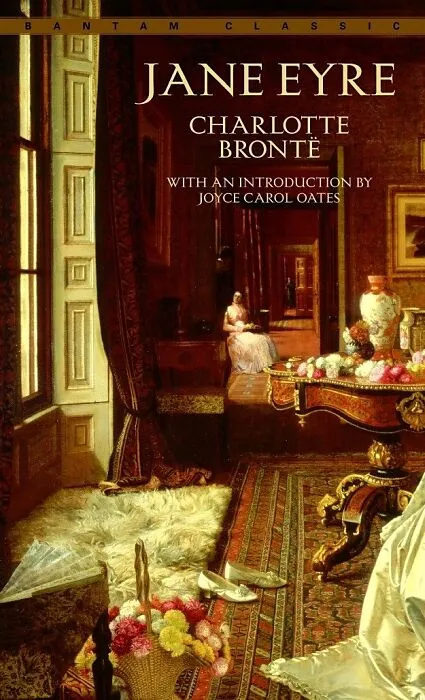
Jane Eyre
Beschreibung
Introduction by Joyce Carol Oates • Nominated as one of America’s best-loved novels by PBS’s The Great American Read Initially published under the pseudonym Currer Bell in 1847, Charlotte Brontë’s Jane Eyre erupted onto the English ...Format auswählen
- Kartonierter EinbandCHF 7.10

Wird oft zusammen gekauft
Andere Kunden kauften auch
Beschreibung
Introduction by Joyce Carol Oates • Nominated as one of America’s best-loved novels by PBS’s The Great American Read Initially published under the pseudonym Currer Bell in 1847, Charlotte Brontë’s Jane Eyre erupted onto the English literary scene, immediately winning the devotion of many of the world’s most renowned writers, including William Makepeace Thackeray, who declared it a work “of great genius.” Widely regarded as a revolutionary novel, Brontë’s masterpiece introduced the world to a radical new type of heroine, one whose defiant virtue and moral courage departed sharply from the more acquiescent and malleable female characters of the day. Passionate, dramatic, and surprisingly modern, Jane Eyre endures as one of the world’s most beloved novels.
"At the end we are steeped through and through with the genius, the vehemence, the indignation of Charlotte Brontë."—Virginia Woolf
Autorentext
Emily Jane Brontë was the most solitary member of a unique, tightly-knit, English provincial family. Born in 1818, she shared the parsonage of the town of Haworth, Yorkshire, with her older sister, Charlotte, her brother, Branwell, her younger sister, Anne, and her father, The Reverend Patrick Brontë. All five were poets and writers; all but Branwell would publish at least one book.
Fantasy was the Brontë children’s one relief from the rigors of religion and the bleakness of life in an impoverished region. They invented a series of imaginary kingdoms and constructed a whole library of journals, stories, poems, and plays around their inhabitants. Emily’s special province was a kingdom she called Gondal, whose romantic heroes and exiles owed much to the poems of Byron.
Brief stays at several boarding schools were the sum of her experiences outside Haworth until 1842, when she entered a school in Brussels with her sister Charlotte. After a year of study and teaching there, they felt qualified to announce the opening of a school in their own home, but could not attract a single pupil.
In 1845 Charlotte Brontë came across a manuscript volume of her sister’s poems. She knew at once, she later wrote, that they were “not at all like poetry women generally write…they had a peculiar music–wild, melancholy, and elevating.” At her sister’s urging, Emily’s poems, along with Anne’s and Charlotte’s, were published pseudonymously in 1846. An almost complete silence greeted this volume, but the three sisters, buoyed by the fact of publication, immediately began to write novels. Emily’s effort was Wuthering Heights; appearing in 1847 it was treated at first as a lesser work by Charlotte, whose Jane Eyre had already been published to great acclaim. Emily Brontë’s name did not emerge from behind her pseudonym of Ellis Bell until the second edition of her novel appeared in 1850.
In the meantime, tragedy had struck the Brontë family. In September of 1848 Branwell had succumbed to a life of dissipation. By December, after a brief illness, Emily too was dead; her sister Anne would die the next year. Wuthering Heights, Emily’s only novel, was just beginning to be understood as the wild and singular work of genius that it is. “Stronger than a man,” wrote Charlotte, “Simpler than a child, her nature stood alone.”
Klappentext
Introduction by Joyce Carol Oates • Nominated as one of America’s best-loved novels by PBS’s The Great American Read
Initially published under the pseudonym Currer Bell in 1847, Charlotte Brontë’s Jane Eyreerupted onto the English literary scene, immediately winning the devotion of many of the world’s most renowned writers, including William Makepeace Thackeray, who declared it a work “of great genius.” Widely regarded as a revolutionary novel, Brontë’s masterpiece introduced the world to a radical new type of heroine, one whose defiant virtue and moral courage departed sharply from the more acquiescent and malleable female characters of the day. Passionate, dramatic, and surprisingly modern, *Jane Eyre *endures as one of the world’s most beloved novels.
Leseprobe
Chapter One
There was no possibility of taking a walk that day. We had been wandering, indeed, in the leafless shrubbery an hour in the morning; but since dinner (Mrs. Reed, when there was no company, dined early) the cold winter wind had brought with it clouds so sombre, and a rain so penetrating, that further outdoor exercise was now out of the question.
I was glad of it; I never liked long walks, especially on chilly afternoons: dreadful to me was the coming home in the raw twilight, with nipped fingers and toes, and a heart saddened by the chidings of Bessie, the nurse, and humbled by the consciousness of my physical inferiority to Eliza, John, and Georgiana Reed.
The said Eliza, John, and Georgiana were now clustered round their mamma in the drawing-room: she lay reclined on a sofa by the fireside, and with her darlings about her (for the time neither quarrelling nor crying) looked perfectly happy. Me, she had dispensed from joining the group, saying, "She regretted to be under the necessity of keeping me at a distance; but that until she heard from Bessie, and could discover by her own observation that I was endeavouring in good earnest to acquire a more sociable and childlike disposition, a more attractive and sprightly manner--something lighter, franker, more natural, as it were--she really must exclude me from privileges intended only for contented, happy little children."
"What does Bessie say I have done?" I asked.
"Jane, I don't like cavillers or questioners; besides, there is something truly forbidding in a child taking up her elders in that manner. Be seated somewhere; and until you can speak pleasantly, remain silent."
A small breakfast-room adjoined the drawing-room, I slipped in there. It contained a bookcase; I soon possessed myself of a volume, taking care that it should be one stored with pictures. I mounted into the window-seat: gathering up my feet, I sat crosslegged, like a Turk; and, having drawn the red moreen curtain nearly close, I was shrined in double retirement.
Folds of scarlet drapery shut in my view to the right hand; to the left were the clear panes of glass, protecting, but not separating me from the drear November day. At intervals, while turning over the leaves in my book, I studied the aspect of that winter afternoon. Afar, it offered a pale blank of mist and cloud; near, a scene of wet lawn and storm-beat shrub, with ceaseless rain sweeping away wildly before a long and lamentable blast.
I returned to my book--Bewick's History of British Birds: the letterpress thereof I cared little for, generally speaking; and yet there were certain introductory pages that, child as I was, I could not pass quite as a blank. They were those which treat of the haunts of sea-fowl; of "the solitary rocks and promontories" by them only inhabited; of the coast of Norway, studded with isles from its southern extremity, the Lindeness, or Naze, to the North Cape--
Where the Northern Ocean, in vast whirls,
Boils round the naked, melancholy isles
Of farthest Thule; and the Atlantic surge
Pours in among the stormy Hebrides.
Nor could I pass unnoticed the suggestion of the bleak shores of Lapland, Siberia, Spitzbergen, Nova Zembla, Iceland, Greenland, with "the vast sweep of the Arctic Zone, and those forlorn regions of dreary space--that reservoir of frost and snow, where firm fields of ice, the accumulation of centuries of winters, glazed in Alpine heights above heights, surround the pole, and concentre the multiplied rigours of extreme co…