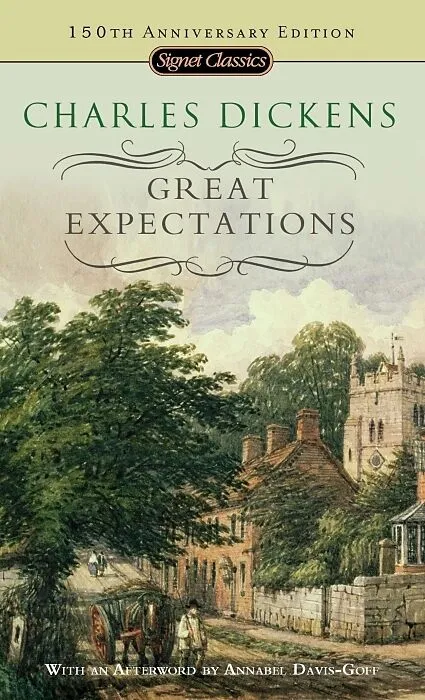
Great Expectations
Beschreibung
Zusatztext "No story in the first person was ever better told." Informationen zum Autor As a child, Charles Dickens (181270) came to know not only hunger and privation, but also the horror of the infamous debtors' prison and the evils of child labor. A surpris...Format auswählen
- Poche format ACHF 8.70

Wird oft zusammen gekauft
Andere Kunden kauften auch
Beschreibung
Zusatztext "No story in the first person was ever better told." Informationen zum Autor As a child, Charles Dickens (181270) came to know not only hunger and privation, but also the horror of the infamous debtors' prison and the evils of child labor. A surprise legacy brought release from the nightmare of prison and slave factories and afforded Dickens the opportunity of two years' formal schooling. He taught himself shorthand and worked as a parliamentary reporter until his writing career took off with the publication of Sketches by Boz (1836) and The Pickwick Papers (1837). As a novelist and magazine editor, Dickens had a long run of serialized success through Our Mutual Friend (186465). In later years, ill health slowed him down, but he continued his popular dramatic readings from his fiction to an adoring public, which included Queen Victoria. At his death, The Mystery of Edwin Drood remained unfinished. Stanley Weintraub is the author or editor of more than fifty books of biography, culture history, and military history, including The London Yankees , Whistler , Victoria , and Uncrowned King: The Life of Prince Albert . He retired from Pennsylvania State University as Evan Hugh Professor Emeritus and director of Institute for the Arts and Humanistic Studies. Annabel Davis-Goff is the author of The Dower House, This Cold Country, and The Fox's Walk. All three novels were selected by the New York Times as Notable Books. She is also the author of Walled Gardens , a family memoir, and is editor of The Literary Companion to Gambling. She now teaches literature at Bennington College. Klappentext From the agony of Charles Dickens' disenchantment with the Victorian middle class comes a profound novel of spellbinding mystery... An orphan living with his older sister and her kindly husband, Pip is hired by wealthy and embittered Miss Havisham as a companion for her and her beautiful adopted daughter, Estella. His years in service to the Havishams fill his heart with the desire to rise above his station in life. Pip's wish is fulfilled when a mysterious benefactor provides him with great expectationsthe means to be tutored as a gentleman. Thrust into London's high-society circles, Pip grows accustomed to a life of leisure, only to find himself lacking as a suitor competing for Estella's favor. After callously discarding everything he once valued for his own selfish pursuits, Pip learns the identity of his patrona revelation that shatters his very soul. With an Introduction by Stanley Weintraub and an Afterword by Annabel Davis-Goff Leseprobe Chapter I. My father's family name being Pirrip, and my christian name Philip, my infant tongue could make of both names nothing longer or more explicit than Pip. So, I called myself Pip, and came to be called Pip. I give Pirrip as my father's family name, on the authority of his tombstone and my sister Mrs. Joe Gargery, who married the blacksmith. As I never saw my father or my mother, and never saw any likeness of either of them (for their days were long before the days of photographs), my first fancies regarding what they were like, were unreasonably derived from their tombstones. The shape of the letters on my father's, gave me an odd idea that he was a square, stout, dark man, with curly black hair. From the character and turn of the inscription, "Also Georgiana Wife of the Above," I drew a childish conclusion that my mother was freckled and sickly. To five little stone lozenges, each about a foot and a half long, which were arranged in a neat row beside their grave, and were sacred to the memory of five little brothers of mine who gave up trying to get a living exceedingly earl...
"No story in the first person was ever better told."
Autorentext
As a child, Charles Dickens (1812–70) came to know not only hunger and privation, but also the horror of the infamous debtors’ prison and the evils of child labor. A surprise legacy brought release from the nightmare of prison and “slave” factories and afforded Dickens the opportunity of two years’ formal schooling. He taught himself shorthand and worked as a parliamentary reporter until his writing career took off with the publication of Sketches by Boz (1836) and The Pickwick Papers (1837). As a novelist and magazine editor, Dickens had a long run of serialized success through Our Mutual Friend (1864–65). In later years, ill health slowed him down, but he continued his popular dramatic readings from his fiction to an adoring public, which included Queen Victoria. At his death, The Mystery of Edwin Drood remained unfinished.
Stanley Weintraub is the author or editor of more than fifty books of biography, culture history, and military history, including The London Yankees, Whistler, Victoria, and Uncrowned King: The Life of Prince Albert. He retired from Pennsylvania State University as Evan Hugh Professor Emeritus and director of Institute for the Arts and Humanistic Studies.
Annabel Davis-Goff is the author of The Dower House, This Cold Country, and The Fox’s Walk. All three novels were selected by the New York Times as Notable Books. She is also the author of Walled Gardens, a family memoir, and is **editor of The Literary Companion to Gambling. She now teaches literature at Bennington College.
Klappentext
**From the agony of Charles Dickens’ disenchantment with the Victorian middle class comes a profound novel of spellbinding mystery...
**An orphan living with his older sister and her kindly husband, Pip is hired by wealthy and embittered Miss Havisham as a companion for her and her beautiful adopted daughter, Estella. His years in service to the Havishams fill his heart with the desire to rise above his station in life. Pip’s wish is fulfilled when a mysterious benefactor provides him with “great expectations”—the means to be tutored as a gentleman.
Thrust into London’s high-society circles, Pip grows accustomed to a life of leisure, only to find himself lacking as a suitor competing for Estella’s favor. After callously discarding everything he once valued for his own selfish pursuits, Pip learns the identity of his patron—a revelation that shatters his very soul.
With an Introduction by Stanley Weintraub
and an Afterword by Annabel Davis-Goff
Leseprobe
Chapter I.
My father's family name being Pirrip, and my christian name Philip, my
infant tongue could make of both names nothing longer or more explicit than
Pip. So, I called myself Pip, and came to be called Pip.
I give Pirrip as my father's family name, on the authority of his tombstone
and my sister – Mrs. Joe Gargery, who married the blacksmith. As I never saw
my father or my mother, and never saw any likeness of either of them (for
their days were long before the days of photographs), my first fancies
regarding what they were like, were unreasonably derived from their
tombstones. The shape of the letters on my father's, gave me an odd idea
that he was a square, stout, dark man, with curly black hair. From the
character and turn of the inscription, "Also Georgiana Wife of the Above,"
I drew a childish conclusion that my mother was freckled and sickly. To
five little stone lozenges, each about a foot and a half long, which were
arranged in a neat row beside their grave, and were sacred to the memory of
five little brothers of mine – who gave up trying to get a living exceedingly
early in that universal struggle – I am indebted for a belief I religiously
entertained that they had all been born on their backs with their hands in
their trousers-pockets, and had never taken them out in this state of
existence.
Ours was the marsh country, down by the river, within as the river wound,
twenty miles of the sea.…