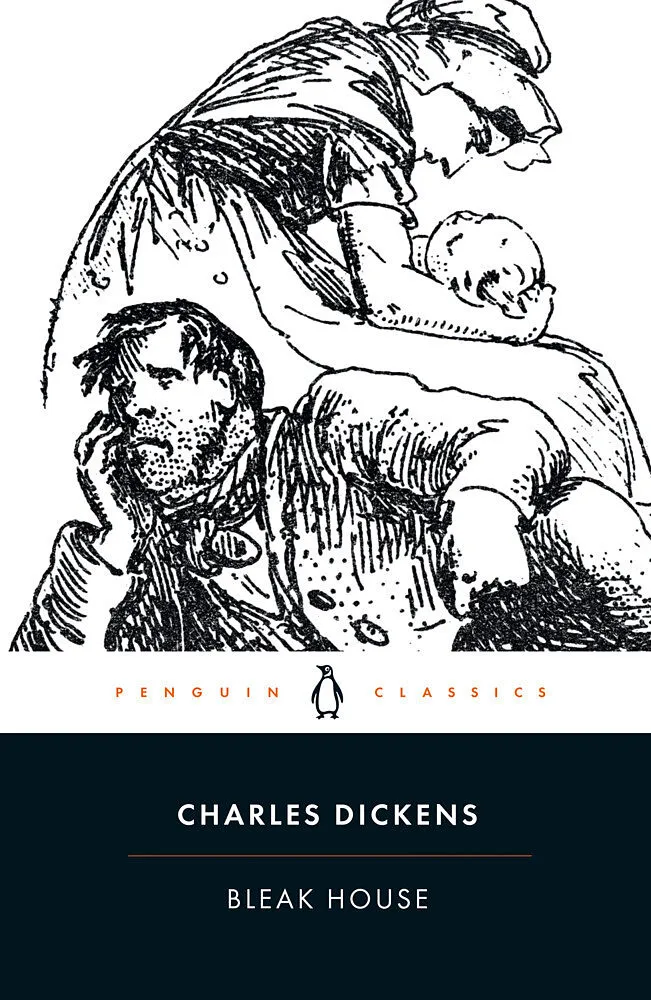
Bleak House
Beschreibung
The unabridged text of Dickens's classic tale that offers both a scathing satire on the corruption of the law and a vivid portrait of London life. Zusatztext Perhaps Bleak House is his best novel. . . . When Dickens wrote Bleak House he had grown up. G. K...Format auswählen
- Kartonierter EinbandCHF 17.30
- Fester EinbandCHF 38.00
- E-Book (epub)CHF 7.50

Wird oft zusammen gekauft
Andere Kunden kauften auch
Beschreibung
The unabridged text of Dickens's classic tale that offers both a scathing satire on the corruption of the law and a vivid portrait of London life.
Zusatztext Perhaps Bleak House is his best novel. . . . When Dickens wrote Bleak House he had grown up. G. K. Chesterton Informationen zum Autor Charles Dickens was born on February 7, 1812, in Landport, Portsea, England. He died in Kent on June 9, 1870. The second of eight children of a family continually plagued by debt, the young Dickens came to know not only hunger and privation,but also the horror of the infamous debtors' prison and the evils of child labor. A turn of fortune in the shape of a legacy brought release from the nightmare of prison and slave factories and afforded Dickens the opportunity of two years' formal schooling at Wellington House Academy. He worked as an attorney's clerk and newspaper reporter until his Sketches by Boz (1836) and The Pickwick Papers (1837) brought him the amazing and instant success that was to be his for the remainder of his life. In later years, the pressure of serial writing, editorial duties, lectures, and social commitments led to his separation from Catherine Hogarth after twenty-three years of marriage. It also hastened his death at the age of fifty-eight, when he was characteristically engaged in a multitude of work. Nicola Bradbury is Lecturer in English at the University of Reading. Klappentext Charles Dickens's masterful assault on the injustices of the British legal system As the interminable case of 'Jarndyce and Jarndyce' grinds its way through the Court of Chancery, it draws together a disparate group of people: Ada and Richard Clare, whose inheritance is gradually being devoured by legal costs; Esther Summerson, a ward of court, whose parentage is a source of deepening mystery; the menacing lawyer Tulkinghorn; the determined sleuth Inspector Bucket; and even Jo, the destitute little crossing-sweeper. A savage, but often comic, indictment of a society that is rotten to the core, Bleak House is one of Dickens's most ambitious novels, with a range that extends from the drawing rooms of the aristocracy to the poorest of London slums. This edition follows the first book edition of 1853, and includes all the original illustrations by 'Phiz', as well as appendices on the Chancery and spontaneous combustion. In his preface, Terry Eagleton examines characterisation and considers Bleak House as an early work of detective fiction. For more than seventy years, Penguin has been the leading publisher of classic literature in the English-speaking world. With more than 1,700 titles, Penguin Classics represents a global bookshelf of the best works throughout history and across genres and disciplines. Readers trust the series to provide authoritative texts enhanced by introductions and notes by distinguished scholars and contemporary authors, as well as up-to-date translations by award-winning translators. Chapter One In Chancery London. Michaelmas Term lately over, and the Lord Chancellor sitting in Lincoln's Inn Hall. Implacable November weather. As much mud in the streets, as if the waters had but newly retired from the face of the earth, and it would not be wonderful to meet a Megalosaurus,forty feet long or so, waddling like an elephantine lizard up Holborn-hill. Smoke lowering down from chimney-pots, making a soft black drizzle, with flakes of soot in it as big as full-grown snow-flakes-gone into mourning, one might imagine, for the death of the sun. Dogs, undistinguishable in mire. Horses, scarcely better; splashed to their very blinkers. Foot passengers, jostling one another's umbrellas, in a general infection of ill-temper, and losing their foot-hold at street corners, where tens of thousands of other foot passengers have been slipping and sliding since the day broke (if the day ever broke), adding new deposits to the crust upon crust of mud, sticking at those points tenaciously to the pavement, and accumulat...
#8220;Perhaps **Bleak House **is his best novel. . . . When Dickens wrote Bleak House he had grown up.” —G. K. Chesterton
Autorentext
Charles Dickens was born on February 7, 1812, in Landport, Portsea, England. He died in Kent on June 9, 1870. The second of eight children of a family continually plagued by debt, the young Dickens came to know not only hunger and privation,but also the horror of the infamous debtors’ prison and the evils of child labor. A turn of fortune in the shape of a legacy brought release from the nightmare of prison and “slave” factories and afforded Dickens the opportunity of two years’ formal schooling at Wellington House Academy. He worked as an attorney’s clerk and newspaper reporter until his Sketches by Boz (1836) and The Pickwick Papers (1837) brought him the amazing and instant success that was to be his for the remainder of his life. In later years, the pressure of serial writing, editorial duties, lectures, and social commitments led to his separation from Catherine Hogarth after twenty-three years of marriage. It also hastened his death at the age of fifty-eight, when he was characteristically engaged in a multitude of work.
Nicola Bradbury is Lecturer in English at the University of Reading.
Klappentext
Charles Dickens's masterful assault on the injustices of the British legal system
As the interminable case of 'Jarndyce and Jarndyce' grinds its way through the Court of Chancery, it draws together a disparate group of people: Ada and Richard Clare, whose inheritance is gradually being devoured by legal costs; Esther Summerson, a ward of court, whose parentage is a source of deepening mystery; the menacing lawyer Tulkinghorn; the determined sleuth Inspector Bucket; and even Jo, the destitute little crossing-sweeper. A savage, but often comic, indictment of a society that is rotten to the core, Bleak House is one of Dickens's most ambitious novels, with a range that extends from the drawing rooms of the aristocracy to the poorest of London slums. This edition follows the first book edition of 1853, and includes all the original illustrations by 'Phiz', as well as appendices on the Chancery and spontaneous combustion. In his preface, Terry Eagleton examines characterisation and considers Bleak House as an early work of detective fiction.
For more than seventy years, Penguin has been the leading publisher of classic literature in the English-speaking world. With more than 1,700 titles, Penguin Classics represents a global bookshelf of the best works throughout history and across genres and disciplines. Readers trust the series to provide authoritative texts enhanced by introductions and notes by distinguished scholars and contemporary authors, as well as up-to-date translations by award-winning translators.
Leseprobe
*Chapter One
In Chancery
*
London. Michaelmas Term lately over, and the Lord Chancellor sitting in Lincoln's Inn Hall. Implacable November weather. As much mud in the streets, as if the waters had but newly retired from the face of the earth, and it would not be wonderful to meet a Megalosaurus,forty feet long or so, waddling like an elephantine lizard up Holborn-hill. Smoke lowering down from chimney-pots, making a soft black drizzle, with flakes of soot in it as big as full-grown snow-flakes-gone into mourning, one might imagine, for the death of the sun. Dogs, undistinguishable in mire. Horses, scarcely better; splashed to their very blinkers. Foot passengers, jostling one another's umbrellas, in a general infection of ill-temper, and losing their foot-hold at street corners, where tens of thousands of other foot passengers have been slipping and sliding since the day broke (if the day ever broke), adding new deposits to the crust upon crust of mud, sticking at those points tenaciously to the pavement, and accum…