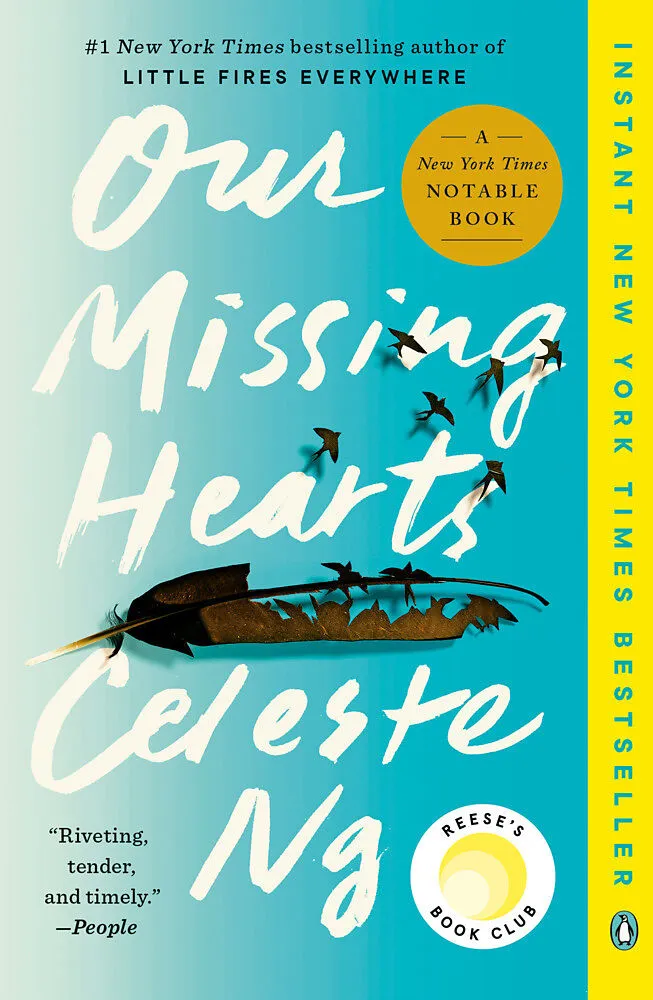
Our Missing Hearts
Beschreibung
An instant • A Named a Best Book of 2022 by • A Reese''s Book Club Pick From the #1 bestselling author of “It’s impossible not to be moved.” --Stephen King, “Riveting, tender, and timely.” -- People, Book of the Week &ld...Format auswählen
- Kartonierter EinbandCHF 21.10
- Fester EinbandCHF 31.90
- Kartonierter EinbandCHF 34.00
- Kartonierter EinbandCHF 12.20
Wird oft zusammen gekauft
Andere Kunden kauften auch
Beschreibung
An instant • A Named a Best Book of 2022 by • A Reese''s Book Club Pick From the #1 bestselling author of “It’s impossible not to be moved.” --Stephen King, “Riveting, tender, and timely.” -- People, Book of the Week “Thought-provoking, heart-wrenching . . . I was so invested in the future of this mother and son, and I can’t wait to hear what you think of this deeply suspenseful story!” -- Reese Witherspoon (Reese’s Book Club Pick) Twelve-year-old Bird Gardner lives a quiet existence with his loving father, a former linguist who now shelves books in a university library. His mother Margaret, a Chinese American poet, left without a trace when he was nine years old. He doesn’t know what happened to her--only that her books have been banned--and he resents that she cared more about her work than about him. Then one day, Bird receives a mysterious letter containing only a cryptic drawing, and soon he is pulled into a quest to find her. His journey will take him back to the many folktales she poured into his head as a child, through the ranks of an underground network of heroic librarians, and finally to New York City, where he will finally learn the truth about what happened to his mother, and what the future holds for them both. <Our Missing Hearts <is an old story made new, of the ways supposedly civilized communities can ignore the most searing injustice. It’s about the lessons and legacies we pass on to our children, and the power of art to create change....
Autorentext
Celeste Ng is the number one New York Times bestselling author of the novels Everything I Never Told You, Little Fires Everywhere, and Our Missing Hearts. Ng is the recipient of fellowships from the National Endowment for the Arts and the Guggenheim Foundation, and her work has been published in over thirty languages.
Klappentext
*An instant New York Times bestseller • A New York Times Notable Book • Named a Best Book of the Year by People, TIME Magazine, The Washington Post, USA Today, NPR, Los Angeles Times, and Oprah Daily, and more • A Reese's Book Club Pick • New York Times* Paperback Row Selection
“Thought-provoking, heart-wrenching . . . I was so invested in the future of this mother and son.” —Reese Witherspoon
“Riveting, tender, and timely.” —People
"Remarkable . . . An unflinching yet life-affirming drama about the power of art and love to push back in dangerous times." —Oprah Daily
From the #1 bestselling author of Little Fires Everywhere, comes the inspiring new novel about a mother’s unshakeable love.**
Twelve-year-old Bird Gardner lives a quiet existence with his loving father, a former linguist who now shelves books in a university library. His mother, Margaret, a Chinese American poet, left without a trace when he was nine years old. He doesn’t know what happened to her—only that her books have been banned—and he resents that she cared more about her work than about him.
Then one day Bird receives a mysterious letter containing only a cryptic drawing, and soon he is pulled into a quest to find her. His journey will take him back to the many folktales she poured into his head as a child, through the ranks of an underground network of heroic librarians, and finally to New York City, where he will learn the truth about what happened to his mother and what the future holds for them both.
Our Missing Hearts is an old story made new, of the ways supposedly civilized communities can ignore the most searing injustice. It’s about the lessons and legacies we pass on to our children and the power of art to create change.
Leseprobe
The letter arrives on a Friday. Slit and resealed with a sticker, of course, as all their letters are: Inspected for your safety-PACT. It had caused confusion at the post office, the clerk unfolding the paper inside, studying it, passing it up to his supervisor, then the boss. But eventually it had been deemed harmless and sent on its way. No return address, only a New York, NY postmark, six days old. On the outside, his name-Bird-and because of this he knows it is from his mother.
He has not been Bird for a long time.
We named you Noah after your father's father, his mother told him once. Bird was all your own doing.
The word that, when he said it, felt like him. Something that did not belong on earth, a small quick thing. An inquisitive chirp, a self that curled up at the edges.
The school hadn't liked it. Bird is not a name, they'd said, his name is Noah. His kindergarten teacher, fuming: He won't answer when I call him. He only answers to Bird.
Because his name is Bird, his mother said. He answers to Bird, so I suggest you call him that, birth certificate be damned. She'd taken a Sharpie to every handout that came home, crossing off Noah, writing Bird on the dotted line instead.
That was his mother: formidable and ferocious when her child was in need.
In the end the school conceded, though after that the teacher had written Bird in quotation marks, like a gangster's nickname. Dear "Bird," please remember to have your mother sign your permission slip. Dear Mr. and Mrs. Gardner, "Bird" is respectful and studious but needs to participate more fully in class. It wasn't until he was nine, after his mother left, that he became Noah.
His father says it's for the best, and won't let anyone call him Bird anymore.
If anyone calls you that, he says, you correct them. You say: Sorry, no, that's not my name.
It was one of the many changes that took place after his mother left. A new apartment, a new school, a new job for his father. An entirely new life. As if his father had wanted to transform them completely, so that if his mother ever came back, she wouldn't even know how to find them.
He'd passed his old kindergarten teacher on the street last year, on his way home. Well, hello, Noah, she said, how are you this morning? and he could not tell whether it was smugness or pity in her voice.
He is twelve now; he has been Noah for three years, but Noah still feels like one of those Halloween masks, something rubbery and awkward he doesn't quite know how to wear.
So now, out of the blue: a letter from his mother. It looks like her handwriting-and no one else would call him that. Bird. After all these years he forgets her voice sometimes; when he tries to summon it, it slips away like a shadow dissolving in the dark.
He opens the envelope with trembling hands. Three years without a single word, but finally he'll understand. Why she left. Where she's been.
But inside: nothing but a drawing. A whole sheet of paper, covered edge to edge in drawings no bigger than a dime: cats. Big cats, little cats, striped and calico and tuxedo, sitting pert, licking their paws, lolling in puddles of sunlight. Doodles really, like the ones his mother drew on his lunch bags many years ago, like the ones he sometimes draws in his class notebooks today. Barely more than a few curved lines, but recognizable. Alive. That's all-no message, no words even, just cat after cat in ballpoint squiggle. Something about it tugs at the back of his mind, but he can't quite hook it.
He turns the paper over, looking for clues, but the back of the page is blank.
Do you remember anything about your mother, Sadie had asked him once. They were on the playground, atop the climbing structure, the slide yawning down before them. Fifth grade, the last year with recess. Everything too small for them by then, meant for little children. Across the blacktop they watched their classmates hunting each other out: ready or not, here I come.
The truth was that he did, but he didn't feel like sharing, even with Sadie. The…