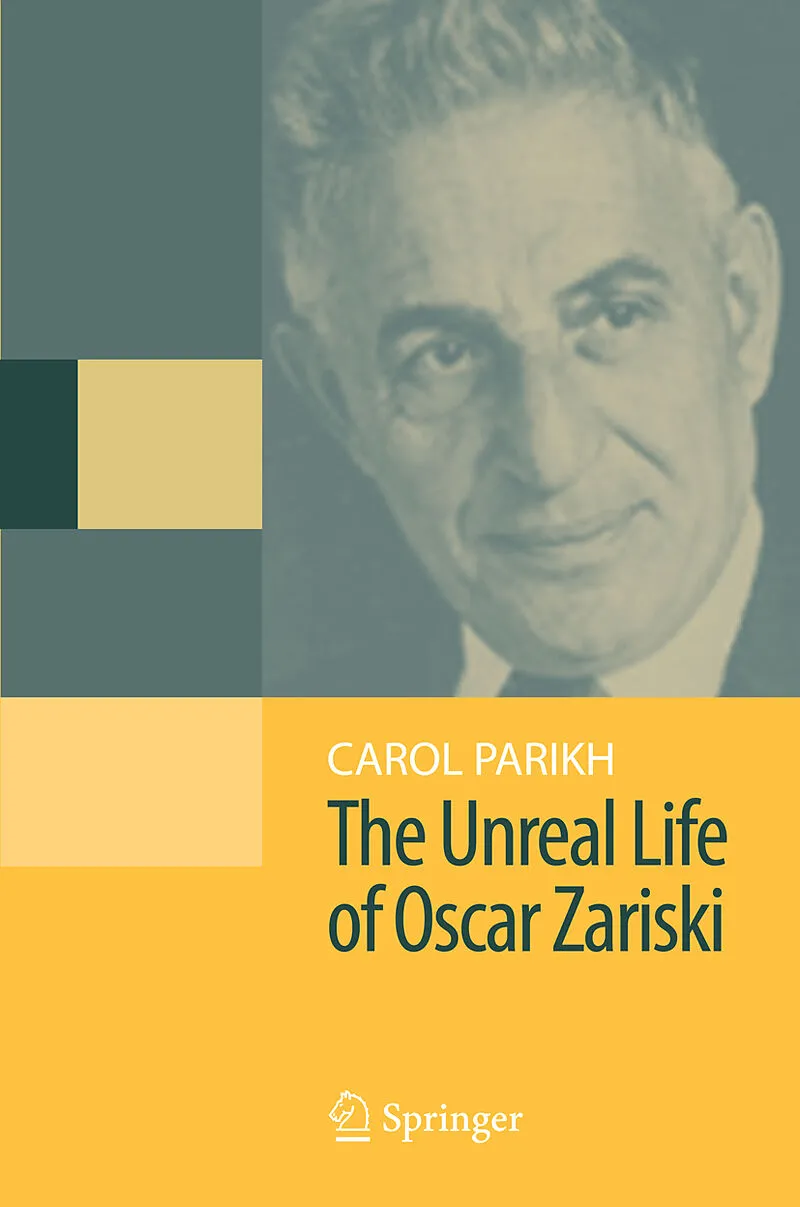

The Unreal Life of Oscar Zariski
Beschreibung
First published in 1991, The Unreal Life of Oscar Zariski was highly successful and widely praised, but has been out of print for many years. Springer is proud to make this book available again, introducing Oscar Zariski to a new generation of mathematicians. ...Format auswählen
- Kartonierter EinbandCHF 94.40
- E-Book (pdf)CHF 65.90

Wird oft zusammen gekauft
Andere Kunden kauften auch
Beschreibung
First published in 1991, The Unreal Life of Oscar Zariski was highly successful and widely praised, but has been out of print for many years. Springer is proud to make this book available again, introducing Oscar Zariski to a new generation of mathematicians.
Oscar Zariski's work in mathematics permanently altered the foundations of algebraic geometry. The powerful tools he forged from the ideas of modern algebra allowed him to penetrate classical problems with an unaccustomed depth, and brought new rigor to the intuitive proofs of the Italian School. The students he trained at Hopkins, and later at Harvard, are among the foremost mathematicians of our time.
While what he called his real life is recorded in almost a hundred books and papers, this story of his unreal life is based upon Parikh's interviews with his family, colleagues, and students, and on his own memories from a series of tape-recorded interviews made a few years before his death in 1986.
First published in 1991, The Unreal Life of Oscar Zariski was highly successful and widely praised, but has been out of print for many years. Springer is proud to make this book available again, introducing Oscar Zariski to a new generation of mathematicians.
The only biography of the personal life of this important mathematician Engaging look at the development of algebraic geometry in the 20th century
Autorentext
Alexander Soifer is a Russian born and educated American mathematician, a professor of mathematics at the University of Colorado, an author of some 200 articles on mathematics, history of mathematics, mathematics education, film reviews, etc. He is Senior Vice President of the World Federation of National Mathematics Competitions, which in 2006 awarded him The Paul Erdös Award. 26 years ago Soifer founded has since chaired The Colorado Mathematical Olympiad, and served on both USSR and USA Mathematical Olympiads committees. Soifer's Erdös number is 1. Springer has contracted his 7 books. "The Mathematical Coloring Book" is coming out in October 2008; 4 books will appear in 2009; followed by "Life and Fate: In Search of Van der Waerden", and a joint book with the late Paul Erdos "Problems of p.g.o.m. Erdos." The author's previous books were self-published and received many positive reviews, below are excerpts from reviews of "How Does One Cut A Triangle?: "Why am I urging you to read this? Mainly because it is such a refreshing book. Professor Soifer makes the problems fascinating, the methods of attack even more fascinating, and the whole thing is enlivened by anecdotes about the history of the problems, some of their recent solvers, and the very human reactions of the author to some beautiful mathematics. Most of all, the book has charm, somehow enhanced by his slightly eccentric English, sufficient to carry the reader forward without minding being asked to do rather a lot of work. I am tempted to include several typical quotations but I'll restrain myself to two: From Chapter 8 "Here is an easy problem for your entertainment. Problem 8.1.2. Prove that for any parallelogram P, S(P)=5. Now we have a new problem, therefore we are alive! And the problem is this: what are all possible values of our newly introduced function S(F)? Can the function S(F) help us to classify geometry figures?" And from an introduction by Cecil Rousseau: 'There is a view, held by many, that mathematics books are dull. This view is not without support. It is reinforced by numerous examples at all levels, from elementary texts with page after page of mind-numbing drill to advanced books written in a relentless Theorem-Proof style. "How does one cut a triangle?" is an entirely different matter. It reads like an adventure story. In fact, it is an adventure story, complete with interesting characters, moments of exhilaration, examples of serendipity, and unanswered questions. It conveys the spirit of mathematical discovery and it celebrates the event as have mathematicians throughout history.' And this isn't just publishers going over the top - it's all true!" -- JOHN Baylis in The Mathematical Gazette Soifer's work can rightly be called a "mathematical gem." -- JAMES N. BOYD in Mathematics Teacher This delightful book considers and solves many problems in dividing triangles into n congruent pieces and also into similar pieces, as well as many extremal problems about placing points in convex figures. The book is primarily meant for clever high school students and college students interested in geometry, but even mature mathematicians will find a lot of new material in it. I very warmly recommend the book and hope the readers will have pleasure in thinking about the unsolved problems and will find new ones. -- PAUL ERDÖS It is impossible to convey the spirit of the book by merely listing the problems considered or even a number of solutions. The manner of presentation and the gentle guidance toward a solution and hence to generalizations and new problems takes this elementary treatise out of the prosaic and into the stimulating realm of mathematical creativity. Not only young talented people but dedicated secondary teachers and even a few mathematical sophisticates will find this reading both pleasant and profitable. -- L. M. KELLY in Mathematical Reviews We do not often have possibilities to look into a creative workshop of a mathematician... The beginner, who is interested in the book, not only comprehends a situation in a creativ
Inhalt
That Darling Old Lady Kobrin and Chernigov 1899 1918.- Birds Whirling like Numbers Kiev 19181920.- Three Great Mathematicians Rome 19211926.- Reading Pushkin and Dante.- Oscar, You Are Not One of Us..- Walking with Lefschetz Baltimore 19271928.- A Voyage of Discovery 19281932.- The Algebra Which Sheds Light on Geometry 19321935.- A Citizen of the World of Mathematics 19351937.- The Resolution of Some Singularities.- A Land of Intellectual Cannibals 19391944.- A Superb Audience of One André Weil São Paulo 1945.- Normal Points of a Variety Cambridge 1947.- The Pure Pleasure of It.- An Attack on the Theory of Linear Systems 19501956.- Tying Bells on Characteristic Zero 19571961.- A Feeling of Awe 19621974.- The Depth of His Attachment.