Beschreibung
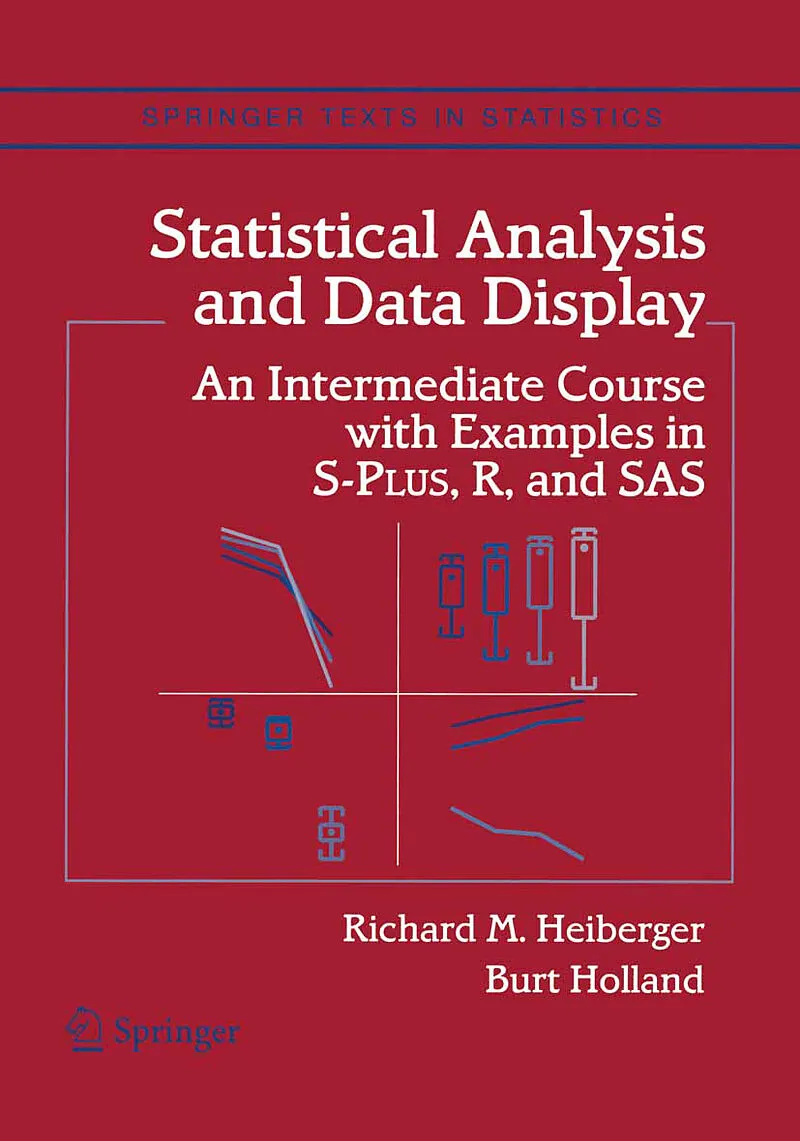
This book provides a concise overview of modern statistical topics at an elementary level. Assuming an understanding of basic calculus and a previous statistics course, it will serve as a reference book for applied statisticians in many quantitative areas who...This book provides a concise overview of modern statistical topics at an elementary level. Assuming an understanding of basic calculus and a previous statistics course, it will serve as a reference book for applied statisticians in many quantitative areas who are interested in statistical methods. Each chapter introduces concepts and terminology, develops the rationale for its methods, and gives examples supported by graphs and computer output. There is an emphasis on graphical displays, and computeroutput is given in both S-PLUS and SAS.
Provides and discusses S-PLUS, R, and SAS executable functions and macros for all new graphical display formats All graphs and tabular output in the book were constructed using these programs
Klappentext
This contemporary presentation of statistical methods features extensive use of graphical displays for exploring data and for displaying the analysis. The authors demonstrate how to analyze datashowing code, graphics, and accompanying computer listingsfor all the methods they cover. They emphasize how to construct and interpret graphs, discuss principles of graphical design, and show how accompanying traditional tabular results are used to confirm the visual impressions derived directly from the graphs. Many of the graphical formats are novel and appear here for the first time in print. All chapters have exercises.
This book can serve as a standalone text for statistics majors at the master's level and for other quantitatively oriented disciplines at the doctoral level, and as a reference book for researchers. In-depth discussions of regression analysis, analysis of variance, and design of experiments are followed by introductions to analysis of discrete bivariate data, nonparametrics, logistic regression, and ARIMA time series modeling. The authors illustrate classical concepts and techniques with a variety of case studies using both newer graphical tools and traditional tabular displays.
The authors provide and discuss S-Plus, R, and SAS executable functions and macros for all new graphical display formats. All graphs and tabular output in the book were constructed using these programs. Complete transcripts for all examples and figures are provided for readers to use as models for their own analyses.
Richard M. Heiberger and Burt Holland are both Professors in the Department of Statistics at Temple University and elected Fellows of the American Statistical Association. Richard M. Heiberger participated in the design of the S-Plus linear model and analysis of variance commands while on research leave at Bell Labs in 198788 and has been closely involved as a beta tester and user of S-Plus. Burt Hollandhas made many research contributions to linear modeling and simultaneous statistical inference, and frequently serves as a consultant to medical investigators. Both teach the Temple University course sequence that inspired them to write this text.
Inhalt
1 Introduction and Motivation.- 2 Data and Statistics.- 3 Statistics Concepts.- 4 Graphs.- 5 Introductory Inference.- 6 One-Way Analysis of Variance.- 7 Multiple Comparisons.- 8 Linear Regression by Least Squares.- 9 Multiple RegressionMore Than One Predictor.- 10 Multiple RegressionDummy Variables and Contrasts.- 11 Multiple RegressionRegression Diagnostics.- 12 Two-Way Analysis of Variance.- 13 Design of ExperimentsFactorial Designs.- 14 Design of ExperimentsComplex Designs.- 15 Bivariate StatisticsDiscrete Data.- 16 Nonparametrics.- 17 Logistic Regression.- 18 Time Series Analysis.- A Software.- A.1 Statistical Software.- A.2 Text Editing Software.- A.2.1 Emacs.- A.2.2 Microsoft Word.- A.3 Word Processing Software.- A.3.2 Microsoft Word.- A.4 Graphics Display Software.- A.5 Operating Systems.- A.6 Mathematical Fonts.- A.7 Directory Structure.- A.7.1 HOME Directory.- A.7.2 HH Book Online Files.- B.1 Create Your Working Directory and Make the HH Library Available.- B.1.3 Windows and R.- B.1.6 Unix and R.- B.4 HH Library Functions.- B.5 Learning the S Language.- B.6 S Language Style.- C SAS.- C.1 Make the HH Library Available.- C.1.1 Windows.- C.1.2 Unix.- C.2 Using SAS with HH.- C.2.1 Reading HH Datasets.- C.2.2 Any Other Data Files.- C.2.3 ASCII Data Files with TAB Characters.- C.2.4 Windows and Unix EOL (End-of-Line) Conventions.- C.3 Macros.- C.4 Learning the SAS Language.- C.5 SAS Coding Conventions.- D Probability Distributions.- D.1.1 An Example Involving Calculations with the Binomial Distribution.- D.2 Noncentral Probability Distributions.- E Editors.- E.1 Working Style.- E.2 Typography.- E.3 Emacs and ESS.- E.3.1 ESS.- E.3.2 Mouse and Keyboard.- E.3.3 Learning Emacs.- E.3.4 Requirements.- E.4 Microsoft Word.- E.4.1 Learning Word.- E.4.2Requirements 6.- E.5 Microsoft Excel.- E.5.1 Database Management.- E.5.2 Organizing Calculations.- E.5.3 Excel as a Statistical Calculator.- E.6 Exhortations, Some of Which Are Writing Style.- E.6.1 Writing Style.- E.6.2 Programming Style and Common Errors.- E.6.3 Presentation of Results.- F Mathematics Preliminaries.- F.1 Algebra Review.- F.2 Elementary Differential Calculus.- F.3 An Application of Differential Calculus.- F.4 Topics in Matrix Algebra.- F.4.1 Elementary Operations.- F.4.2 Linear Independence.- F.4.3 Rank.- F.4.4 Quadratic Forms.- F.4.5 Orthogonal Transformations.- F.4.6 Orthogonal Basis.- F.4.8 Matrix FactorizationCholesky.- F.4.9 Orthogonal Polynomials.- F.4.10 Projection Matrices.- F.4.11 Geometry ot Mlatrices.- F.4.12 Eigenvalues and Eigenvectors.- F.4.13 Singular Value Decomposition.- F.4.14 Generalized Inverse.- F.4.15 Solving Linear Equations.- F.5 Combinations and Permutations.- F.5.1 Factorial.- F.5.2 Permutations.- F.5.3 Combinations.- F.6 Exercises.- G Graphs Based on Cartesian Products.- G.1 Structured Sets of Graphs.- G.1.1 Cartesian Products.- G.1.2 Trellis Paradigm.- G.2 Scatterplot Matrices: splom and xysplom.- G.3 Cartesian Products of Sets of Functions.- G.4 Graphs Requiring Multiple Calls to xysplom.- G.5 Asymmetric Roles for the Row and Column Sets.- G.6 Rotated Plots.- G.7 Squared Residual Plots.- G.8 Alternate Presentations.- References.- List of Datasets.