
IHR WARENKORB IST AKTUELL LEER.
Haben Sie noch nichts passendes gefunden? Stöbern Sie durch unser komplettes Sortiment.
Oder melden Sie sich an bzw. registrieren Sie sich.
- Kostenlose Lieferung
- Kauf auf Rechnung
- Ex Libris Tiefpreis
- Filiallieferung und 650+ Abholorte
- Rabatt-Bons als Club-Mitglied
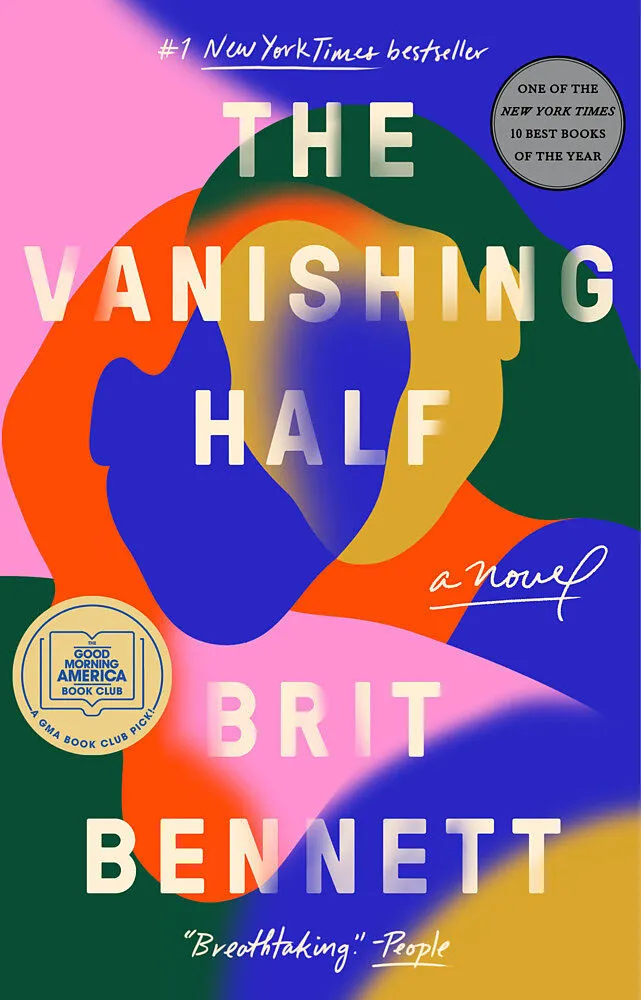
The Vanishing Half
Beschreibung
#1 NEW YORK TIMES BESTSELLER NAMED A BEST BOOK BY THE NEW YORK TIMES THE WASHINGTON POST NPR PEOPLE TIME MAGAZINE VANITY FAIR GLAMOUR BARACK OBAMA New York Times Readers Pick: 100 Best Books of the 21st Century Bennett s tone and style recalls James Baldwin an...Format auswählen
- Kartonierter EinbandCHF 21.10
- Fester EinbandCHF 30.00
- Audio CD (CD/SACD)CHF 32.50
Wird oft zusammen gekauft
Andere Kunden kauften auch
Beschreibung
#1 NEW YORK TIMES BESTSELLER****
**
NAMED A BEST BOOK BY THE NEW YORK TIMES THE WASHINGTON POST NPR PEOPLE TIME MAGAZINE VANITY FAIR GLAMOUR BARACK OBAMA****
New York Times Readers Pick: 100 Best Books of the 21st Century
**
**Bennett s tone and style recalls James Baldwin and Jacqueline Woodson, but it s especially reminiscent of Toni Morrison s 1970 debut novel, The Bluest Eye. Kiley Reid, *Wall Street Journal
*From the New York Times-bestselling author of The Mothers, a stunning new novel about twin sisters, inseparable as children, who ultimately choose to live in two very different worlds, one black and one white.
**
The Vignes twin sisters will always be identical. But after growing up together in a small, southern black community and running away at age sixteen, it's not just the shape of their daily lives that is different as adults, it's everything: their families, their communities, their racial identities. Many years later, one sister lives with her black daughter in the same southern town she once tried to escape. The other secretly passes for white, and her white husband knows nothing of her past. Still, even separated by so many miles and just as many lies, the fates of the twins remain intertwined. What will happen to the next generation, when their own daughters' storylines intersect?
Weaving together multiple strands and generations of this family, from the Deep South to California, from the 1950s to the 1990s, Brit Bennett produces a story that is at once a riveting, emotional family story and a brilliant exploration of the American history of passing*.* Looking well beyond issues of race, The Vanishing Half considers the lasting influence of the past as it shapes a person's decisions, desires, and expectations, and explores some of the multiple reasons and realms in which people sometimes feel pulled to live as something other than their origins.
As with her New York Times-bestselling debut The Mothers, Brit Bennett offers an engrossing page-turner about family and relationships that is immersive and provocative, compassionate and wise.
Autorentext
Born and raised in Southern California, Brit Bennett graduated from Stanford University and later earned her MFA in fiction at the University of Michigan. Her debut novel, The Mothers, was a New York Times bestseller and a finalist for both the NBCC John Leonard First Novel Prize and the PEN/Robert W. Bingham Prize for Debut Fiction. Her second novel, The Vanishing Half, was an instant **#1 New York Times bestseller, longlisted for the National Book Award, a finalist for the Women’s Prize, and named one of the ten best books of the year by The New York Times. Bennet has been named a National Book Foundation 5 Under 35 honoree, a NAACP Image Award Finalist, and one of Time’s Next 100 Influential People. Her essays have been featured in The New Yorker, The New York Times Magazine, The Paris Review, and Jezebel.
Klappentext
#1 NEW YORK TIMES BESTSELLER****
**
NAMED A BEST BOOK BY THE NEW YORK TIMES • THE WASHINGTON POST • NPR • PEOPLE • TIME MAGAZINE • VANITY FAIR • GLAMOUR • **BARACK OBAMA
New York Times Readers Pick: 100 Best Books of the 21st Century
**“Bennett’s tone and style recalls James Baldwin and Jacqueline Woodson, but it’s especially reminiscent of Toni Morrison’s 1970 debut novel, The Bluest Eye.” —Kiley Reid, *Wall Street Journal
*From the New York Times-bestselling author of The Mothers, a stunning new novel about twin sisters, inseparable as children, who ultimately choose to live in two very different worlds, one black and one white.
**
The Vignes twin sisters will always be identical. But after growing up together in a small, southern black community and running away at age sixteen, it's not just the shape of their daily lives that is different as adults, it's everything: their families, their communities, their racial identities. Many years later, one sister lives with her black daughter in the same southern town she once tried to escape. The other secretly passes for white, and her white husband knows nothing of her past. Still, even separated by so many miles and just as many lies, the fates of the twins remain intertwined. What will happen to the next generation, when their own daughters' storylines intersect?
Weaving together multiple strands and generations of this family, from the Deep South to California, from the 1950s to the 1990s, Brit Bennett produces a story that is at once a riveting, emotional family story and a brilliant exploration of the American history of passing*.* Looking well beyond issues of race, The Vanishing Half considers the lasting influence of the past as it shapes a person's decisions, desires, and expectations, and explores some of the multiple reasons and realms in which people sometimes feel pulled to live as something other than their origins.
As with her New York Times-bestselling debut The Mothers, Brit Bennett offers an engrossing page-turner about family and relationships that is immersive and provocative, compassionate and wise.
Leseprobe
One
The morning one of the lost twins returned to Mallard, Lou LeBon ran to the diner to break the news, and even now, many years later, everyone remembers the shock of sweaty Lou pushing through the glass doors, chest heaving, neckline darkened with his own effort. The barely awake customers clamored around him, ten or so, although more would lie and say that they'd been there too, if only to pretend that this once, they'd witnessed something truly exciting. In that little farm town, nothing surprising ever happened, not since the Vignes twins had disappeared. But that morning in April 1968, on his way to work, Lou spotted Desiree Vignes walking along Partridge Road, carrying a small leather suitcase. She looked exactly the same as when she'd left at sixteen-still light, her skin the color of sand barely wet. Her hipless body reminding him of a branch caught in a strong breeze. She was hurrying, her head bent, and-Lou paused here, a bit of a showman-she was holding the hand of a girl, eight or so, and black as tar.
"Blueblack," he said. "Like she flown direct from Africa."
Lou's Egg House splintered into a dozen different conversations. The line cook wondered if it had been Desiree after all, since Lou was turning sixty in May and still too vain to wear his eyeglasses. The waitress said that it had to be-even a blind man could spot a Vignes girl and it certainly couldn't have been that other one. The diners, abandoning grits and eggs on the counter, didn't care about that Vignes foolishness-who on earth was the dark child? Could she possibly be Desiree's?
"Well, who else's could it be?" Lou said. He grabbed a handful of napkins from the dispenser, dabbing his damp forehead.
"Maybe it's an orphan that got took in."
"I just don't see how nothin that black coulda come out Desiree."
"Desiree seem like the type to take in no orphan to you?"
Of course she didn't. She was a selfish girl. If they remembered anything about Desiree, it was that and most didn't recall much more. The twins had been gone fourteen years, nearly as long as anyone had ever known them. Vanished from bed after the Founder's Day dance, while their mother slept right down the hall. One morning, the twins crowded in front of their bathroom mirror, four identical girls fussing with their hair. The next, the bed was empty, the covers pulled back like any other day, taut when Stella made it, crumpled when Desiree did. The town spent all morning searching for them, calling their names through t…