Haben Sie noch nichts passendes gefunden? Stöbern Sie durch unser komplettes Sortiment.
Oder melden Sie sich an bzw. registrieren Sie sich.


Beschreibung
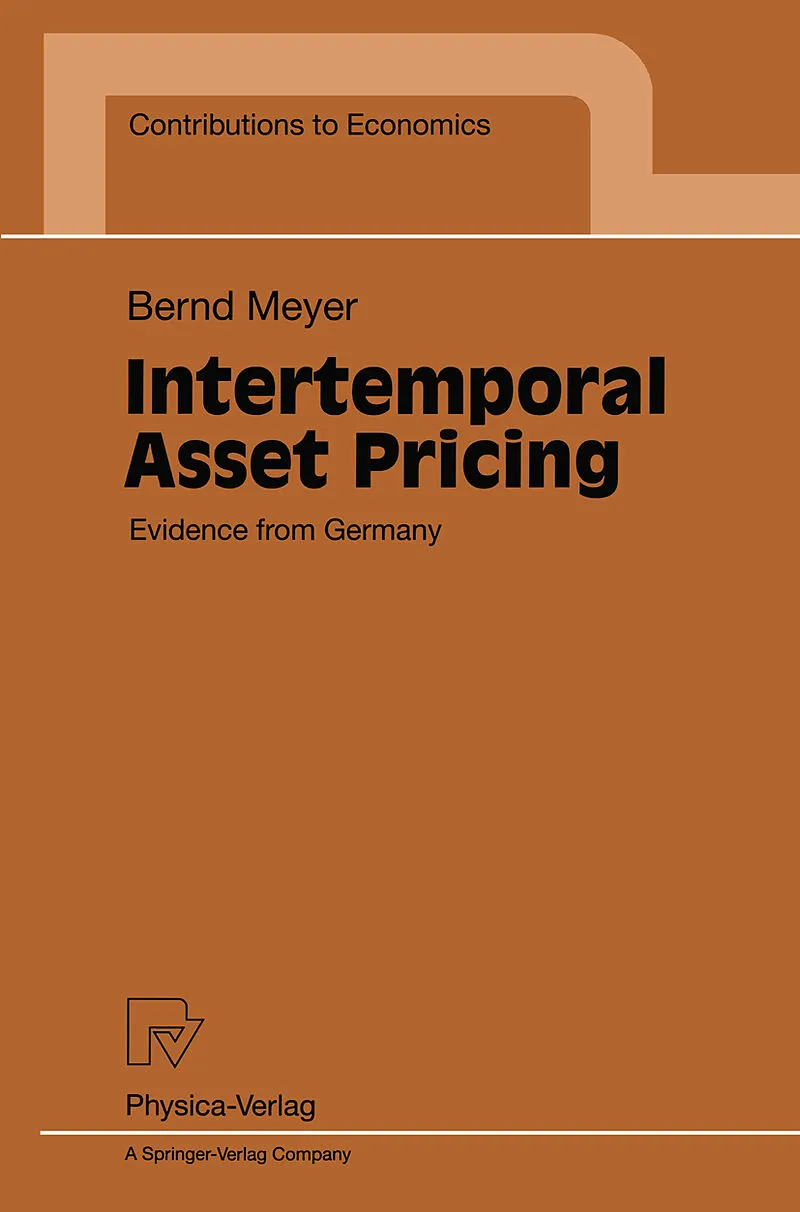
In the mid-eighties Mehra and Prescott showed that the risk premium earned by American stocks cannot reasonably be explained by conventional capital market models. Using time additive utility, the observed risk pre mium can only be explained by unrealistically...In the mid-eighties Mehra and Prescott showed that the risk premium earned by American stocks cannot reasonably be explained by conventional capital market models. Using time additive utility, the observed risk pre mium can only be explained by unrealistically high risk aversion parameters. This phenomenon is well known as the equity premium puzzle. Shortly aft erwards it was also observed that the risk-free rate is too low relative to the observed risk premium. This essay is the first one to analyze these puzzles in the German capital market. It starts with a thorough discussion of the available theoretical mod els and then goes on to perform various empirical studies on the German capital market. After discussing natural properties of the pricing kernel by which future cash flows are translated into securities prices, various multi period equilibrium models are investigated for their implied pricing kernels. The starting point is a representative investor who optimizes his invest ment and consumption policy over time. One important implication of time additive utility is the identity of relative risk aversion and the inverse in tertemporal elasticity of substitution. Since this identity is at odds with reality, the essay goes on to discuss recursive preferences which violate the expected utility principle but allow to separate relative risk aversion and intertemporal elasticity of substitution.
Autorentext
Vladimir Stefanovich Litvinenko, Doctor of Engineering, Professor; Rector of the National Mineral Resources University "Mining University" since 1994, (formerly the St. Petersburg State Mining Institute (Technical University)). Prof. Vladimir Stefanovich Litvinenko is the author of over 150 scientific papers including 5 monographs, 28 patents and inventions (Russian and foreign ones), Laureate of State Prize of the Russian Federation in Science and Technology for "Geological Atlas of Russia", Laureate of Russian Government Award in Science and Technology for "Development and implementation of environmentally friendly combined technologies of ore mining and complex ore processing that ensured putting into operation and development of the unique Yakovlevsky mine of rich iron ore" (2008), Laureate of St. Petersburg Government Prize for outstanding achievements in the field of higher and secondary vocational education (2008). He is also the recipient of state awards: the Order of Honor (1998), Order "For Merit to the Fatherland" 4th degree (2003) and 3d degree (2010), member of the Presidential Commission on the development strategy of the fuel and energy complex and environmental safety, member of the Governmental Commission on the fuel and energy complex, mineral reserves replacement and increasing the energy efficiency of the economy, and the chairperson from the Russian side of the Russian-German Resource Forum. Professor Bernd Meyer, Doctor of Engineering, Professor; Director of the Institute of Energy Process Engineering and Chemical Engineering (IEC) since 1994. Professor Bernd Meyer is the author of over 400 scientific papers, including 10 monographs, 150 patents and inventions. He was elected president of Technical University Mining Academy Freiberg for two terms (2008-2015, maximum number of terms one can be elected as president for the university). He is Laureate of Honorary Medal by the Association of German Engineers (Saxony) in 2012. He is the recipient of a degree of honorary doctorate of National Mining University, Dnepropetrovsk, Ukraine (2012) and St. Petersburg Mining University, Russia (2016). He is also the recipient of a degree of Honorary Professorship of Lomonosov Moscow State University, Russia (2015). He is a Honorary Scientist of the Russian Federation (2015, single foreigner to have received this honor from Ministry of Education and Science, Russia). He is the initiator and Founding President of World Forum of Universities of Resources on Sustainability (2002-2015) and its Honorary Member (since 2015). He is the founder and key coordinator of the Competence Centre Deutsches Brennstoffinstitut: bergakademie. Founder and Key Coordinator of the Energy Raw Materials Network (ERN). He is the co-founder of the Centre of Competence "Large Research Facilities for Efficient High Temperature Conversion Processes. He is the Head ofthe Competence Centre "High Temperature Processes". He is member of the Management Board and Scientific Speaker for the national platform "Regional Centre of Growth Innovative Brown Coal Integration in Middle Germany".
Inhalt
1 Introduction.- 1.1 Subject of Analysis.- 1.2 International Evidence on the Risk-free Rate and the Equity Premium.- 1.3 Purpose and Outline of Analysis.- I Intertemporal Asset Pricing: Theory.- 2 The Market Pricing Kernel Approach.- 3 Implications of Asset Prices for the Market Pricing Kernel.- 4 Parametric Models of the Market Pricing Kernel.- 5 The Calibration Approach for Empirically Investigating Parametric Models of the Market Pricing Kernel.- II Intertemporal Asset Pricing: Empirical Analysis.- 6 Overview and Description of Data.- 7 Analyzing Variance Bounds of the Market Pricing Kernel.- 8 Applying the Calibration Approach.- 9 Evaluating the Calibrated Equilibrium Models.- 10 Conclusion.- A.1 Expected Value of the Product of Jointly Lognormally Distributed Variables.- A.2 Additional Tables and Figures.- List of Symbols.- List of Tables.- List of Figures.
Tief- preis