
IHR WARENKORB IST AKTUELL LEER.
Haben Sie noch nichts passendes gefunden? Stöbern Sie durch unser komplettes Sortiment.
Oder melden Sie sich an bzw. registrieren Sie sich.
- Kostenlose Lieferung
- Kauf auf Rechnung
- Ex Libris Tiefpreis
- Filiallieferung und 650+ Abholorte
- Rabatt-Bons als Club-Mitglied
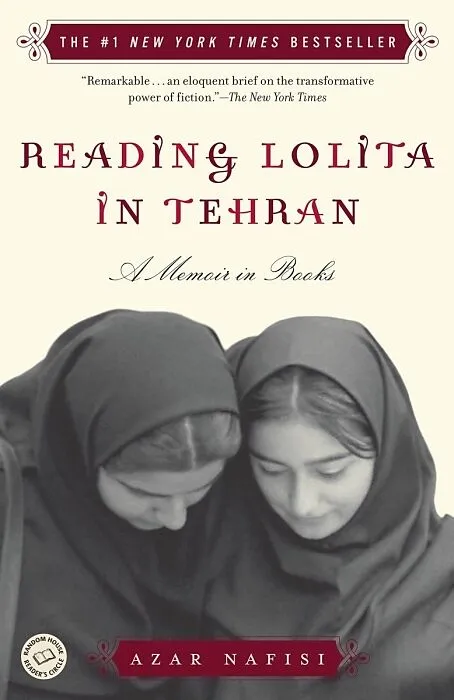
Reading Lolita in Tehran
Beschreibung
Anyone who has ever belonged to a book group must read this book. Azar Nafisi takes us into the vivid lives of eight women who must meet in secret to explore the forbidden fiction of the West. It is at once a celebration of the power of the novel and a cry of ...Format auswählen
- Poche format BCHF 23.45

Wird oft zusammen gekauft
Andere Kunden kauften auch
Beschreibung
Anyone who has ever belonged to a book group must read this book. Azar Nafisi takes us into the vivid lives of eight women who must meet in secret to explore the forbidden fiction of the West. It is at once a celebration of the power of the novel and a cry of outrage at the reality in which these women are trapped. The ayatollahs don' t know it, but Nafisi is one of the heroes of the Islamic Republic. Geraldine Brooks, author of Nine Parts of Desire I was enthralled and moved by Azar Nafisi's account of how she defied, and helped others to defy, radical Islam's war against women. Her memoir contains important and properly complex reflections about the ravages of theocracy, about thoughtfulness, and about the ordeals of freedomas well as a stirring account of the pleasures and deepening of consciousness that result from an encounter with great literature and with an inspired teacher. Susan Sontag When I first saw Azar Nafisi teach, she was standing in a university classroom in Tehran, holding a bunch of red fake poppies in one hand and a bouquet of daffodils in the other, and asking, "What is kitsch?" Now, mesmerizingly, she reveals the shimmering worlds she created in those classrooms, inside a revolution that was an apogee of kitsch and cruelty. Here, people think for themselves because James and Fitzgerald and Nabokov sing out against authoritarianism and repression. You will be taken inside a culture, and on a journey, that you will never forget. Jacki Lyden, National Public Radio, author of Daughter of the Queen of Sheba A memoir about teaching Western literature in revolutionary Iran, with profound and fascinating insights into both. A masterpiece. Bernard Lewis, author of The Crisis of Islam ? [A] vividly braided memoir...anguished and glorious. Cynthia Ozick, The New Republic Stunning...a literary life raft on Iran's fundamentalist sea...All readers should read it. Margaret Atwood Remarkable...an eloquent brief on the transformative power of fiction. The New York Times Certain books by our most talented essayists...carry inside their covers the heat and struggle of a life's central choice being made and the price being paid, while the writer tells us about other matters, and leaves behind a path of sadness and sparkling loss. Reading Lolita in Tehran is such a book. Mona Simpson, The Atlantic Monthly Informationen zum Autor Azar Nafisi is a professor at Johns Hopkins University. She won a fellowship from Oxford and taught English literature at the University of Tehran, the Free Islamic University and Allameh Tabatabai University in Iran. She was expelled from the University of Tehran for refusing to wear the veil and left Iran for America in 1997. She has written for The New York Times, The Washington Post, The Wall Street Journal and The New Republic , and is the author of Anti-Terra: A Critical Study of Vladimir Nabokov's Novels . She lives in Washington, D.C., with her husband and two children. Klappentext #1 NEW YORK TIMES BESTSELLER • SOON TO BE A MAJOR MOTION PICTURE • ONE OF THE BEST NONFICTION BOOKS OF THE CENTURY* In this celebrated modern classic, a former teacher in revolutionary Iran tells the extraordinary true story of the women who risked their lives to study Western literature in her living room. Stunning . . . a literary life raft on Iran's fundamentalist sea.Margaret Atwood, author of The Handmaid's Tale An intimate memoir of life under a repressive regime and a celebration of the vitality of literature . . . as rich and profound as the novels Nafisi teaches. The Miami Herald Every Thursday morning for two years in the Islamic Republic of Iran, Azar Nafisi, a bold and inspired teacher, secretly gathered...
Autorentext
Azar Nafisi
Klappentext
#1 NEW YORK TIMES BESTSELLER • SOON TO BE A MAJOR MOTION PICTURE • ONE OF THE BEST NONFICTION BOOKS OF THE CENTURY*
In this celebrated modern classic, a former teacher in revolutionary Iran tells the extraordinary true story of the women who risked their lives to study Western literature in her living room.
“Stunning . . . a literary life raft on Iran’s fundamentalist sea.”—Margaret Atwood, author of The Handmaid’s Tale
“An intimate memoir of life under a repressive regime and a celebration of the vitality of literature . . . as rich and profound as the novels Nafisi teaches.”—The Miami Herald
***Every Thursday morning for two years in the Islamic Republic of Iran, Azar Nafisi, a bold and inspired teacher, secretly gathered seven of her most committed female students to read forbidden Western classics.
Some of the women came from conservative and religious families, others were progressive and secular; some had spent time in jail. They were shy and uncomfortable at first, unaccustomed to being asked to speak their minds, but soon they removed their veils and began to speak more freely—their stories intertwining with the novels they were reading by Jane Austen, F. Scott Fitzgerald, Henry James, and Vladimir Nabokov.
As Islamic morality squads staged arbitrary raids in Tehran, as fundamentalists seized hold of the universities and a blind censor stifled artistic expression, the women in Nafisi’s living room spoke not only of the books they were reading but also about themselves, their dreams, and disappointments.
Azar Nafisi’s luminous masterwork gives us a rare glimpse, from the inside, of women’s lives in revolutionary Iran. Reading Lolita in Tehran is a work of great passion and poetic beauty, a remarkable exploration of resilience in the face of tyranny, and a celebration of the liberating power of literature.
*Kirkus Reviews
Leseprobe
Chapter 1
In the fall of 1995, after resigning from my last academic post, I decided to indulge myself and fulfill a dream. I chose seven of my best and most committed students and invited them to come to my home every Thursday morning to discuss literature. They were all women-to teach a mixed class in the privacy of my home was too risky, even if we were discussing harmless works of fiction. One persistent male student, although barred from our class, insisted on his rights. So he, Nima, read the assigned material, and on special days he would come to my house to talk about the books we were reading.
I often teasingly reminded my students of Muriel Spark's The Prime of Miss Jean Brodie and asked, Which one of you will finally betray me? For I am a pessimist by nature and I was sure at least one would turn against me. Nassrin once responded mischievously, You yourself told us that in the final analysis we are our own betrayers, playing Judas to our own Christ. Manna pointed out that I was no Miss Brodie, and they, well, they were what they were. She reminded me of a warning I was fond of repeating: do not, under any circumstances, belittle a work of fiction by trying to turn it into a carbon copy of real life; what we search for in fiction is not so much reality but the epiphany of truth. Yet I suppose that if I were to go against my own recommendation and choose a work of fiction that would most resonate with our lives in the Islamic Republic of Iran, it would not be The Prime of Miss Jean Brodie or even 1984 but perhaps Nabokov's Invitation to a Beheading or better yet, Lolita.
A couple of years after we had begun our Thursday-morning seminars, on the last night I was in Tehran, a few friends and students came to say good-bye and to help me pack. When we had deprived the house of all its items, when the objects had vanished and the colors had faded into eight gray suitcases, like errant genies evaporating into their bottles, my students and I stood against the bare white wall of the dining room and took two photographs.
I have the two photographs in front of me now. In the first there are seven women, standing against a white …