
IHR WARENKORB IST AKTUELL LEER.
Haben Sie noch nichts passendes gefunden? Stöbern Sie durch unser komplettes Sortiment.
Oder melden Sie sich an bzw. registrieren Sie sich.
- Kostenlose Lieferung
- Kauf auf Rechnung
- Ex Libris Tiefpreis
- Filiallieferung und 650+ Abholorte
- Rabatt-Bons als Club-Mitglied
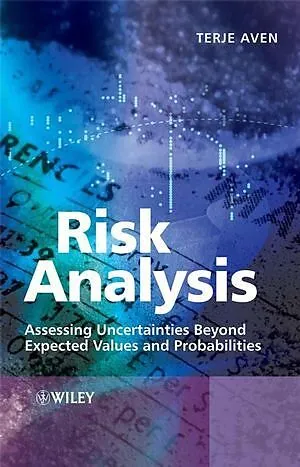
Risk Analysis
Beschreibung
In order to successfully develop such a systematic use of information, those analyzing the risk need to understand the fundamental concepts of risk analysis and be proficient in a variety of methods and techniques. Risk Analysis adopts a practical, predictive ...Format auswählen
- Fester EinbandCHF 126.00
Wird oft zusammen gekauft
Andere Kunden kauften auch
Beschreibung
In order to successfully develop such a systematic use of information, those analyzing the risk need to understand the fundamental concepts of risk analysis and be proficient in a variety of methods and techniques. Risk Analysis adopts a practical, predictive approach and guides the reader through a number of applications. It features many real-life case studies from a variety of applications and practical industry problems, including areas such as security, business and economy, transport, oil and gas, and ICT (Information and Communication Technology).
Autorentext
Terje Aven is Professor of risk analysis and risk management at the University of Stavanger, and a Principle Researcher at the International Research Institute of Stavanger (IRIS). Having worked in both industry and academia, he has participated in, and led, many safety and risk related projects, winning several awards for both research and teaching. He has published numerous papers in international journals, and has authored several books.
Klappentext
Everyday we face decisions that carry an element of risk and uncertainty. The ability to analyze, predict, and prepare for the level of risk entailed by these decisions is, therefore, one of the most constant and vital skills needed for analysts, scientists and managers. Risk analysis can be defined as a systematic use of information to identify hazards, threats and opportunities, as well as their causes and consequences, and then express risk. In order to successfully develop such a systematic use of information, those analyzing the risk need to understand the fundamental concepts of risk analysis and be proficient in a variety of methods and techniques. Risk Analysis adopts a practical, predictive approach and guides the reader through a number of applications.
- Provides an accessible and concise guide to performing risk analysis in a wide variety of fields, with minimal prior knowledge required.
- Adopts a broad perspective on risk, with focus on predictions and highlighting uncertainties beyond expected values and probabilities, allowing a more flexible approach than traditional statistical analysis.
- Acknowledges that expected values and probabilities could produce poor predictions - surprises may occur.
- Emphasizes the planning and use of risk analyses, rather than just the risk analysis methods and techniques, including the statistical analysis tools.
- Features many real-life case studies from a variety of applications and practical industry problems, including areas such as security, business and economy, transport, oil & gas and ICT (Information and Communication Technology).
- Forms an ideal companion volume to Aven's previous Wiley text Foundations of Risk Analysis.
Professor Aven's previous book Foundations of Risk Analysis presented and discussed several risk analysis approaches and recommended a predictive approach. This new text expands upon this predictive approach, exploring further the risk analysis principles, concepts, methods and models in an applied format. This book provides a useful and practical guide to decision-making, aimed at professionals within the risk analysis and risk management field.
Zusammenfassung
Provides an accessible and concise guide to performing risk analysis in a wide variety of fields, with minimal prior knowledge required. The Predictive Approach adopts a broad perspective, discussing topics such as uncertainty assessments and subjective elements, allowing a more flexible approach than traditional statistical analysis.
Inhalt
Preface. Part I: Theory and methods.
1 What is a risk analysis?
1.1 Why risk analysis?.
1.2 Risk management.
1.2.1 Decision-making under uncertainty.
1.3 Examples: decision situations.
1.3.1 Risk analysis for a tunnel.
1.3.2 Risk analysis for an offshore installation.
1.3.3 Risk analysis related to a cash depot.
2 What is risk?
2.1 Vulnerability.
2.2 How to describe risk quantitatively.
2.2.1 Description of risk in a financial context.
2.2.2 Description of risk in a safety context.
3 The risk analysis process: planning.
3.1 Problem definition.
3.2 Selection of analysis method.
3.2.1 Checklist-based approach.
3.2.2 Risk-based approach.
4 The risk analysis process: risk assessment.
4.1 Identification of initiating events.
4.2 Cause analysis.
4.3 Consequence analysis.
4.4 Probabilities and uncertainties.
4.5 Risk picture: Risk presentation.
4.5.1 Sensitivity and robustness analyses.
4.5.2 Risk evaluation.
5 The risk analysis process: risk treatment.
5.1 Comparisons of alternatives.
5.1.1 How to assess measures?
5.2 Management review and judgement.
6 Risk analysis methods.
6.1 Coarse risk analysis.
6.2 Job safety analysis.
6.3 Failure modes and effects analysis.
6.3.1 Strengths and weaknesses of an FMEA.
6.4 Hazard and operability studies.
6.5 SWIFT.
6.6 Fault tree analysis.
6.6.1 Qualitative analysis.
6.6.2 Quantitative analysis.
6.7 Event tree analysis.
6.7.1 Barrier block diagrams.
6.8 Bayesian networks.
6.9 Monte Carlo simulation.
Part II Examples of applications.
7 Safety measures for a road tunnel.
7.1 Planning.
7.1.1 Problem definition.
7.1.2 Selection of analysis method.
7.2 Risk assessment.
7.2.1 Identification of initiating events.
7.2.2 Cause analysis.
7.2.3 Consequence analysis.
7.2.4 Risk picture.
7.3 Risk treatment.
7.3.1 Comparison of alternatives.
7.3.2 Management review and decision.
8 Risk analysis process for an offshore installation.
8.1 Planning.
8.1.1 Problem definition.
8.1.2 Selection of analysis method.
8.2 Risk analysis.
8.2.1 Hazard identification.
8.2.2 Cause analysis.
8.2.3 Consequence analysis.
8.3 Risk picture and comparison of alternatives.
8.4 Management review and judgement.
9 Production assurance.
9.1 Planning.
9.2 Risk analysis.
9.2.1 Identification of failures.
9.2.2 Cause analysis.
9.2.3 Consequence analysis.
9.3 Risk picture and comparison of alternatives.
9.4 Management review and judgement. Decision.
10 Risk analysis process for a cash depot.
10.1 Planning.
10.1.1 Problem definition.
10.1.2 Selection of analysis method.
10.2 Risk analysis.
10.2.1 Identification of hazards and threats.
10.2.2 Cause analysis.
10.2.3 Consequence analysis.
10.3 Risk picture.
10.4 Risk-reducing measures.
10.4.1 Relocation of the NOKAS facility.
10.4.2 Erection of a wall.
10.5 Management review and judgment. Decision.
10.6 Discussion.
11 Risk analysis process for municipalities.
11.1 Planning .
11.1.1 Problem definition.
11.1.2 Selection of analysis method.
11.2 Risk assessment.
11.2.1 Hazard and threat identification.
11.2.2 Cause and consequence analysis. Risk picture.
11.3 Risk treatment.
12 Risk analysis process for the entire enterprise.
12.1 Planning.
12.1.1 Problem definition.
12.1.2 Selection of analysis method.
12.2 Risk analysis.
12.2.1 Price risk.
12.2.2 Operational risk.
12.2.3 Health, Environment and Safety (HES).
12.2.4 Reputation risk.
12.3 Overall risk picture.
12.4 Risk treatment.
13 Discussion.
13.1 Risk analysis as a decision support tool.
13.2 Risk is more than the calculated probabilities and expected values.
13.3 Risk analysis has both strengths and weaknesses.
13.3.1 Precision of a risk analysis: uncertainty and sensitivity analysis.
13.3.2 Terminology.
13.3.3 Risk acceptance criteria (tolerability limits).
13.4 Reflection on approaches, methods and results.
13.5 Limitations of the causal chain approach.
13.6 Risk perspectives.
13.7 Scientific basis.
13.8 The implications of the limitations of risk assessment.
13.9 Critical systems and activities.
13.10 Conclusions.
A Probability calculus and statistics.
A.1 The meaning of a probability. …