
IHR WARENKORB IST AKTUELL LEER.
Haben Sie noch nichts passendes gefunden? Stöbern Sie durch unser komplettes Sortiment.
Oder melden Sie sich an bzw. registrieren Sie sich.
- Kostenlose Lieferung
- Kauf auf Rechnung
- Ex Libris Tiefpreis
- Filiallieferung und 650+ Abholorte
- Rabatt-Bons als Club-Mitglied
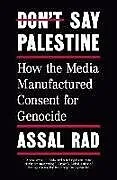
Don't Say Palestine
Beschreibung
A searing indictment of Western media that lays bare how a so-called free press, long tasked with speaking truth to power, instead became a vital part of the machinery that enabled the genocide in Palestine <If you’re not writing the truth about crim...Format auswählen
- Kartonierter EinbandCHF 21.10

Wird oft zusammen gekauft
Andere Kunden kauften auch
Beschreibung
A searing indictment of Western media that lays bare how a so-called free press, long tasked with speaking truth to power, instead became a vital part of the machinery that enabled the genocide in Palestine
<If you’re not writing the truth about crimes against humanity, you’re culpable in them.<
Human rights activist and Middle East scholar Assal Rad is known online as the "headline fixer"—with a special focus on exposing double standards in Western media, especially about Palestine. Israelis are described as "children" and "civilians," while Palestinians are "people under 18" and "collateral damage"; Israelis are <killed<; Palestinians <die.< Even in the wake of the ceasefire, major Western media continually obfuscates Israeli violence in Palestine, with the Associated Press reporting, for example, that "Gaza''s living conditions worsen as strong winds and hypothermia kill 5." <No<, Rad corrects: <Gaza''s living conditions worsen as Israel blocks aid<. And all of this is in stark contrast, Rad points out, with the highly sympathetic mainstream coverage of the Russian invasion in Ukraine, a conflict that Western media has been quick to condemn.
This pattern of dehumanizing language, DON’T SAY PALESTINE reveals, has been so consistent throughout the Palestinian genocide that it amounts to a policy. Over the past three years, headlines in outlets from CNN to Reuters to the <New York Times< have consistently downplayed Israeli responsibility, “othered” Palestinians, and called into question inviolable tenets of international law like the sanctity of hospitals and journalists in warzones. Highlighting the linguistic moves and framing devices at play and surfacing stories Western media decided not to report, Rad maps with devastating clarity mainstream media’s instrumental role in sanitizing, white-washing, and downplaying a human rights crisis.
DON’T SAY PALESTINE offers both a moral reckoning and an urgent call to action. When these years are studied, this will be the book people read to understand how "this" was allowed to happen, and the one people turn to when looking to rebuild their faith in the media....
Autorentext
ASSAL RAD is an activist, historian of the modern Middle East, and a fellow at the Arab Center Washington DC and DAWN. Her first book, The State of Resistance: Politics, Culture, and Identity in Modern Iran, was published by Cambridge University Press in 2022. Her writing has appeared in Newsweek, The National Interest, The Independent, Foreign Policy, and other publications, and she has appeared as a commentator on BBC World, Al Jazeera, CNN, NPR, and elsewhere.
Klappentext
**A searing indictment of Western media that lays bare how the "free press," long tasked with speaking truth to power, instead became a vital part of the machinery that enabled the genocide in Palestine
"In this important new work of media criticism, Rad dissects the biases, distortions, and falsehoods by which press institutions conceal the atrocities of empire—as well as delivering a powerful call for accountability, justice, and truth." —Molly Crabapple, author of Here Where We Live Is Our Country**
If you’re not writing the truth about crimes against humanity, you’re culpable in them.
Activist and Middle East historian Assal Rad is known as the “headline fixer” for her powerful posts that illustrate how mainstream Western media’s coverage of the Gaza Genocide is filled with double standards. Israelis are described as "children" and "civilians," while Palestinians are "people under 18" and "collateral damage"; Israelis are killed; Palestinians die. Even in the wake of the so-called ceasefire, major Western media continually obfuscates Israeli violence in Palestine: For example, the Associated Press reported that "Gaza's living conditions worsen as strong winds and hypothermia kill 5." No, Rad corrects: Gaza's living conditions worsen as Israel blocks aid.
In Don’t Say Palestine, Rad reveals a pattern of dehumanizing language—in outlets from CNN and the AP to the BBC and The New York Times—so consistently employed throughout the Palestinian genocide that it amounts to a policy. Mainstream Western media consistently downplays Israeli responsibility, “others” Palestinians, and casts doubt on inviolable tenets of international law like the sanctity of hospitals and journalists in war zones. This groundbreaking, eye-opening exposé offers both a moral reckoning and an urgent call to action, mapping with devastating clarity the media’s complicity in whitewashing a human rights crisis.
Leseprobe
Chapter 1
When Dehumanization Becomes Standard
I. Rationalizing Atrocities
As a society, we often reflect on historic human brutalities with dismay. Questions like “how could they let that happen?” or “how were people okay with it?” are raised in a manner that implies such cruelties would not be permissible today. Yet the world watched in horror as Israel’s most devastating assault on the besieged Gaza Strip to date unfolded with nightmarish scenes of entire neighborhoods reduced to rubble, children pulled lifeless from the debris, and parents cradling shrouded bodies too small for graves.
By January 2026, the official death toll had surpassed 71,000, the majority of whom were civilians. According to researchers, these figures significantly undercount the actual death toll in Gaza. The evidence of atrocity was not only overwhelming, it was broadcast in real time by Palestinian journalists who remained on the ground, often until they themselves were killed by Israeli forces. And yet much of the Western media refused to name what was unfolding: a genocide.
Instead, we were told this was a “war” against Hamas, a “response” to the attacks of October 7, a part of the “conflict” between Israel and Palestinians—whose land Israel has illegally occupied for decades. The headlines echoed official Israeli and U.S. talking points nearly word for word. When entire families were wiped out, the language softened the crime: Israel said it was targeting Hamas. When children starved due to deliberate aid blockages, the narrative focused on logistics, not policy. Hospitals were not obliterated; they were caught in cross fire. All the while, Palestinian lives were rendered abstract, conditional, and unworthy of the same humanity as Israeli lives.
But this is not a book seeking to prove what is known to be true and what most of the world knows to be true. This is a book about how it was allowed to happen. This book is a study in how narrative shapes reality. It is not simply about media bias. It is about the weaponization of language to justify the most heinous of crimes. It is about how a self-styled free press became complicit in silencing the truth and shielding power. It is about how the media, rather than holding those in power accountable, became a vital part of the machinery that enabled genocide. It is about how Western media manufactured consent for Israel’s genocide against Palestinians.
To understand how this happened, we must first recognize the long history of how Palestine has been framed in Western thinking—not as a nation seeking liberation and self-determination, but as a problem to be managed. For decades, Western media have largely repeated the framing of Israel as a liberal democracy defending itself, and Palestinians as either obstacles to peace or threats to be neutralized. Long before the events of October 2023, this framing laid the groundwork for what would come. Israel’s actions were always couched in the language of self-defense, no matter the scale of violence;…