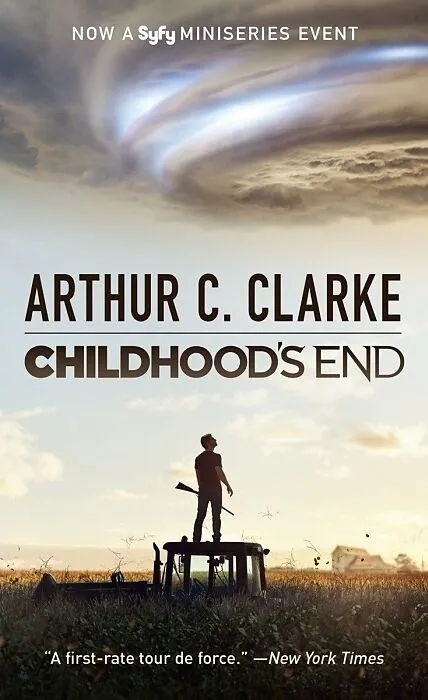
Childhood's End
Beschreibung
Zusatztext A first-rate tour de force. The New York Times Frighteningly logical! believable! and grimly prophetic . . . [Arthur C.] Clarke is a master. Los Angeles Times There has been nothing like it for years; partly for the actual invention! but partly beca...Format auswählen
- Poche format ACHF 12.20

Wird oft zusammen gekauft
Andere Kunden kauften auch
Beschreibung
Zusatztext A first-rate tour de force. The New York Times Frighteningly logical! believable! and grimly prophetic . . . [Arthur C.] Clarke is a master. Los Angeles Times There has been nothing like it for years; partly for the actual invention! but partly because here we meet a modern author who understands that there may be things that have a higher claim on humanity than its own 'survival.' C. S. Lewis As a science fiction writer! Clarke has all the essentials. Jeremy Bernstein! The New Yorker Informationen zum Autor Arthur C. Clarke Klappentext The inspiration for the Syfy miniseries. Childhood's End is one of the defining legacies of Arthur C. Clarke, the author of 2001: A Space Odyssey and many other groundbreaking works. Since its publication in 1953, this prescient novel about first contact gone wrong has come to be regarded not only as a science fiction classic but as a literary thriller of the highest order. Spaceships have suddenly appeared in the skies above every city on the planet. Inside is an intellectually, technologically, and militarily superior alien race known as the Overlords. At first, their demands seem benevolent: unify Earth, eliminate poverty, end war. But at what cost? To those who resist, it's clear that the Overlords have an agenda of their own. Has their arrival marked the end of humankind . . . or the beginning? Praise for Childhood's End "A first-rate tour de force."-The New York Times "Frighteningly logical, believable, and grimly prophetic . . . Clarke is a master."-Los Angeles Times "There has been nothing like it for years; partly for the actual invention, but partly because here we meet a modern author who understands that there may be things that have a higher claim on humanity than its own 'survival.' "-C. S. Lewis "As a science fiction writer, Clarke has all the essentials."-Jeremy Bernstein, The New YorkerThe volcano that had reared Tratua up from the Pacific depths had been sleeping now for half a million years. Yet in a little while, thought Reinhold, the island would be bathed with fires fiercer than any that had attended its birth. He glanced towards the launching site, and his gaze climbed the pyramid of scaffolding that still surrounded the Columbus. Two hundred feet above the ground, the ship's prow was catching the last rays of the descending sun. This was one of the last nights it would ever know: soon it would be floating in the eternal sunshine of space. It was quiet here beneath the palms, high up on the rocky spine of the island. The only sound from the Project was the occasional yammering of an air compressor or the faint shout of a workman. Reinhold had grown fond of these clustered palms; almost every evening he had come here to survey his little empire. It saddened him to think that they would be blasted to atoms when the Columbus rose in flame and fury to the stars. A mile beyond the reef, the James Forrestal had switched on her searchlights and was sweeping the dark waters. The sun had now vanished completely, and the swift tropical night was racing in from the east. Reinhold wondered, a little sardonically, if the carrier expected to find Russian submarines so close to shore. The thought of Russia turned his mind, as it always did, to Konrad and that morning in the cataclysmic spring of 1945. More than thirty years had passed, but the memory of those last days when the Reich was crumbling beneath the waves from the East and from the West had never faded. He could see Konrad's tired blue eyes, and the golden stubble on his chin, as they shook hands and parted in that ruined Prussian village, while the refugees streamed endlessly past. It was a parting that symbolized everything that had since happened to the worldthe cleavage between East...
ldquo;A first-rate tour de force.”—The New York Times
“Frighteningly logical, believable, and grimly prophetic . . . [Arthur C.] Clarke is a master.”—Los Angeles Times
“There has been nothing like it for years; partly for the actual invention, but partly because here we meet a modern author who understands that there may be things that have a higher claim on humanity than its own ‘survival.’ ”—C. S. Lewis
“As a science fiction writer, Clarke has all the essentials.”—Jeremy Bernstein, The New Yorker
Autorentext
Arthur C. Clarke
Klappentext
The inspiration for the Syfy miniseries.
Childhood's End is one of the defining legacies of Arthur C. Clarke, the author of 2001: A Space Odyssey and many other groundbreaking works. Since its publication in 1953, this prescient novel about first contact gone wrong has come to be regarded not only as a science fiction classic but as a literary thriller of the highest order.
Spaceships have suddenly appeared in the skies above every city on the planet. Inside is an intellectually, technologically, and militarily superior alien race known as the Overlords. At first, their demands seem benevolent: unify Earth, eliminate poverty, end war. But at what cost? To those who resist, it's clear that the Overlords have an agenda of their own. Has their arrival marked the end of humankind . . . or the beginning?
Praise for Childhood's End
"A first-rate tour de force."-The New York Times
"Frighteningly logical, believable, and grimly prophetic . . . Clarke is a master."-Los Angeles Times
"There has been nothing like it for years; partly for the actual invention, but partly because here we meet a modern author who understands that there may be things that have a higher claim on humanity than its own 'survival.' "-C. S. Lewis
"As a science fiction writer, Clarke has all the essentials."-Jeremy Bernstein, The New Yorker
Zusammenfassung
The inspiration for the Syfy miniseries.
Childhood’s End is one of the defining legacies of Arthur C. Clarke, the author of 2001: A Space Odyssey and many other groundbreaking works. Since its publication in 1953, this prescient novel about first contact gone wrong has come to be regarded not only as a science fiction classic but as a literary thriller of the highest order.
Spaceships have suddenly appeared in the skies above every city on the planet. Inside is an intellectually, technologically, and militarily superior alien race known as the Overlords. At first, their demands seem benevolent: unify Earth, eliminate poverty, end war. But at what cost? To those who resist, it’s clear that the Overlords have an agenda of their own. Has their arrival marked the end of humankind . . . or the beginning?
Praise for Childhood’s End
**
“A first-rate tour de force.”—The New York Times
“Frighteningly logical, believable, and grimly prophetic . . . Clarke is a master.”—Los Angeles Times
“There has been nothing like it for years; partly for the actual invention, but partly because here we meet a modern author who understands that there may be things that have a higher claim on humanity than its own ‘survival.’ ”—C. S. Lewis
“As a science fiction writer, Clarke has all the essentials.”—Jeremy Bernstein, The New Yorker**
Leseprobe
The volcano that had reared Tratua up from the Pacific depths had been sleeping now for half a million years. Yet in a little while, thought Reinhold, the island would be bathed with fires fiercer than any that had attended its birth. He glanced towards the launching site, and his gaze climbed the pyramid of scaffolding that still surrounded the “Columbus.” Two hundred feet above the ground, the ship’s prow was catching the last rays of the descending sun. This was one of the last nights it would ever know: so…