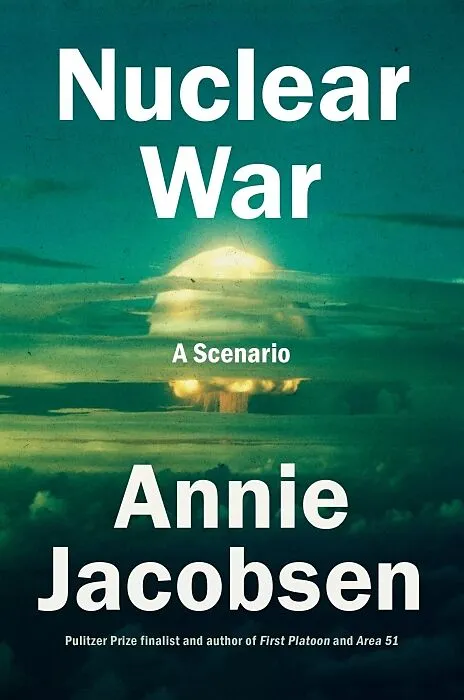
Nuclear War
Beschreibung
Informationen zum Autor Annie Jacobsen Klappentext The INSTANT New York Times bestseller Instant Los Angeles Times bestseller Finalist, Dayton Literary Peace Prize One of NPR's Books We Love One of Newsweek Staffers' Favorite Books of the Year Shortlisted for ...Format auswählen
- Fester EinbandCHF 40.70

Wird oft zusammen gekauft
Andere Kunden kauften auch
Beschreibung
Informationen zum Autor Annie Jacobsen Klappentext The INSTANT New York Times bestseller Instant Los Angeles Times bestseller Finalist, Dayton Literary Peace Prize One of NPR's Books We Love One of Newsweek Staffers' Favorite Books of the Year Shortlisted for the Baillie Gifford Prize In Nuclear War: A Scenario , Annie Jacobsen gives us a vivid picture of what could happen if our nuclear guardians failTerrifying. Wall Street Journal There is only one scenario other than an asteroid strike that could end the world as we know it in a matter of hours: nuclear war. And one of the triggers for that war would be a nuclear missile inbound toward the United States. Every generation, a journalist has looked deep into the heart of the nuclear military establishment: the technologies, the safeguards, the plans, and the risks. These investigations are vital to how we understand the world we really live inwhere one nuclear missile will beget one in return, and where the choreography of the world's end requires massive decisions made on seconds' notice with information that is only as good as the intelligence we have. Pulitzer Prize finalist Annie Jacobsen's Nuclear War: A Scenario explores this ticking-clock scenario, based on dozens of exclusive new interviews with military and civilian experts who have built the weapons, have been privy to the response plans, and have been responsible for those decisions should they have needed to be made. Nuclear War: A Scenario examines the handful of minutes after a nuclear missile launch. It is essential reading, and unlike any other book in its depth and urgency. Leseprobe PROLOGUE Hell on Earth Washington, D.C., Possibly Sometime in the Near Future A 1-megaton thermonuclear weapon detonation begins with a flash of light and heat so tremendous it is impossible for the human mind to comprehend. One hundred and eighty million degrees Fahrenheit is four or five times hotter than the temperature that occurs at the center of the Earth's sun. In the first fraction of a millisecond after this thermonuclear bomb strikes the Pentagon outside Washington, D.C., there is light. Soft X-ray light with a very short wavelength. The light superheats the surrounding air to millions of degrees, creating a massive fireball that expands at millions of miles per hour. Within a few seconds, this fireball increases to a diameter of a little more than a mile (5,700 feet across), its light and heat so intense that concrete surfaces explode, metal objects melt or evaporate, stone shatters, humans instantaneously convert into combusting carbon. The five-story, five-sided structure of the Pentagon and everything inside its 6.5 million square feet of office space explodes into superheated dust from the initial flash of light and heat, all the walls shattering with the near-simultaneous arrival of the shock wave, all 27,000 employees perishing instantly. Not a single thing in the fireball remains. Nothing. Ground zero is zeroed. Traveling at the speed of light, the radiating heat from the fireball ignites everything flammable within its line of sight several miles out in every direction. Curtains, paper, books, wood fences, people's clothing, dry leaves explode into flames and become kindling for a great firestorm that begins to consume a 100-or-more-square-mile area that, prior to this flash of light, was the beating heart of American governance and home to some 6 million people. Several hundred feet northwest of the Pentagon, all 639 acres of Arlington National Cemeteryincluding the 400,000 sets of bones and gravestones honoring the war dead, the 3,800 African American freedpeople buried in section 27, the living visitors paying respects on this early spring a...
Autorentext
Annie Jacobsen
Klappentext
The INSTANT New York Times bestseller
Instant Los Angeles Times **bestseller
Finalist, Dayton Literary Peace Prize
One of NPR's Books We Love
One of Newsweek Staffers' Favorite Books of the Year
Shortlisted for the Baillie Gifford Prize
“In Nuclear War: A Scenario, Annie Jacobsen gives us a vivid picture of what could happen if our nuclear guardians fail…Terrifying.”—Wall Street Journal
There is only one scenario other than an asteroid strike that could end the world as we know it in a matter of hours: nuclear war. And one of the triggers for that war would be a nuclear missile inbound toward the United States.
Every generation, a journalist has looked deep into the heart of the nuclear military establishment: the technologies, the safeguards, the plans, and the risks. These investigations are vital to how we understand the world we really live in—where one nuclear missile will beget one in return, and where the choreography of the world’s end requires massive decisions made on seconds’ notice with information that is only as good as the intelligence we have.
Pulitzer Prize finalist Annie Jacobsen’s Nuclear War: A Scenario explores this ticking-clock scenario, based on dozens of exclusive new interviews with military and civilian experts who have built the weapons, have been privy to the response plans, and have been responsible for those decisions should they have needed to be made. Nuclear War: A Scenario examines the handful of minutes after a nuclear missile launch. It is essential reading, and unlike any other book in its depth and urgency.
Leseprobe
PROLOGUE
Hell on Earth
Washington, D.C.,
Possibly Sometime in the Near Future
A 1-megaton thermonuclear weapon detonation begins with a flash of light and heat so tremendous it is impossible for the human mind to comprehend. One hundred and eighty million degrees Fahrenheit is four or five times hotter than the temperature that occurs at the center of the Earth’s sun.
In the first fraction of a millisecond after this thermonuclear bomb strikes the Pentagon outside Washington, D.C., there is light. Soft X-ray light with a very short wavelength. The light superheats the surrounding air to millions of degrees, creating a massive fireball that expands at millions of miles per hour. Within a few seconds, this fireball increases to a diameter of a little more than a mile (5,700 feet across), its light and heat so intense that concrete surfaces explode, metal objects melt or evaporate, stone shatters, humans instantaneously convert into combusting carbon.
The five-story, five-sided structure of the Pentagon and everything inside its 6.5 million square feet of office space explodes into superheated dust from the initial flash of light and heat, all the walls shattering with the near-simultaneous arrival of the shock wave, all 27,000 employees perishing instantly.
Not a single thing in the fireball remains.
Nothing.
Ground zero is zeroed.
Traveling at the speed of light, the radiating heat from the fireball ignites everything flammable within its line of sight several miles out in every direction. Curtains, paper, books, wood
fences, people’s clothing, dry leaves explode into flames and become kindling for a great firestorm that begins to consume a 100-or-more-square-mile area that, prior to this flash of light, was the beating heart of American governance and home to some 6
million people.
Several hundred feet northwest of the Pentagon, all 639 acres of Arlington National Cemetery—including the 400,000 sets of bones and gravestones honoring the war dead, the 3,800 African
American freedpeople buried in section 27, the living visitors paying respects on this early spring afternoon, the groundskeepers mowing the lawns, the arborists tending to the trees, the tour
guides touring, the white-gloved members of the Old Guard keeping watch over the Tomb of the Unknowns—are instantly transformed into combusting and charred human figurines. Into black
organic-matter powder…