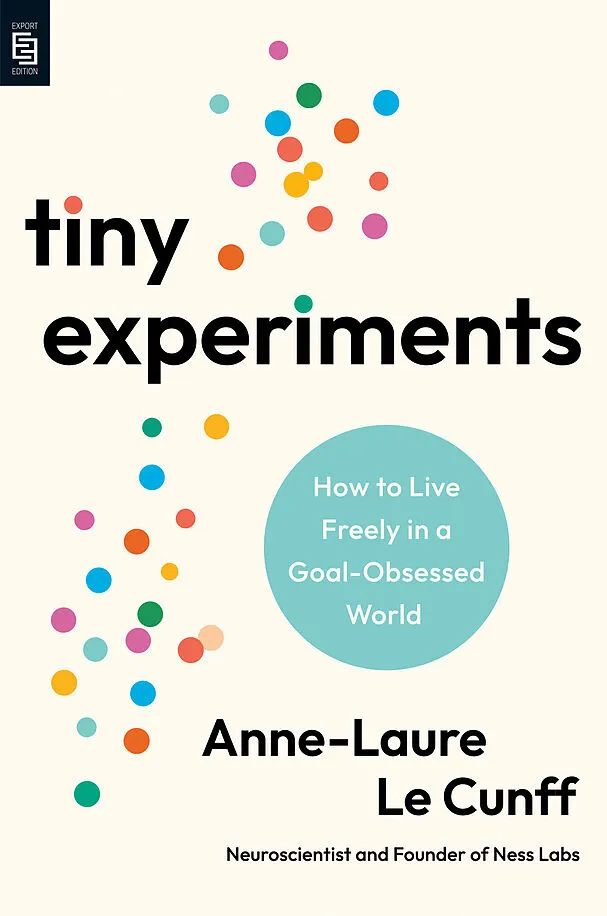
Tiny Experiments
Beschreibung
A transformative guide to rethinking our approach to goals, creativity, and life itself from a neuroscientist and entrepreneur, and the creator of the popular Ness Labs newsletter Life isn’t linear, and yet we constantly try to mold it around linear goal...Format auswählen
- Kartonierter EinbandCHF 20.30

Wird oft zusammen gekauft
Andere Kunden kauften auch
Beschreibung
A transformative guide to rethinking our approach to goals, creativity, and life itself from a neuroscientist and entrepreneur, and the creator of the popular Ness Labs newsletter Life isn’t linear, and yet we constantly try to mold it around linear goals: four-year college degrees, ten-year career plans, thirty-year mortgages. What if instead we approached life as a giant playground for experimentation? Based on ancestral philosophy and the latest scientific research, Neuroscientist and entrepreneur Anne-Laure Le Cunff reveals that all you need is an experimental mindset to turn challenges into self-discovery and doubt into opportunity. Readers will replace the old linear model of success with a circular model of growth in which goals are discovered, pursued, and adapted--not in a vacuum, but in conversation with the larger world. Throughout the book, you will ask hard questions and design simple yet meaningful experiments to find the answers. You will learn how to break free from the invisible cognitive scripts that shape your life, how to harness the power of imperfection, and how to make smarter decisions when the path forward is unclear. This is a guide to: • Discover your true ambitions through conducting tiny personal experiments • Dismantle harmful beliefs about success that have kept you stuck • Dare to make decisions true to your own aspirations • Stop trying to find your purpose and start living instead 1
Why Goal Setting Is Broken
It was raining as the woman climbed out of her plane, her legs shaky from the long flight. She looked around, taking in the unfamiliar surroundings, unsure of where she was. She had landed in a big field with a beautiful view of woodland and water. This definitely didn't look like Paris, her intended destination. But she didn't have much time to enjoy the panorama; soon her plane was surrounded by hundreds of locals, curious to meet the famous Miss Amelia Earhart. When a farmer asked her, "Have you flown far?" she replied: "From America."
Yes, she had done it: Though technical issues with her plane and bad weather had forced her to land in Northern Ireland, she had become the first woman to fly solo across the Atlantic.
Amelia Earhart is renowned for this incredible feat, but few people know that she had made the same trip less than five years prior, albeit in very different circumstances. Then unable to make a living as a pilot, she was working as a social worker for low-income immigrants when she received a strange phone call: She could be the first woman to fly across the Atlantic, but she would not be allowed to pilot the plane-she was to be a mere passenger. The female passenger who was initially supposed to fly with them had deemed the journey too risky.
Earhart was already an experienced aviator; she could have turned down the offer and waited for a better opportunity. But she said yes and negotiated to be in charge of the logbook so she would at least have an active role. It was this first experience that allowed her to unlock the necessary resources to try to cross the Atlantic again, this time with her own plane.
Even less known are the myriad of other experiments she performed outside of aviation. Flying was expensive, so Earhart worked as a clerk for a telephone company. She ventured into portrait photography with a friend, and when that project failed, she launched a trucking business with another friend. After she became a celebrity, she designed a functional clothing line providing comfortable yet elegant pants "for the woman who lives actively." She worked as a consultant at Purdue University to support women in pursuing traditionally male careers. She also experimented in her personal life. When she married publisher George Palmer Putnam, she told him she would not be bound by "any medieval code of faithfulness" and openly took fellow aviator Gene Vidal as a lover.
And those notes she captured during her first transatlantic flight? She published them as her first book.
We are told that success is the result of extraordinary gifts or exceptional grit. But rather than some innate quality or the single-minded pursuit of a big dream, endless curiosity is what enabled Amelia Earhart to discover her path. She saw "liking to experiment" as a common thread driving her actions in life-"the something inside me that has always liked to try new things." She was sometimes scared of failing, but she embraced her fears. She was ambitious, and yet she cared about having a positive impact. She was driven, and yet she did not focus on an end goal. She considered adventure to be worthwhile in itself. All those other facets of her life-a life of fertile uncertainty-are rarely mentioned in history books, and yet it is precisely the fact that Earhart swerved many times in the course of becoming an aviator that makes her life so extraordinary. She consistently reinvented her career, questioned the status quo, and sought to elevate others as she forged her own path.
We were all born with this sense of adventure. It's in children's nature to experiment and explore the unknown. They learn first and foremost through movement, which is considered the foundational skill for developing emotional, cognitive, and social skills. Children collect and connect information by constantly scouting their environment. They try activities beyond their capabilities, they attempt to predict the effects of their actions, and they keep asking "Why?"-in fact, children ask more than a hundred questions per hour on average. By failing fast and often, they learn from every experience to propel themselves forward. Children are insatiable adventurers.
But then something changes. We are taught to perform, in both meanings of the word: to achieve specific targets whether in school or at work, but also to present ourselves in a way that conforms with societal expectations. While some manage to preserve an attitude of childlike adventure, keeping their options open, always on the lookout for hints of what may be coming, most of us cling to what we know. When we consider our professional future, we seek a legible story, one that provides the appearance of stability, with a cohesive narrative and clear steps to success. If everything goes well, we get hired to provide answers based on our expertise-not questions based on our curiosity. We begin caring about what people think of us and we project an image of confidence, focusing on self-packaging over self-improvement. We welcome anything that provides the perception of control-whether it's a productivity tool, a time management method, or a goal-setting framework.
This common shift from boundless curiosity to narrow determination is at the heart of why the traditional approach to goals keeps on letting us down; it impedes our creativity and prevents us from seeing and seizing new opportunities.
The Trap of Linear Goals
Philosophers were already discussing goal setting more than two thousand years ago. "Let all your efforts be directed to something, let it keep that end in view," advised Seneca. For Epictetus, goal setting was a matter of clarity and determination: "First say to yourself what you would be, and then do what you have to do."
In the 1960s, American psychologist Edwin Locke was inspired by the work of those ancient philosophers. His goal-setting theory set off a flurry of research into the relationship between goals and performance. One of those goal-setting frameworks, devised in the early 1980s, advocated for specific, measurable, assignable, realistic, and timely goals-which you may have heard of as SMART goals. This framework is still used to this day by thousands of companies around the world and has escaped the sphere of management to permeate the sphere of personal development.
All these approaches to goal setting are based on linear goals: they were created for controll…