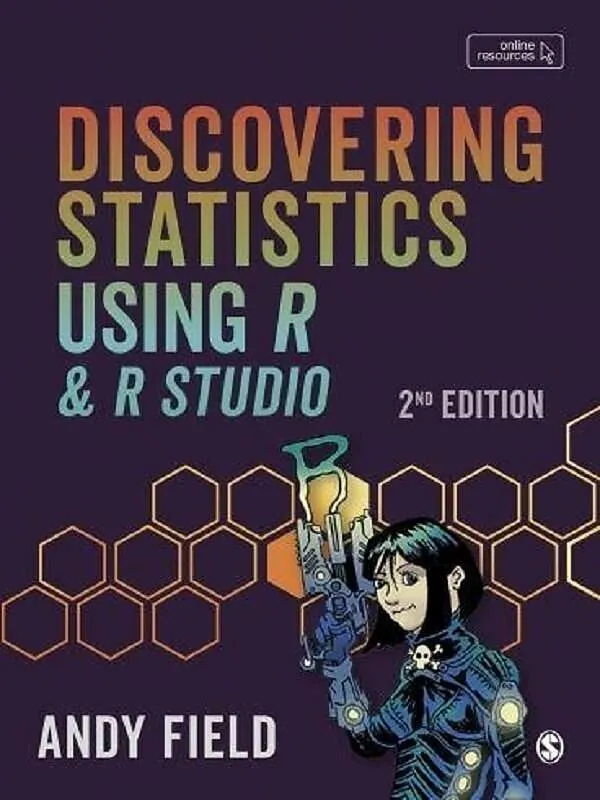
Discovering Statistics Using R and RStudio
Beschreibung
Taking you on a voyage of discovery through R and RStudio, this completely updated second edition combines real-world examples and humour with a hands-on 'how to' approach that brings statistics and programming to life.In his characteristic irreverent and enga...Format auswählen
- Kartonierter EinbandCHF 84.80
- Fester EinbandCHF 187.20

Wird oft zusammen gekauft
Andere Kunden kauften auch
Beschreibung
Taking you on a voyage of discovery through R and RStudio, this completely updated second edition combines real-world examples and humour with a hands-on 'how to' approach that brings statistics and programming to life.In his characteristic irreverent and engaging style, Andy Field takes a fun and flexible yet rigorous approach to doing statistics in a book that: Builds statistical understanding at an accessible pace, giving you the confidence to develop your statistics and programming knowledge Encourages self-testing and reflection so you can practice your new skills Offers support and resources for whatever your learning style and wherever you are on your journey via a cast of colourful characters With an exciting new look and new characters to meet, this is the go-to text for anyone in the social and behavioural sciences who wants to learn about statistics in R and R Studio.
Autorentext
Andy Field is Professor of Quantitative Methods at the University of Sussex. He has published widely (100+ research papers, 29 book chapters, and 17 books in various editions) in the areas of child anxiety and psychological methods and statistics. His current research interests focus on barriers to learning mathematics and statistics.
He is internationally known as a statistics educator. He has written several widely used statistics textbooks including Discovering Statistics Using IBM SPSS Statistics (winner of the 2007 British Psychological Society book award), Discovering Statistics Using R, and An Adventure in Statistics (shortlisted for the British Psychological Society book award, 2017; British Book Design and Production Awards, primary, secondary and tertiary education category, 2016; and the Association of Learned & Professional Society Publishers Award for innovation in publishing, 2016), which teaches statistics through a fictional narrative and uses graphic novel elements. He has also written the adventr and discovr packages for the statistics software R that teach statistics and R through interactive tutorials.
His uncontrollable enthusiasm for teaching statistics to psychologists has led to teaching awards from the University of Sussex (2001, 2015, 2016, 2018, 2019), the British Psychological Society (2006) and a prestigious UK National Teaching fellowship (2010).
Hes done the usual academic things: had grants, been on editorial boards, done lots of admin/service but he finds it tedious trying to remember this stuff. None of them matter anyway because in the unlikely event that youve ever heard of him itll be as the Stats book guy. In his spare time, he plays the drums very noisily in a heavy metal band, and walks his cocker spaniel, both of which he finds therapeutic.
Klappentext
Taking students on a journey of statistical discovery using R and R Studio, Andy Field's second edition of this popular text offers a friendly, engaging and practical resource with tools that allow students to practice and develop their skills and knowledge.
Inhalt
Chapter 1: Why Is My Evil Lecturer Forcing Me to Learn Statistics?
Chapter 2: The SPINE of statistics
Chapter 3: The phoenix of statistics
Chapter 4: ARGH! ARGH!Studio and Quarto
Chapter 5: Describing and visualizing data
Chapter 6: The beast of bias
Chapter 7: Correlation
Chapter 8: The linear model (regression)
Chapter 9: Categorical predictors: Comparing two means
Chapter 10: A tale of three Ms: Moderation, mediation, and missingness
Chapter 11: GLM 1: Comparing several independent means
Chapter 12: GLM 2: Comparing means adjusted for other predictors (analysis of covariance)
Chapter 13: GLM 3: Factorial designs
Chapter 14: GLM 4: Multilevel linear models
Chapter 15: GLM 5: Repeated-measures designs
Chapter 16: GLM 6: Mixed designs
Chapter 17: Exploratory factor analysis
Chapter 18: Categorical outcomes: chi-square and loglinear analysis
Chapter 19: Categorical outcomes: logistic regression
Chapter 20: Epilogue
Appendix
Glossary