Beschreibung
The Field Orientation Principle was fIrst formulated by Haase, in 1968, and Blaschke, in 1970. At that time, their ideas seemed impractical because of the insufficient means of implementation. However, in the early eighties, technological advances in static po...The Field Orientation Principle was fIrst formulated by Haase, in 1968, and Blaschke, in 1970. At that time, their ideas seemed impractical because of the insufficient means of implementation. However, in the early eighties, technological advances in static power converters and microprocessor-based control systems made the high-performance a. c. drive systems fully feasible. Since then, hundreds of papers dealing with various aspects of the Field Orientation Principle have appeared every year in the technical literature, and numerous commercial high-performance a. c. drives based on this principle have been developed. The term "vector control" is often used with regard to these systems. Today, it seems certain that almost all d. c. industrial drives will be ousted in the foreseeable future, to be, in major part, superseded by a. c. drive systems with vector controlled induction motors. This transition has already been taking place in industries of developed countries. Vector controlled a. c. drives have been proven capable of even better dynamic performance than d. c. drive systems, because of higher allowable speeds and shorter time constants of a. c. motors. It should be mentioned that the Field Orientation Principle can be used in control not only of induction (asynchronous) motors, but of all kinds of synchronous motors as well. Vector controlled drive systems with the so called brushless d. c. motors have found many applications in high performance drive systems, such as machine tools and industrial robots.
Klappentext
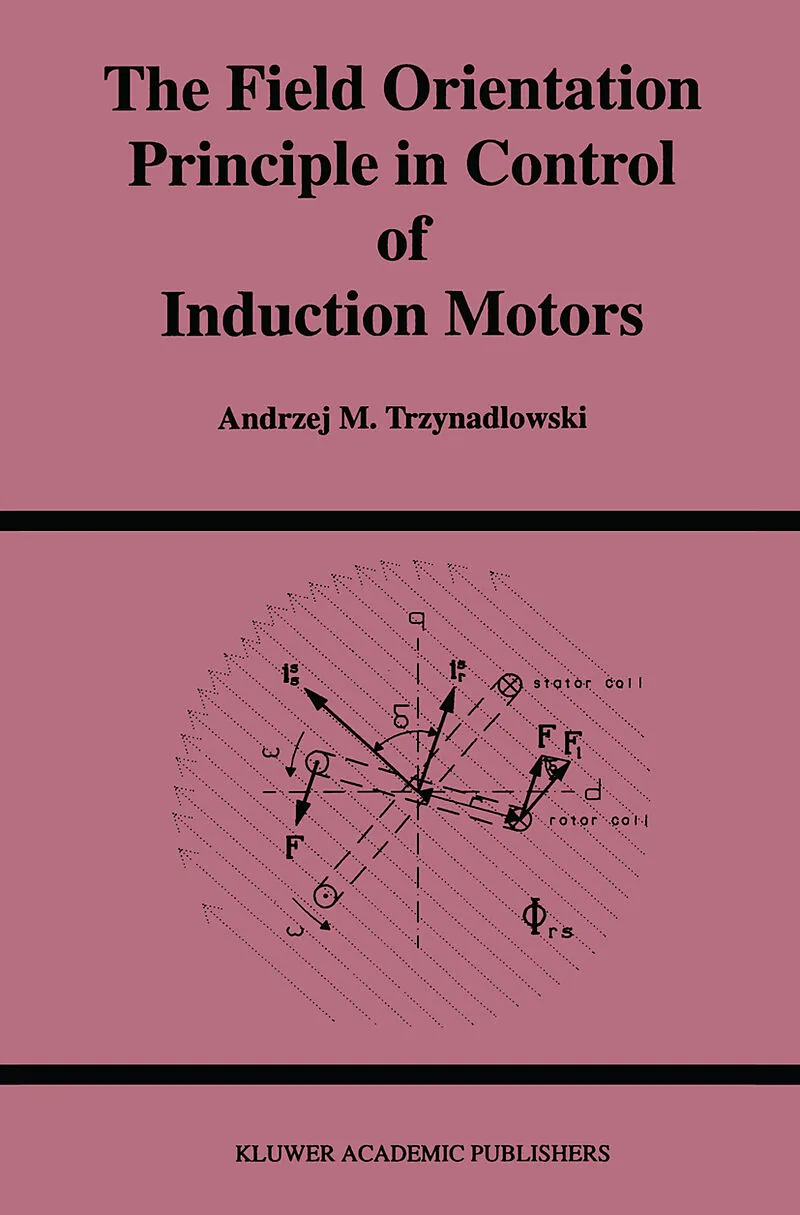
The Field Orientation Principle (FOP) constitutes a fundamental concept behind the modern technology of high-performance, vector-controlled drive systems with AC motors. The recent intense interest in these systems has been spawned by the widespread transition from DC to AC drives in industry. Induction motors, industry's traditional workhorses, are particularly well suited for FOP-based vector control. br/ emThe Field Orientation Principle in Control of Induction Motors/em presents the FOP in a simple, easy-to-understand framework based on the space-vector dynamic model of the induction machine. Relationships between the classic phasor equivalent circuits of the motor and their vector counterparts are highlighted. A step-by-step derivation of dynamic equations of the motor provides a formal background for explanation of the basic approaches to vector control. In addition, the author presents scalar control methods for low-performance drives as an intermediate stage between uncontrolled and high-performance drives. br/ The reader will also find a full chapter devoted to power inverters, which constitute an important component of adjustable speed AC drive systems, and a review of associated issues such as observers of motor variables, parameter estimation, adaptive tuning, and principles of the position and speed control of field-oriented induction motors. br/ With a wealth of numerical examples and computer simulations illustrating the ideas and techniques discussed and an extensive bibliography, emThe Field Orientation Principle in Control of/em emInduction Motors/em is a practical resource and valuable reference for researchers and students interested in motor control, power and industrial electronics, and control theory. br/
Zusammenfassung
drive systems with vector controlled induction motors. drive systems, because of higher allowable speeds and shorter time constants of a. Vector controlled drive systems with the so called brushless d. motors have found many applications in high performance drive systems, such as machine tools and industrial robots.
Inhalt
1 Dynamic Model of the Induction Motor.- 1.1 Space Vectors in Stator Reference Frame.- 1.2 Direct and Inverse Three-Phase to Stator Reference Frame Transformations.- 1.3 Voltage and Current Equations in Stator Reference Frame.- 1.4 Torque Equation.- 1.5 Dynamic Equivalent Circuit.- 1.6 Direct and Inverse Stator to Excitation Reference Frame Transformations.- 1.7 Motor Equations in Excitation Reference Frame.- 1.8 Examples and Simulations.- 2 Scalar Control of Induction Motors.- 2.1 The ? Equivalent Circuit of an Induction Motor.- 2.2 Principles of the Constant Volts/Hertz Control.- 2.3 Scalar Speed Control System.- 2.4 The ? Equivalent Circuit of an Induction Motor.- 2.5 Principles of the Torque Control.- 2.6 Scalar Torque Control System.- 2.7 Examples and Simulations.- 3 Field Orientation Principle.- 3.1 Optimal Torque Production Conditions.- 3.2 Dynamic Block Diagram of an Induction Motor in the Excitation Reference Frame.- 3.3 Field Orientation Conditions.- 4 Classic Field Orientation Schemes.- 4.1 Field Orientation with Respect to the Rotor Flux Vector.- 4.2 Direct Rotor Flux Orientation Scheme.- 4.3 Indirect Rotor Flux Orientation Scheme.- 4.4 Examples and Simulations.- 5 Inverters.- 5.1 Voltage Source Inverter.- 5.2 Voltage Control in Voltage Source Inverters.- 5.3 Current Control in Voltage Source Inverters.- 5.4 Current Source Inverter.- 5.5 Examples and Simulations.- 6 Review of Vector Control Systems.- 6.1 Systems with Stator Flux Orientation.- 6.2 Systems with Airgap Flux Orientation.- 6.3 Systems with Current Source Inverters.- 6.4 Observers for Vector Control Systems.- 6.5 Adaptive Schemes.- 6.6 Position and Speed Control of Field-Oriented Induction Motors.- 6.7 Examples and Simulations.