
IHR WARENKORB IST AKTUELL LEER.
Haben Sie noch nichts passendes gefunden? Stöbern Sie durch unser komplettes Sortiment.
Oder melden Sie sich an bzw. registrieren Sie sich.
- Kostenlose Lieferung
- Kauf auf Rechnung
- Ex Libris Tiefpreis
- Filiallieferung und 650+ Abholorte
- Rabatt-Bons als Club-Mitglied
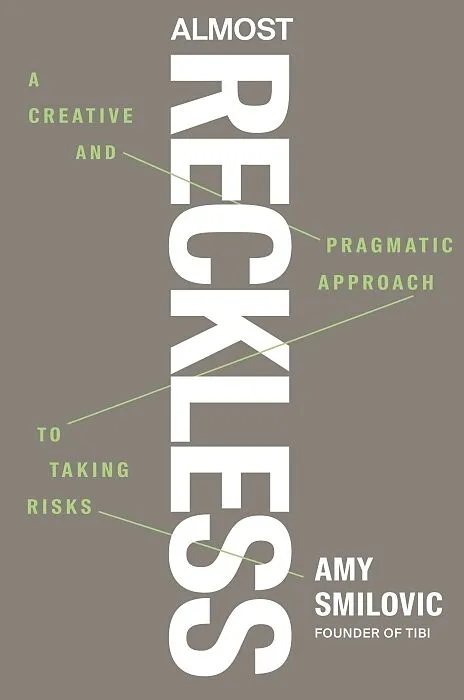
Almost Reckless
Beschreibung
The groundbreaking founder of Tibi shares her secret to taking bold risks Amy Smilovic''s fashion brand, Tibi, had been a thriving multimillion global business for almost three decades when her gut told her something was off. All was good--on paper. But Smilov...Format auswählen
- Fester EinbandCHF 33.00

Wird oft zusammen gekauft
Andere Kunden kauften auch
Beschreibung
The groundbreaking founder of Tibi shares her secret to taking bold risks Amy Smilovic''s fashion brand, Tibi, had been a thriving multimillion global business for almost three decades when her gut told her something was off. All was good--on paper. But Smilovic realized that she was achieving the industry’s idea of success, not her own. She had a choice to make--would she continue to cater to data-driven algorithms? Or could she trust herself enough to do the work she believed in, even if it meant reinventing her brand? Smilovic went with her gut. One step at a time, she made moves that looked wildly reckless to others but aligned with her core principles. She was creative. Pragmatic. And the bet paid off: her style--and, more importantly, mindset--resonated with thousands. Today Tibi is flourishing as the oldest independently owned luxury fashion brand in the US, and Smilovic has launched a movement of self-identified Creative Pragmatists. In <Almost Reckless<, Smilovic invites you to get comfortable with what she calls “the good ick” and embrace smart risks in pursuit of your own vision. Sharing her business story and drawing on her years of helping others identify their personal style, she teaches you to hone your gut--and your trust in it--through rigorous definition of your core principles. With humor and practicality, she coaches you in how to determine which success metrics are right for you and how to ignore the algorithm that tells you to do the opposite of what you know is best. For you.
Autorentext
Amy Smilovic
Klappentext
“Almost Reckless is not just a book, it's a permission slip. It's about the courage it takes to step off the algorithm's path, the clarity that comes from defining your own principles, and the joy of building something that feels unmistakably yours.” —Will Guidara, bestselling author of Unreasonable Hospitality
Amy Smilovic's cult fashion brand, Tibi, was a thriving $70 million business when she realized she was working toward someone else's idea of success. So she threw out the rulebook of how things should be done and went with her gut instead.
Today Tibi is more successful than ever, and all on Smilovic's groundbreaking entrepreneurial terms.
In Almost Reckless, she invites you to get comfortable with embracing smart risks in pursuit of your own vision. Sharing her story and drawing on her years of helping others identify their values and principles, Smilovic teaches you to hone your gut, and your trust in it.
With humor and practicality she coaches you in how to determine what success means to you, including:
- why you don’t have to listen to the data guys
- why you should be a Creative Pragmatist
- why sticking to your principles isn’t incompatible with success
- why work/life balance is bullshit
Almost Reckless is the essential blueprint for entrepreneurs, leaders, creatives, and anyone who wants a working life that feels aligned with who they truly are.
Leseprobe
Chapter 1
Running Toward Something
Recently, I put out a question to my followers on social media: What risks would you take if you knew it would all work out?
The responses were varied. People would quit jobs, start new businesses, ask for promotions, even move to faraway countries.
I then asked a follow-up question: What does "all work out" mean to you?
The answers had resounding consensus: They all assigned a numerical value. Interesting.
Around the same time, I'd done a few interviews on my (Almost) Reckless podcast with highly successful entrepreneurs who'd taken dramatically different paths. Every single one of them said frequently that they framed their decisions, their appetite for risk, against their "breakeven." That number didn't assure them that the future decisions were right and would guarantee they would flourish, but they understood where the line was drawn-the worst that could go wrong-and not to cross it.
For them, knowing it would all work out meant knowing first how to define what it means to not work out. But this break-even number, while important for a business, only tells you what failure is. It doesn't help you understand what you're running toward. And if we don't know that, it's hard for us to know when we've arrived.
In order to do big things, understand truly how much you're willing to risk, you must first figure out for yourself: What does it mean to all work out? There's a problem with setting a number as your goal, though. Numbers are a moving target, a form of measurement that, just like international currency, can be quickly devalued. Today's quest for $3 million may be tomorrow's inflation-adjusted quest for $5 million.
Ultimately, you need to drill down to the very core of who you are to know what happiness and contentment look like for you. To define how you want to be. You need to know your principles, using them as the measuring stick for making bold decisions or simply giving your gut permission to lead the way.
It's your gut check, defined not as a rumbling feeling but in real words.
Your principles give you permission to gauge success for yourself, to see industry standards as immaterial. They give you freedom to think about possibility. They're what help you logically and, ultimately, help you intuitively understand the next steps that are right. For you.
Eventually, for Tibi, we identified three principles that, if adhered to without fail, would ensure that we were on the path to contentment. The financial breakeven was done, of course. That's our line in the sand. (More about that later.) But the principles are what keep the guardrails in place for moving in the right direction. They are the assurance that moving off path and taking steps that are wildly different from those of our industry peers is part of a bigger plan.
I can't tell you what your principles are (and if you think I can, then you're misunderstanding the premise of this book). But I can tell you mine, and how they got that way.
Different and Better
"Pack up the gerbils and the kids, we're moving south."
I'm not sure that this is exactly how that conversation went, but that's what my parents did. At the time, my sister and I were six and eight, and we lived outside Chicago. My dad was working in my uncle's psychiatry practice in Oak Brook and took weekend and evening shifts at emergency services in a mental health center in a city hospital, and Mom was a teacher at one of the local schools. We had a small two-bedroom apartment; my sister and I had bunk beds, and we'd tie a rope around the top bunk to reenact scenes from Batman. I was Bruce Wayne, and my little sister had to be Robin the sidekick; as the elder, I gave her no choice.
Life was just fine. If Mom was really tired, we got to eat Taco Bell after ballet class, and I had found out that by lifting up the sod around the common areas of our apartment, you could find lots of earthworms. I could sell the worms to other kids for fishing, for unregulated scientific experiments, or just as pets.
Why in the world would my parents want to leave this slice of heaven?
My grandmother was sobbing, hearing the news. How could we do this? We were close enough to my grandparents' home in Indiana for a Sunday lunch or two. My cousins were one town over. "Why would you leave us? Don't you love your sister?" Grandma asked my dad. "Yeah, why don't you love me?" my dad's sister asked.
My dad explained. He and my mom weren't running from something; they were running toward something.
My parents shared a common sentiment: They felt their happiest, their most content, in the time spent with each other and their kids. Time was measured in the activities my parents loved doing, like the weekends fishing at Bill's lake. My grandparents' little fishing shack there had a …