
IHR WARENKORB IST AKTUELL LEER.
Haben Sie noch nichts passendes gefunden? Stöbern Sie durch unser komplettes Sortiment.
Oder melden Sie sich an bzw. registrieren Sie sich.
- Kostenlose Lieferung
- Kauf auf Rechnung
- Ex Libris Tiefpreis
- Filiallieferung und 650+ Abholorte
- Rabatt-Bons als Club-Mitglied
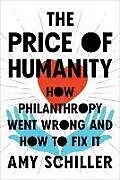
The Price of Humanity
Beschreibung
Informationen zum Autor Amy Schiller is a journalist, academic, and consultant. She is currently a postdoctoral fellow at Dartmouth College in the Society of Fellows. She previously held fellowships at Stanford University and Bard College. Her writing has been...Format auswählen
- Fester EinbandCHF 33.20

Wird oft zusammen gekauft
Andere Kunden kauften auch
Beschreibung
Informationen zum Autor Amy Schiller is a journalist, academic, and consultant. She is currently a postdoctoral fellow at Dartmouth College in the Society of Fellows. She previously held fellowships at Stanford University and Bard College. Her writing has been published in The Atlantic , The Washington Post , The Nation , and The Daily Beast and has been quoted as an expert on philanthropy in The New York Times , The New Yorker , Bloomberg , and Slate . She has also had a nearly 15-year career in major gift fundraising consulting. She has worked in a wide range of settings, from international humanitarian nonprofits to a major New York City dance company. Klappentext A journalist, academic and consultant evaluates the history of philanthropy, from the ideas of St. Augustine to the work of Lebron James, arguing that philanthropy can no longer be premised around basic survival and that public institutions must assume that burden so that philanthropy can support human flourishing as originally intended. Leseprobe Chapter 1: From St. Augustine to Bill and Melinda Gates Let's start with a game. Fill in the blanks: [Name] is [number] years old. A [heartwarming detail] with [endearing physical feature], [Name] suffers from [ailment]. Every day, [Name] struggles to [activity], and has to travel [distance] just to get [item]. Yet with just [small dollar amount], [Name] could get the [item] they need. For just [cents] per [unit of time], you could save [Name]'s life. This story is familiar because it's the formula for many fundraising appeals. I know this formula because designing fundraising campaigns is one of the things I do for a living. The details may change from Bolivia to Uganda, from hunger to malaria, from a young child to a devoted mother, but the structurethe beatsremain the same. The formulaic charitable appeals are not about actual people, full human beings with complicated lives, possessing both strengths and weaknesses. Quite the opposite: the idea is to turn human beings into ciphers, uncomplicated representations of desperation and vulnerability. In turn, this flattened suffering gets broken down into a magic number, the minimum financial increment that can turn every potential donor into a lifesaving hero. The point of these appeals is not to share a person's full story, or explain the many reasons why they endure poverty and disease. The point is to show the exchange rate for generosity. At first glance, it's hard to criticize this approach. The ability to save a life is the highest ethical stakes, something anyone would want to do if given the opportunityespecially if it's relatively easy and convenient to do so. Who cares if the fundraising formula is a predictable, or its content a bit melodramatic, if it works? What kind of galaxy-brain grinch would get upset about prose style, if in the end it convinced people to give when they otherwise wouldn't? Spoiler: that would be me. I'm that galaxy-brain grinch. Deciding where and when to give money often seems like a utilitarian challenge: where will this money go farthest? How can each dollar achieve the maximum positive change in another person's life? (A frequent companion: How do I know the person asking really needs the money?) Making these calculations reduces people to their suffering, and the minimum price of alleviating it. This approach objectifies others and prevents us from perceiving their intelligence, power, and complexity. Philanthropy translates to love of humanity, but what do we mean by humanity? Is it physical life-and-death existence, or our larger capacities for imagination, creativity, cooperation, and excellence? Ancient Greek used two terms for lifezoe, which refers to biological existence, and bios, which defined life more broadly, in a way we might recognize as ...
Klappentext
A journalist, academic and consultant evaluates the history of philanthropy, from the ideas of St. Augustine to the work of Lebron James, arguing that philanthropy can no longer be premised around basic survival and that public institutions must assume that burden so that philanthropy can support human flourishing as originally intended.
Zusammenfassung
**"[Schiller] memorably chronicles why philanthropy is important, how it became flawed and what can be done to transform it for the greater good." — Tobias Carroll, InsideHook
An attempt to rescue philanthropy from its progressive decline into vanity projects that drive wealth inequality, so that it may support human flourishing as originally intended.**
The word “philanthropy” today makes people think big money—Bill and Melinda Gates, Warren Buffet, and Andrew Carnegie come to mind. The scope of suffering in the world seems to demand an industry of giving, and yet for all the billions that are dispensed, the wealthy never seem to lose any of their money and nothing seems to change.
Journalist, academic and consultant Amy Schiller shows how we get out of this stalemate by evaluating the history of philanthropy from the ideas of St. Augustine to the work of Lebron James. She argues philanthropy’s contemporary tendency to maintain obscene inequality and reduce every cause to dehumanizing technocratic terms is unacceptable, while maintaining an optimism about the soul and potential of philanthropy in principle.
For philanthropy to get back to its literal roots—the love of humanity—Schiller argues that philanthropy can no longer be premised around basic survival. Public institutions must assume that burden so that philanthropy can shift its focus to initiatives that allow us to flourish into happier, more fulfilled human beings. Philanthropy has to get out of the business of saving lives if we are to save humanity.
Leseprobe
Chapter 1: From St. Augustine to Bill and Melinda Gates
Let’s start with a game. Fill in the blanks:
[Name] is [number] years old. A [heartwarming detail] with [endearing physical feature], [Name] suffers from [ailment]. Every day, [Name] struggles to [activity], and has to travel [distance] just to get [item]. Yet with just [small dollar amount], [Name] could get the [item] they need. For just [cents] per [unit of time], you could save [Name]’s life.
This story is familiar because it’s the formula for many fundraising appeals. I know this formula because designing fundraising campaigns is one of the things I do for a living. The details may change from Bolivia to Uganda, from hunger to malaria, from a young child to a devoted mother, but the structure—the beats—remain the same.
The formulaic charitable appeals are not about actual people, full human beings with complicated lives, possessing both strengths and weaknesses. Quite the opposite: the idea is to turn human beings into ciphers, uncomplicated representations of desperation and vulnerability. In turn, this flattened suffering gets broken down into a magic number, the minimum financial increment that can turn every potential donor into a lifesaving hero.
The point of these appeals is not to share a person’s full story, or explain the many reasons why they endure poverty and disease. The point is to show the exchange rate for generosity.
At first glance, it’s hard to criticize this approach. The ability to save a life is the highest ethical stakes, something anyone would want to do if given the opportunity—especially if it’s relatively easy and convenient to do so. Who cares if the fundraising formula is a predictable, or its content a bit melodramatic, if it works? What kind of galaxy-brain grinch would get upset about prose style, if in the end it convinced people to give when they otherwise wouldn’t?
Spoiler: that would be me. I’m that galaxy-brain grinch.
Deciding where and when to give money often seems like a utilitarian challenge: where will this …