
IHR WARENKORB IST AKTUELL LEER.
Haben Sie noch nichts passendes gefunden? Stöbern Sie durch unser komplettes Sortiment.
Oder melden Sie sich an bzw. registrieren Sie sich.
- Kostenlose Lieferung
- Kauf auf Rechnung
- Ex Libris Tiefpreis
- Filiallieferung und 650+ Abholorte
- Rabatt-Bons als Club-Mitglied
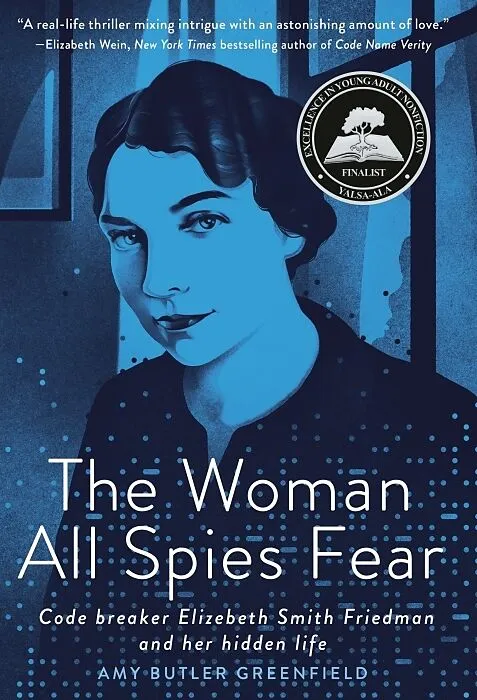
The Woman All Spies Fear
Beschreibung
“A captivating account of the life and critical contributions of 'one of the most formidable code breakers in the world.'” —Publishers Weekly, starred review “Greenfield delivers the tale with enthusiasm and narrative flair,...Format auswählen
- Fester EinbandCHF 19.30

Wird oft zusammen gekauft
Andere Kunden kauften auch
Beschreibung
“A captivating account of the life and critical contributions of 'one of the most formidable code breakers in the world.'” —Publishers Weekly, starred review
“Greenfield delivers the tale with enthusiasm and narrative flair, including lots of photos of her photogenic subject.” —The Bulletin, starred review
“Inspiring, informative, and entertaining.” —Kirkus Reviews, starred review
Autorentext
Amy Butler Greenfield
Klappentext
"Biography of Elizebeth Smith Friedman, an American woman who pioneered codebreaking in WWI and WWII but was only recently recognized for her extraordinary contributions to the field"--
Zusammenfassung
****An inspiring true story, perfect for fans of Hidden Figures, about an American woman who pioneered codebreaking in WWI and WWII but was only recently recognized for her extraordinary contributions.
A YALSA EXCELLENCE IN NONFICTION FINALIST • A KIRKUS REVIEWS BEST BOOK OF THE YEAR****
Elizebeth Smith Friedman had a rare talent for spotting patterns and solving puzzles. These skills led her to become one of the top cryptanalysts in America during both World War I and World War II.
She originally came to code breaking through her love for Shakespeare when she was hired by an eccentric millionaire to prove that Shakespeare's plays had secret messages in them. Within a year, she had learned so much about code breaking that she was a star in the making. She went on to play a major role decoding messages during WWI and WWII and also for the Coast Guard's war against smugglers.
Elizebeth and her husband, William, became the top code-breaking team in the US, and she did it all at a time when most women weren't welcome in the workforce.
Amy Butler Greenfield is an award-winning historian and novelist who aims to shed light on this female pioneer of the STEM community.
Leseprobe
Chapter One
The Doll Shop Spy
In 1942, in the middle of World War II, some strange letters came to the attention of the Federal Bureau of Investigation. They were all addressed to the same person in Argentina, and they all sounded oddly alike, yet they came from four different American women. The letters were about dolls, and they ran like this:
I have been so very busy these days, this is the first time I have been over to Seattle for weeks. I came over today to meet my son who is here from Portland on business and to get my little granddaughters doll repaired. I must tell you this amusing story, the wife of an important business associate gave her an Old German bisque Doll dressed in a Hulu Grass skirt . . .
When the FBI questioned the women who supposedly had sent the letters, the women knew nothing about them. FBI lab experts confirmed that the women’s signatures were excellent forgeries.
Someone knew these women well enough to fake their handwriting. Someone was hiding behind their names. Could it be a spy?
The FBI kept digging for clues. The four women lived in different cities and didn’t know each other, but it turned out they had something in common. All of them were long-distance customers of a doll shop at 718 Madison Avenue in New York City.
The FBI checked out the shop. Filled with pricey dolls in fancy costumes, it didn’t look like the headquarters of a spy ring. The shop’s owner, Velvalee Dickinson, appeared innocent, too. A graduate of Stanford University, she was a fifty-year-old widow who had been in the doll business since 1937. She and her late husband had once been friends with many Japanese officials, but that was before Japan and the United States had gone to war.
The FBI remained leery. They staked out the doll shop, and they examined Dickinson’s bank account and safe-deposit box. In January 1944, after they traced some of her money back to Japanese sources, they arrested her as a spy.
Dickinson fought back. Tiny, dark-haired, and delicate, she screamed and kicked, scratching at the FBI agents like a wildcat. The money had nothing to do with spies, she insisted when they questioned her. It came from her doll business and insurance payouts.
The FBI was worried. While they’d been able to connect Dickinson to the letters, they weren’t sure how to interpret them. The money trail was also murky, with no clear proof of a link to spymasters. Everything was guesswork, which wouldn’t impress anyone when the case went to trial.
One of the lawyers who had to prosecute the case was U.S. attorney Edward Wallace. He had plenty of courtroom experience, and he knew it was time to seek help. He also knew exactly who he wanted to approach--one of America’s top code breakers, Elizebeth Smith Friedman.
Like Dickinson, Elizebeth was also small, dark-haired, and college-educated, but the resemblance ended there. As a young woman, she had played a key role in code breaking during World War I. She later cracked the codes of American mobsters, smashing their crime gangs. Now, in 1944, she had a top-secret job at the Navy.
Wallace believed that if anyone could crack the Doll Woman letters, it was Elizebeth. But when he asked the FBI if he could put her onto the case, the FBI balked. It wasn’t that they doubted her skill. They had worked with her many times before, so they knew just how good she was. As they saw it, the problem was that Elizebeth was too good. They couldn’t stand the thought that the credit for catching Dickinson might go to her, and not to the FBI.
When it came down to it, however, the FBI needed a conviction. After an initial protest, they allowed Wallace to share the Doll Woman letters with Elizebeth. Luckily for them, the Navy wanted her skills to remain secret, so her name had to be kept out of the record. In case documents, she would be called “Confidential Informant T4.”
Although Elizebeth was busy tracking Nazi spies, she made time to look at the Doll Woman letters. At first, she was given very little background to go on, but even so, she made progress. Soon she was startling everyone with her insights.
As she explained to Wallace, the letters were written in what was called “open code.” This meant that ordinary sentences and phrases had been given secret meanings, agreed upon in advance. These phrases were then strung together in ways that made the letter seem more or less natural to a casual reader.
Elizebeth warned Wallace that the precise meaning of this kind of code was hard to prove. There was usually a certain amount of guesswork involved, and that would make the case a challenge to prosecute. Yet her analysis was shrewd and hard-hitting.
Take these sentences, for instance, from a Doll Woman letter dated February 22, 1942:
The only new dolls I have are three lovely Irish dolls. One of these three dolls is an old Fisherman with a Net over his back, another is an old woman with wood on her back and the third is a little boy.
Elizebeth believed that Dickinson was using “doll” to mean “ship.” The different dolls stood for different kinds of vessels. The “old Fisherman with a Net” was probably a minesweeper. The “old woman with wood on her back” might be a ship with a high upper deck. The “little boy” could be a small warship, perhaps a destroyer or torpedo boat.
Elizebeth worked out the likely meaning of many other words, too. When the letters mentioned “family,” they referred to either the Japanese fleet or other agents, depending on context. The “visit of important gentleman’s wife” was probably an “invitation to the Japanese Navy to bomb the harbor.” The phrases “Mr. Shaw” and “back to work” were a warning that the USS Shaw, a damaged destroyer, would soon be ready for action again.
Elizebeth also pinpointed phrases…