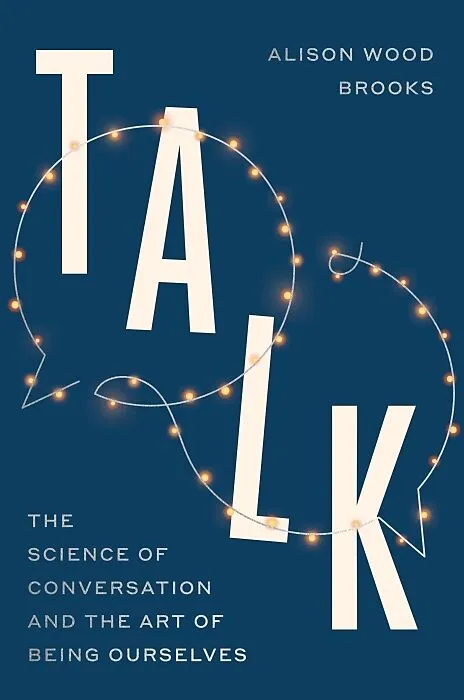
Talk
Beschreibung
A groundbreaking book about how being just a little bit better at conversation canhave a profound impact on our relationships in work and life--from a celebratedHarvard Business School;professor;and leading expert;on the psychology ofconversation We know we st...Format auswählen
- Kartonierter EinbandCHF 22.70

Wird oft zusammen gekauft
Andere Kunden kauften auch
Beschreibung
A groundbreaking book about how being just a little bit better at conversation canhave a profound impact on our relationships in work and life--from a celebratedHarvard Business School;professor;and leading expert;on the psychology ofconversation We know we struggle with difficult conversations, but we’re often not very good at the easy ones, either. Though we do it all the time, Harvard professor Alison Wood Brooks argues that conversation is one of the most complex, demanding, and delicate of all human tasks, rife with the possibility of misinterpreting and misunderstanding. And yet conversations can also be a source of great joy, each one offering an opportunity to express who we are and learn who others are--to feel connected, loved, and alive. In TALK Maxims: T opics: Choose topics and manage them well A sking: Ask more questions L evity: Use humor to keep conversations fizzy K indness: Prioritize their partners conversational needs Through experiments ranging across the conversational spectrum--from speed daters who ask too few questions (or too many), to future business leaders averse to topic forethought, to traffic stops that reveal the essence of kind language--Brooks reveals the hidden architecture of our conversations, giving us the confidence and the advice to approach them with more confidence, ;creativity, and compassion. Addressing our face-to-face conversations as well as those we have by phone, email, text, and social media, <Talk< is a thoughtful guide for anyone seeking to better establish and sustain their relationships. From managing our emotions and sparking creativity to navigating conflict and being more inclusive, the right conversation skills just might be the key to leading a more purposeful life....
Autorentext
Alison Wood Brooks
Klappentext
**A groundbreaking book that reveals the hidden architecture of our conversations and how even small improvements can have a profound impact on our relationships in work and life—from a celebrated Harvard Business School professor and leading expert on the psychology of conversation.
“Alison Wood Brooks brings to life the science of conversation, in which she is a world expert, with the utmost warmth, empathy, and joy.”—Angela Duckworth, #1 New York Times bestselling author of Grit**
All of us can struggle with difficult conversations, but we’re often not very good at the easy ones either. Though we do it all the time, Harvard professor Alison Wood Brooks argues that conversation is one of the most complex, demanding, and delicate of all human tasks, rife with possibilities for misinterpretation and misunderstanding. And yet conversations can also be a source of great joy, each one offering an opportunity to express who we are and learn who others are—to feel connected, loved, and alive.
In Talk, Brooks shows why conversing a little more effectively can make a big difference in the quality of our close personal relationships as well as our professional success. Drawing on the new science of conversation, Brooks distills lessons that show how we can better understand, learn from, and delight each other. The key is her TALK Maxims:
Topics: Choose topics and manage them well
Asking: Ask more questions
Levity: Use humor to keep conversations fizzy
Kindness: Prioritize their partners conversational needs
Through experiments ranging across the conversational spectrum—from speed daters who ask too few questions (or too many), to future business leaders averse to topic forethought, to traffic stops that reveal the essence of kind language—Brooks takes us inside the world of conversation, giving us the confidence and the advice to approach any interaction with more creativity and compassion.
Addressing our face-to-face conversations as well as those we have by phone, email, text, and social media, Talk is a thoughtful guide for anyone seeking to better establish and sustain their relationships. From managing our emotions and sparking creativity to navigating conflict and being more inclusive, the right conversation skills just might be the key to leading a more purposeful life.
Leseprobe
Chapter 1
The Coordination Game
Think of a conversation you had recently. What are you imagining? Domestic chitchat at home? A grid of faces on Zoom or Microsoft Teams, brainstorming? Grocery store gossip? An oozy first date? That sprawling group text chain. A catch-up with your mom. A smoke break in a greasy alley. Pillow talk. Delightfully disordered chitchat with children. A tense work meeting. Polite banter with the cashier. A sincere heart-to-heart.
All are excellent examples. These days, any back-and-forth exchange of words between two or more people counts as conversation. And not only in the soulless world of behavioral science, in which I work, but for most people, everywhere in the world. Merriam-Webster says conversation is “oral exchange of sentiments, observations, opinions, or ideas,” Wikipedia describes conversation as “interactive communication between two or more people,” and the Oxford English Dictionary defines it as “a talk, especially an informal one, between two or more people, in which news and ideas are exchanged.” Though our understanding of conversation today is pragmatic, the definition of conversation was not always so.
Three centuries ago, conversation meant something very different and quite specific (and none of the examples above would have qualified!). It was a high art, defined by elevated exchanges on high-minded topics: opera, poetry, politics, freedom. It took place between particular people—the most cultivated aristocrats and accomplished writers and thinkers of the day. For these luminaries, the art of conversation was itself a fascinating topic of conversation—it was the early days of talking about talking. What defined conversation? And what defined a great one, especially? Which nation practiced it best? This was the Age of Conversation, and almost everyone who was anyone had a view.
The philosophers and socialites who took up these questions—David Hume, Adam Smith, Jonathan Swift, Germaine de Staël, and Johann Wolfgang von Goethe, to name a few—agreed that conversation should be mutually “pleasurable” and “agreeable” for everyone involved, which meant it had no room for “strong opinions.” In her essay “The Spirit of Conversation” (1813), the celebrated Madame de Staël, who presided over one of Paris’s most glittering salons, compared conversation to music and wrote of the former: “It is a certain manner of acting upon one another, of giving mutual and instantaneous delight, of speaking the moment one thinks . . . of eliciting, at will, the electric sparks which relieve some of the excess of their vivacity, and serve to awaken others out of a state of painful apathy.”
You might be thinking, shouldn’t this emphasis on mutual pleasure go without saying? Who wants to host a gathering that only a few people will enjoy? But this seemingly obvious platitude was much less obvious back in the day. In fact, it was pointed. Conversation then meant enlightenment, sparkling and spirited intellectual exchange among people who had the quality of mind and the social graces to generate it. And, crucially, it also meant freedom from the rigid hierarchy and rituals that defined court life in an absolute monarchy. In the decades before and after the French Revolution, dissatisfaction with dynastic rule was rampant. And conversation emerged as a fresh alternative to the old world order. In the salons of Paris, where the men and women who inhabited the so-called “republic of letters” gathered, conversation was not performed for the pleasure…