
IHR WARENKORB IST AKTUELL LEER.
Haben Sie noch nichts passendes gefunden? Stöbern Sie durch unser komplettes Sortiment.
Oder melden Sie sich an bzw. registrieren Sie sich.
- Kostenlose Lieferung
- Kauf auf Rechnung
- Ex Libris Tiefpreis
- Filiallieferung und 650+ Abholorte
- Rabatt-Bons als Club-Mitglied
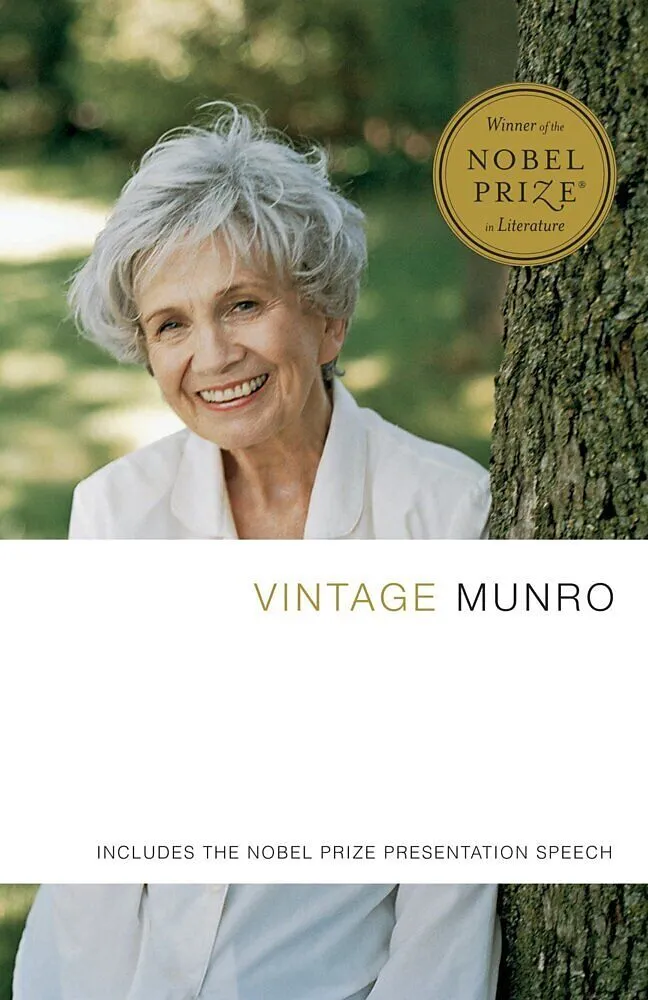
Vintage Munro: Nobel Prize Edition
Beschreibung
The updated and expanded Nobel Prize Edition of this exquisite Story collection, which includes work from the whole span of Alice Munro's venerable career. This classic collection--now revised and expanded--is the perfect introduction to Nobel Laureate Al...Format auswählen
- Kartonierter EinbandCHF 18.00

Wird oft zusammen gekauft
Andere Kunden kauften auch
Beschreibung
The updated and expanded Nobel Prize Edition of this exquisite Story collection, which includes work from the whole span of Alice Munro's venerable career.
This classic collection--now revised and expanded--is the perfect introduction to Nobel Laureate Alice Munro''s brilliant, revelatory short stories, in which she unfolds the wordless secrets that lie at the center of human experience. The stories in this volume span Munro''s career: The title stories from her collections <The Moons of Jupiter; The Progress of Love; <and <Hateship, Friendship, Courtship, Loveship, Marriage; “Differently,” <from <Friend of My Youth; “Carried Away,” <from <Open Secrets; <and (new to this edition) <"In Sight of the Lake," <from <Dear Life. Vintage Munro <also includes the text of the Nobel Prize Presentation Speech, given by Peter Englund, Permanent Secretary of the Swedish Academy.
"Alice Munro is often able to say more in 30 pages than an ordinary novelist is capable of in 300. She is a virtuoso of the elliptical . . . the master of the contemporary short story. . . . Munro, like few others, have come close to solving the greatest mystery of them all: the human heart and its caprices." —The Nobel Prize in Literature 2013 - Presentation Speech
“Her work felt revolutionary when I came to it, and it still does.” —Jhumpa Lahiri
“She is one of the handful of writers, some living, most dead, whom I have in mind when I say that fiction is my religion.” —Jonthan Franzen
“The authority she brings to the page is just lovely.” —Elizabeth Strout
“She’s the most savage writer I’ve ever read, also the most tender, the most honest, the most perceptive.” —Jeffery Eugenides
“Alice Munro can move characters through time in a way that no other writer can.”—Julian Barnes
“She is a short-story writer who…reimagined what a story can do.” —Loorie Moore
“There’s probably no one alive who’s better at the craft of the short story.” —Jim Shepard
“A true master of the form.” —Salman Rushdie
“A wonderful writer.” —Joyce Carol Oates
Autorentext
Alice Munro
Klappentext
This classic collection-now revised and expanded-is the perfect introduction to Nobel Laureate Alice Munro's brilliant, revelatory short stories, in which she unfolds the wordless secrets that lie at the center of human experience.
The stories in this volume span Munro's career: The title stories from her collections The Moons of Jupiter; The Progress of Love; and Hateship, Friendship, Courtship, Loveship, Marriage; "Differently," from Friend of My Youth; "Carried Away," from Open Secrets; and (new to this edition) "In Sight of the Lake," from Dear Life. Vintage Munro also includes the text of the Nobel Prize Presentation Speech, given by Peter Englund, Permanent Secretary of the Swedish Academy.
Zusammenfassung
Six of Nobel Prize–winning author Alice Munro’s revelatory short stories that unfold the wordless secrets that lie at the center of the human experience.
“Alice Munro is often able to say more in thirty pages than an ordinary novelist is capable of in three hundred. She is a virtuoso of the elliptical . . . the master of the contemporary short story. . . . Munro, like few others, [has] come close to solving the greatest mystery of them all: the human heart and its caprices.”—From the Presentation Speech, Nobel Prize in Literature 2013
Vintage Munro includes stories from throughout Alice Munro’s storied career: the title stories from her collections The Moons of Jupiter; The Progress of Love; and Hateship, Friendship, Courtship, Loveship, Marriage, as well as “Differently,” from Friend of My Youth; “Carried Away,” from Open Secrets; and “In Sight of the Lake” from Dear Life.
**
This edition includes the Nobel Prize Presentation Speech
Leseprobe
THE MOONS OF JUPITER
I found my father in the heart wing, on the eighth floor of Toronto General Hospital. He was in a semi-private room. The other bed was empty. He said that his hospital insurance covered only a bed in the ward, and he was worried that he might be charged extra.
"I never asked for a semi-private," he said.
I said the wards were probably full.
"No. I saw some empty beds when they were wheeling me by."
"Then it was because you had to be hooked up to that thing," I said. "Don't worry. If they're going to charge you extra, they tell you about it."
"That's likely it," he said. "They wouldn't want those doohickeys set up in the wards. I guess I'm covered for that kind of thing."
I said I was sure he was.
He had wires taped to his chest. A small screen hung over his head. On the screen a bright jagged line was continually being written. The writing was accompanied by a nervous electronic beeping. The behavior of his heart was on display. I tried to ignore it. It seemed to me that paying such close attention-in fact, dramatizing what ought to be a most secret activity-was asking for trouble. Anything exposed that way was apt to flare up and go crazy.
My father did not seem to mind. He said they had him on tranquillizers. You know, he said, the happy pills. He did seem calm and optimistic.
It had been a different story the night before. When I brought him into the hospital, to the emergency room, he had been pale and closemouthed. He had opened the car door and stood up and said quietly, "Maybe you better get me one of those wheelchairs." He used the voice he always used in a crisis. Once, our chimney caught on fire; it was on a Sunday afternoon and I was in the dining room pinning together a dress I was making. He came in and said in that same matter-of-fact, warning voice, "Janet. Do you know where there's some baking powder?" He wanted it to throw on the fire. Afterwards he said, "I guess it was your fault-sewing on Sunday."
I had to wait for over an hour in the emergency waiting room. They summoned a heart specialist who was in the hospital, a young man. He called me out into the hall and explained to me that one of the valves of my father's heart had deteriorated so badly that there ought to be an immediate operation.
I asked him what would happen otherwise.
"He'd have to stay in bed," the doctor said.
"How long?"
"Maybe three months."
"I meant, how long would he live?"
"That's what I meant, too," the doctor said.
I went to see my father. He was sitting up in bed in a curtained-off corner. "It's bad, isn't it?" he said. "Did he tell you above the valve?"
"It's not as bad as it could be," I said. Then I repeated, even exaggerated, anything hopeful the doctor had said. "You're not in any immediate danger. Your physical condition is good, otherwise."
"Otherwise," said my father, gloomily.
I was tired from the drive-all the way up to Dalgleish, to get him, and back to Toronto since noon-and worried about getting the rented car back on time, and irritated by an article I had been reading in a magazine in the waiting room. It was about another writer, a woman younger, better-looking, probably more talented than I am. I had been in England for two months and so I had not seen this article before, but it crossed my mind while I was reading that my father would have. I could hear him saying, Well, I didn't see anything about you in Maclean's. And if he had read something about me he would say, Wel…