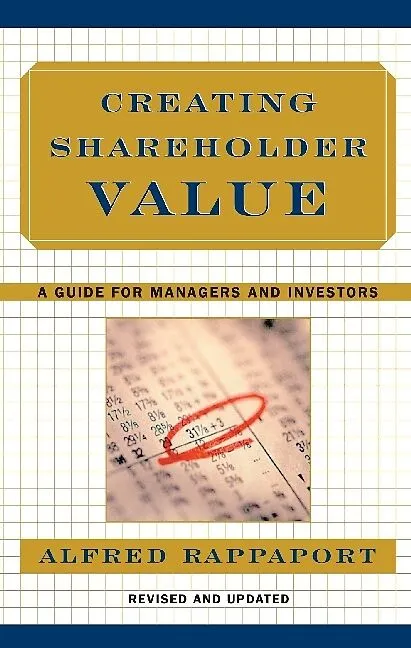
Creating Shareholder Value
Beschreibung
Zusatztext Charles W. McCall President and CEO! HBO & Company I've had the pleasure of following Al Rappaport's work for over 20 years and I feel this is his best work ever. The insights on acquisitions and the work on performance measurements are very importa...Format auswählen
- Fester EinbandCHF 43.10

Wird oft zusammen gekauft
Andere Kunden kauften auch
Beschreibung
Zusatztext Charles W. McCall President and CEO! HBO & Company I've had the pleasure of following Al Rappaport's work for over 20 years and I feel this is his best work ever. The insights on acquisitions and the work on performance measurements are very important for fast-growing companies. Al's principles have helped us grow from a market value of less than $100 million to over $7 billion in the past six years. Informationen zum Autor Dr. Alfred Happaport! the Leonard Spacek Professor Emeritus of J. L. Kellogg Graduate School of Management at Northwestern University! developed the idea for the Shareholder Scoreboard! published annually by The Wall Street Journal. He is co-founder and former Chairman of the Board of The Alcar Group Inc.! whose consulting and education practices are now part of The LEK/Alcar Consulting Group! LLC! the U.S. operation of a worldwide strategy consulting firm. He has been a guest columnist for The Wall Street Journal! The New York Times! and Business Week! and lives in La Jolla! California. Klappentext Updated and featuring a new Introduction by the author, this business classic provides definitive guidance for managers on how to select and implement the tactics that will create the most value for shareholders and businesses. Zusammenfassung Economist! consultant! and Wall Street Journal contributor Alfred Rappaport provides managers and investors with the practical tools and tests for a corporate strategy that creates shareholder value. The ultimate test of corporate strategy! the only reliable measure! is whether it creates economic value for shareholders. After a decade of downsizings frequently blamed on shareholder value decision making! this book presents a new and indepth assessment of the rationale for shareholder value. Further! Rappaport presents provocative new insights on shareholder value applications to: (1) business planning! (2) performance evaluation! (3) executive compensation! (4) mergers and acquisitions! (5) interpreting stock market signals! and (6) organizational implementation. Readers will be particularly interested in Rappaport's answers to three management performance evaluation questions: (1) What is the most appropriate measure of performance? (2) What is the most appropriate target level of performance? and (3) How should rewards be linked to performance? The recent acquisition of Duracell International by Gillette is analyzed in detail! enabling the reader to understand the critical information needed when assessing the risks and rewards of a merger from both sides of the negotiating table. The shareholder value approach presented here has been widely embraced by publicly traded as well as privately held companies worldwide. Brilliant and incisive! this is the one book that should be required reading for managers and investors who want to stay on the cutting edge of success in a highly competitive global economy. Inhaltsverzeichnis List of Illustrations Preface CHAPTER 1. SHAREHOLDER VALUE AND CORPORATE PURPOSE Management Versus Shareholder Objectives Shareholders and Stakeholders Shareholders Are "Us" CHAPTER 2. SHORTCOMINGS OF ACCOUNTING NUMBERS Earnings?An Unreliable Bottom Line The Trouble with Accounting Return on Investment (ROI) ROI Versus DCF Return Illustrated Additional Shortcomings of ROI Shortcomings of Return on Equity (ROE) CHAPTER 3. SHAREHOLDER VALUE APPROACH Estimating Shareholder Value Estimating Shareholder Value Added (SVA) Threshold Margin The Shareholder Value Network Appendix: Conventional Versus Shareholder Value Break-Even Analysis CHAPTER 4. FORMULATING STRATEGIES Strategy Formulation Process Competitive Advantage and Shareholder Value Strategy "Best Sellers" ...
Charles W. McCall* President and CEO, HBO & Company I've had the pleasure of following Al Rappaport's work for over 20 years and I feel this is his best work ever. The insights on acquisitions and the work on performance measurements are very important for fast-growing companies. Al's principles have helped us grow from a market value of less than $100 million to over $7 billion in the past six years.
Autorentext
Dr. Alfred Happaport, the Leonard Spacek Professor Emeritus of J. L. Kellogg Graduate School of Management at Northwestern University, developed the idea for the Shareholder Scoreboard, published annually by The Wall Street Journal. He is co-founder and former Chairman of the Board of The Alcar Group Inc., whose consulting and education practices are now part of The LEK/Alcar Consulting Group, LLC, the U.S. operation of a worldwide strategy consulting firm. He has been a guest columnist for The Wall Street Journal, The New York Times, and Business Week, and lives in La Jolla, California.
Klappentext
Updated and featuring a new Introduction by the author, this business classic provides definitive guidance for managers on how to select and implement the tactics that will create the most value for shareholders and businesses.
Zusammenfassung
Economist, consultant, and Wall Street Journal contributor Alfred Rappaport provides managers and investors with the practical tools and tests for a corporate strategy that creates shareholder value.
The ultimate test of corporate strategy, the only reliable measure, is whether it creates economic value for shareholders.
After a decade of downsizings frequently blamed on shareholder value decision making, this book presents a new and indepth assessment of the rationale for shareholder value. Further, Rappaport presents provocative new insights on shareholder value applications to: (1) business planning, (2) performance evaluation, (3) executive compensation, (4) mergers and acquisitions, (5) interpreting stock market signals, and (6) organizational implementation. Readers will be particularly interested in Rappaport's answers to three management performance evaluation questions: (1) What is the most appropriate measure of performance? (2) What is the most appropriate target level of performance? and (3) How should rewards be linked to performance? The recent acquisition of Duracell International by Gillette is analyzed in detail, enabling the reader to understand the critical information needed when assessing the risks and rewards of a merger from both sides of the negotiating table.
The shareholder value approach presented here has been widely embraced by publicly traded as well as privately held companies worldwide. Brilliant and incisive, this is the one book that should be required reading for managers and investors who want to stay on the cutting edge of success in a highly competitive global economy.
Leseprobe
Chapter 1
SHAREHOLDER VALUE AND CORPORATE PURPOSE
The idea that management's primary responsibility is to increase value has gained widespread acceptance in the United States since the publication of Creating Shareholder Value in 1986. With the globalization of competition and capital markets and a tidal wave of privatizations, shareholder value rapidly is capturing the attention of executives in the United Kingdom, continental Europe, Australia, and even Japan. Over the next ten years shareholder value will more than likely become the global standard for measuring business performance.
In the early 1980s there were very few companies with an unambiguous commitment to shareholder value. While many companies used piecemeal applications of the shareholder value approach, such as discounted cash-flow analysis for capital budgeting decisions and for merger-and-acquisition pricing, management thinking largely was governed by a short-term earnings orientation. The takeover movement of the latter half of the 1980s provided a powerful incentive for managers to focus on creating value. Many companies, particularly those in mature industries such as oil, allocated their very substantial excess cash flow toward uneconomic reinvestment or ill-advised diversi…