
IHR WARENKORB IST AKTUELL LEER.
Haben Sie noch nichts passendes gefunden? Stöbern Sie durch unser komplettes Sortiment.
Oder melden Sie sich an bzw. registrieren Sie sich.
- Kostenlose Lieferung
- Kauf auf Rechnung
- Ex Libris Tiefpreis
- Filiallieferung und 650+ Abholorte
- Rabatt-Bons als Club-Mitglied
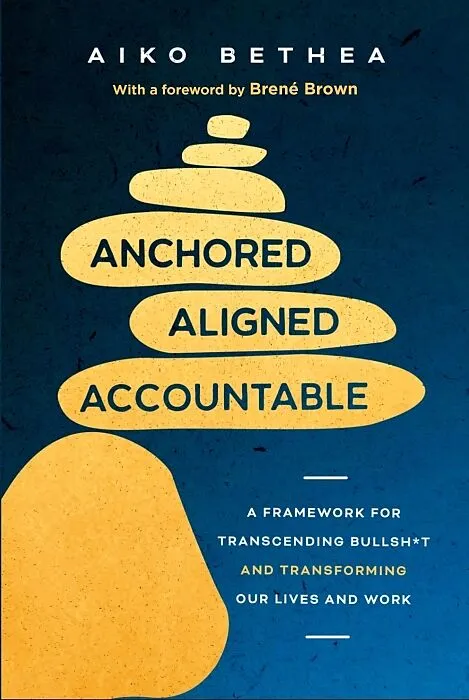
Anchored, Aligned, Accountable
Beschreibung
A bold new framework for successfully navigating complicated interactions at work and at home--by one of the first leadership coaches to infuse her work with an equity lens and propose spaces for connection that require accountability with generosity We all ha...Format auswählen
- Kartonierter EinbandCHF 19.30
- Fester EinbandCHF 28.20
- TaschenbuchCHF 30.50

Wird oft zusammen gekauft
Andere Kunden kauften auch
Beschreibung
A bold new framework for successfully navigating complicated interactions at work and at home--by one of the first leadership coaches to infuse her work with an equity lens and propose spaces for connection that require accountability with generosity We all have that moment we wish we could do over. Maybe it was a comment you made at work. Maybe a look you gave a loved one. These moments can cause real, lasting damage and they happen when we are misaligned with who we aspire to be. In this book, Aiko Bethea teaches us how live every moment intentionally by introducing the "Anchored-Aligned-Accountable" framework: Transformation requires that we are anchored in our values, our intention and impact are aligned ,;and;we are accountable to ourselves and others. Bethea has spent her life helping folks;envision and pursue;their aspirational selves, including becoming the leaders they want to be, both at work and in life. By taking the reader through real-life scenarios from her career, and situations she’s seen first-hand, Bethea shows us how to rethink the moments when we mess up as ones that offer us a choice. We can shrink away, make a halfhearted apology, and refuse to;enact changes in our approach--or we can apply a new framework and change our entire mindset and quality of life. With a warm, inviting, and witty voice, <Anchored Aligned Accountable< teaches us how to intentionally lean into our fears, as well as learn from our mistakes instead of losing our connections with others. Bethea invites us to embrace connection over competition, empathy over pity, and vulnerability over ego, and work towards becoming the version of ourselves we truly admire.
Autorentext
Aiko Bethea
Klappentext
From one of our most visionary leadership coaches comes a bold new framework for successfully navigating complicated interactions at work, at home, and in all our relationships—featuring a foreword by Brené Brown.
“Drawing on her years of coaching experience, Bethea names what is often left unspoken in our workplaces: the dynamics of power, identity, and accountability that shape our relationships.”—Prentis Hemphill, bestselling author of What It Takes to Heal
We’ve all had them—awkward interactions at work that could have gone differently, misunderstandings at home that led to avoidable blowups. But what if those uncomfortable moments could become opportunities for personal transformation?
Renowned leadership coach Aiko Bethea gives us an innovative and road-tested framework for learning to show up in any situation authentically and not as the people-pleasing or conflict-avoidant versions of ourselves that have become second nature to so many of us.
The framework lays out how to successfully navigate moments of conflict: first we must be anchored in our values and purpose, then our actions and principles must be aligned, and finally we must be accountable for our impact. With these three steps, we can remake ourselves and our connections with others, fostering constructive dialogue and creating opportunities for growth.
Throughout the book, Bethea draws on decades of real-life experience to show us the many forms that these scenarios can take, offering practical advice to help us lead from our most genuine selves and deepen relationships in every part of our lives. In doing so, she shows us how to transcend the bullshit we constantly encounter and meet each new day grounded in truth, connected to our values, and in control of not just what we do but who we become.
Leseprobe
Chapter One
Defining the Bullshit
I bet you know bullshit when you see it—even if you can’t define what it is.
I’d even bet you have your own story about how the bullshit got in your way. Maybe without even knowing that’s what was happening.
I know I do. So here’s mine.
I was in my late twenties, a new associate at a law firm, and I’d managed to take some precious time off to go to a wedding. Actually, I was in the wedding. In fact, I was maid of honor. For my sister. A once-in-a-lifetime moment, right? (And the key reason I took time off.)
So there I am on the day of the wedding, with just minutes to go before my sister Yoko walks down the aisle, and I’m standing there, bridesmaid’s dress on, makeup done, little bouquet in one hand and phone in the other. Writing out a damn work email.
Why? Because one of the firm’s partners had sent me an email. And when one of the partners reaches out to you, a mere associate? You better answer. Who cares that your sister’s getting married in T-minus 30? Did they know that I was out of office? Yes. Did they know I was at a family event and on PTO? Yes.
I still remember how keyed up I felt. My nervous system was in overdrive, everything dialed up to 200 percent. My insecurity was blaring at full blast. I need to respond. The track that was playing underneath this, as I knew I had to reply: I don’t want to be seen as someone unreliable, someone not on the fast track. I need to show that I’m dedicated and that I’m available.
But what’s a trip is that I also remember how unimportant the case in question was. Like, not just insignificant compared to my sister’s wedding. Not important, period. It was some throwaway nonsense for a small civil issue with no deadlines approaching, no serious consequences, nothing that couldn’t wait forty-eight hours for me to be back in Atlanta after my red-eye and once again at my desk.
But I was still writing the f***ing email.
I managed to wrap it up in time, get my makeup finished, and hustle into place for my MOH duties. The wedding went on perfectly smoothly, and pretty much everyone had a great time. Except me. Because even after the ceremonies and my little speech honoring the newlyweds, I was mentally occupied by . . . work stuff.
Don’t get me wrong—I was thrilled for Yoko and her husband, and more than ready to relax and cheer them on. But something was nagging at me. I didn’t quite know what, though—at that time, I had done zero self-reflection, no journaling or mantra-writing or any kind of formal soul-searching. Yet in between the champagne toasts and first dances, I still hit this moment of clarity when I couldn’t stop thinking about that damn email.
This is some bullshit.
And I immediately told myself, basically, to shut up. Stop complaining. You’re being paid more than most people. You should be grateful.
Because, to my mind, I had plenty of good reasons not to think like that. I was making over six figures in my late twenties. I was at a prestigious, competitive, name-brand firm. I got all kinds of luxe perks, like client lunches in fancy restaurants and swanky after-work receptions.
In addition, it didn’t seem like too many Black folks were coming in as associates straight out of law school, or further climbing the ladder. So yeah, I had to—had to—prove myself, prove that people like me could cut it. And opting out of practicing law impacted other folks and their narratives and sense of worth. Ask any Asian person what their parents wanted for their career: doctor or lawyer (now maybe engineer can be added to the list). I believe my mom didn’t really second-guess that my work was harassing me . . . because wasn’t there a sense of pride that this big law firm kept reaching out to her daughter?
And the law is not a profession where you can take it easy—at least, not at that level of firm. If you were an associate, you were busting your ass, because you wanted to be on track. Make partner. And once you made partner, well, …