
IHR WARENKORB IST AKTUELL LEER.
Haben Sie noch nichts passendes gefunden? Stöbern Sie durch unser komplettes Sortiment.
Oder melden Sie sich an bzw. registrieren Sie sich.
- Kostenlose Lieferung
- Kauf auf Rechnung
- Ex Libris Tiefpreis
- Filiallieferung und 650+ Abholorte
- Rabatt-Bons als Club-Mitglied
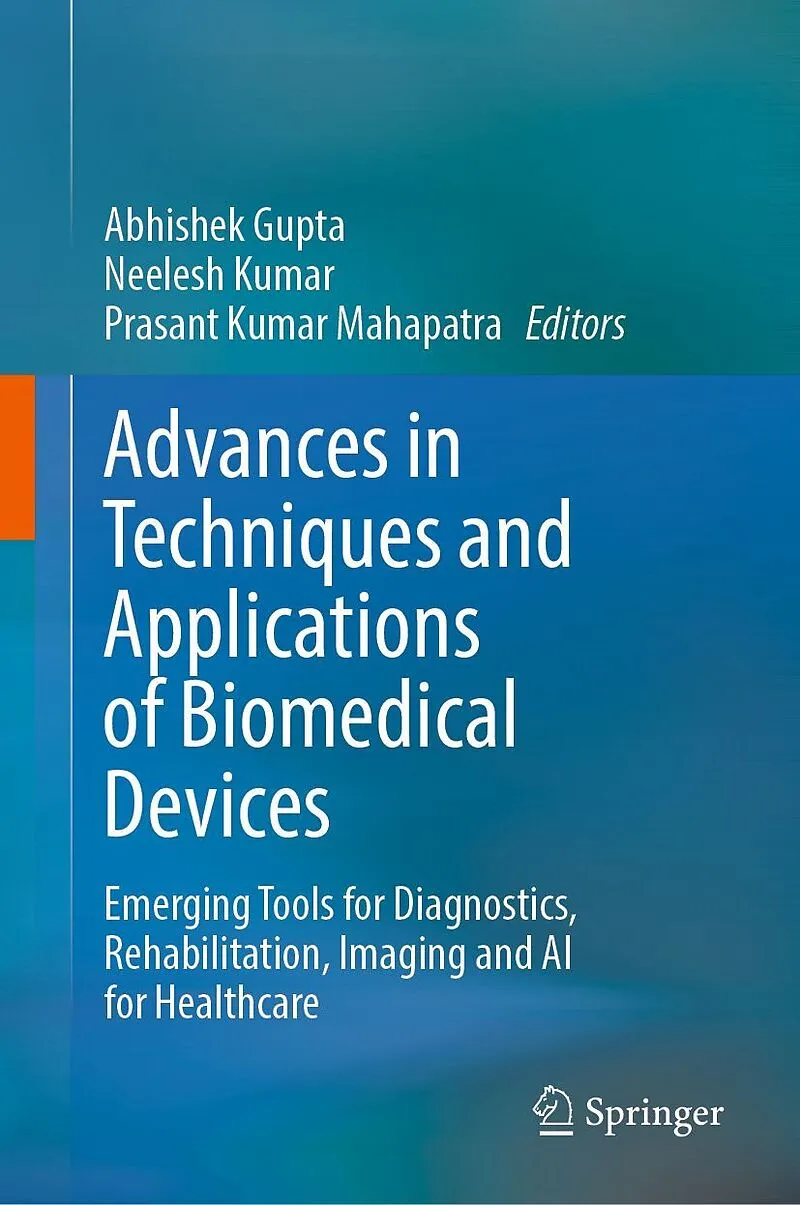
Advances in Techniques and Applications of Biomedical Devices
Beschreibung
This book presents a comprehensive overview of recent innovations in biomedical engineering, focusing on novel devices and applications. It offers insights into diagnostic, rehabilitative, and assistive technologies, alongside emerging trends in imaging, mach...
Format auswählen
- Fester EinbandCHF 156.40

Wird oft zusammen gekauft
Andere Kunden kauften auch
Beschreibung
This book presents a comprehensive overview of recent innovations in biomedical engineering, focusing on novel devices and applications. It offers insights into diagnostic, rehabilitative, and assistive technologies, alongside emerging trends in imaging, machine intelligence, and artificial intelligence for healthcare advancement.
The background of this work lies in the growing intersection of technology and healthcare. Rapid advancements in AI, IoT, and smart materials are transforming clinical practices and patient care. By compiling current developments and futuristic approaches, the book aims to educate, inspire, and guide students, researchers, and professionals in the field.
Organized into four sections, the book covers a wide range of topics. Section A explores diagnostic and therapeutic devices such as dialysis machines and photothermal therapeutics. Section B focuses on rehabilitation and assistive systems, including VR-based spinal therapy and soft exosuits. Section C delves into imaging and machine intelligence, while Section D highlights AI-driven applications for diagnostics, speech disorder recognition, and neuroimaging.
Targeted at biomedical engineers, researchers, clinicians, and postgraduate students, the book serves as both a practical guide and academic reference. It supports innovation, promotes best practices, and fosters interdisciplinary collaboration in the development of next-generation biomedical solutions.
Presents cutting-edge biomedical devices in diagnostics, rehabilitation, and assistive technologies Explores AI and machine learning applications in imaging, diagnosis, and neuro-disorder detection Provides practical insights and frameworks for developing next-gen biomedical engineering solutions
Autorentext
Dr. Abhishek Gupta is currently serving as a Senior Scientist at CSIR-Central Scientific Instruments Organisation (CSIR-CSIO), Chandigarh. His expertise lies in computational image processing, with research interests spanning medical and dental imaging, computer vision, and artificial intelligence. He holds a B.E. in Computer Engineering from Rajasthan University, an M.E. in Computer Science and Engineering from PEC University of Technology, Chandigarh, and a Ph.D. in Engineering from the Academy of Scientific and Innovative Research (AcSIR) at CSIR-CSIO. Dr. Gupta has made significant contributions in computational dentistry and holds 8 patents (India and US), with 2 US and 2 Indian patents granted. He has authored 33 SCI-indexed journal articles and numerous conference and Scopus-indexed publications. He has delivered expert talks at prestigious institutions and served as Lead Guest Editor for SCI journals published by Springer and Wiley. Currently, he is Associate Editor for Nature Scientific Reports and the Journal of Multimedia Tools and Applications. He has edited two books (Elsevier, Springer), led several government-funded projects, and mentored multiple B.Tech, M.Tech, and Ph.D. students (4 Ph.D.s awarded). He is recognized in the "World Ranking of Top 2% Scientists" (Stanford University, 2024).
Dr. Neelesh Kumar is Chief Scientist and Head of the Biomedical Applications Group at CSIR-CSIO, with over 23 years of R&D experience. He has also served as Head of Mechatronics/Electronics at the CSIO-Indo-Swiss Training Centre. He holds an M.E. in Instrumentation & Control (2005), an MBA in HRM (2006), and a Ph.D. in Gait Analysis for Prosthetic Biomechanics (2012). Additionally, he completed PG diplomas in IPR and International Business Operations. Dr. Kumar has worked on 23 nationally significant projects, including the Linear Accelerator under Jai Vigyan, FES systems, electronic knee joints, exoskeletons, and robotic gait rehabilitation devices. He established the Gait Motion Analysis (GATI) Lab in 2008 and the Cognitive and Virtual Rehabilitation (CARE) Lab in 2016 at CSIO. His expertise includes gait assessment, assistive device design, biomechanics, sensor development, and prosthetic rehabilitation. He has received several awards, including the National Awards (2012, 2019) for technological aids for the disabled, IEI Young Engineers Award (2009), IETE BV Baliga Award (2018), and Raman Research Fellowship (2013). He has 07 patents filed, 07 copyrights, 03 design rights, 63 journal papers, 70 conference papers, and 09 commercialized technologies to his credit.
Dr. Prasant Mahapatra is a Senior Principal Scientist in the Biomedical Applications Group at CSIR-CSIO, Chandigarh, with over 20 years of research experience. His areas of expertise include biomedical computing, soft computing, machine vision, image processing, and thermography for musculoskeletal disorders. He has led and contributed to several national and international projects as Principal Investigator and collaborator. Dr. Mahapatra has developed four technologies, with three transferred to industries, and holds one patent. He is a Fellow of IETE and IE (India) and a Senior Member of IEEE. He has been awarded national and international fellowships, including the INSA Fellowship and ICMR-DHR International Fellowship for Senior Biomedical Scientists (2023). Dr. Mahapatra has published numerous SCI journal articles and has guided several Ph.D. students in biomedical and computational imaging domains.
Inhalt
Part I. Diagnostics and Therapeutic Devices.- Chapter 1. Kidney Dialysis Machine for Renal Replacement Therapy.- Chapter 2. Plasmonic photothermal therapeutics.- Chapter 3. Point-of-Care Devices: Revolutionizing Diagnostics and Care.- Chapter 4. Ballistocardiography: Rediscovering a Lost Cardiovascular Diagnostic Tool.- Part II. Rehabilitation and Assistive Devices.- Chapter 5. Neurophysiological and Motor Recovery in Spinal Cord Injury through VR-Based Rehabilitation.- Chapter 6. Role of Infrared Thermography in Rehabilitation Robots.- Chapter 7. Recent Advances in Machine Learning based Control Approaches for Neuro-Motor Assistive Devices.- Chapter 8. From Material to Motion: A Research Framework for Gait Assistance Using Low-Pressure PAM-Actuated Soft Exosuit.- Part III. Imaging and machine intelligence based Applications.- Chapter 9. Volumetric Reconstruction from Biplane 2D X-rays: Methods and Clinical Applications.- Chapter 10. Virtual reality design and simulation of endoscopic surgery.- Chapter 11. Detecting Major Depressive Disorder in Obstructive Sleep Apnea Patients Using Cardiac Signals: Challenges and Opportunities.- Chapter 12. Heart Disease Prediction Through Machine Learning and Ensemble Models.- Part IV. Artificial intelligence for biomedical Applications.- Chapter 13. Automated Recognition of Speech Fluency Disorders.- Chapter 14. Early Detection of Mobility Impairments during task-specific conditions.- Chapter 15. Deep Learning in Biomedical Applications: Pixels to Neurons.- Chapter 16. MRI-Based Binary Classification of Anxiety Disorder Using Deep Learning.