
IHR WARENKORB IST AKTUELL LEER.
Haben Sie noch nichts passendes gefunden? Stöbern Sie durch unser komplettes Sortiment.
Oder melden Sie sich an bzw. registrieren Sie sich.
- Kostenlose Lieferung
- Kauf auf Rechnung
- Ex Libris Tiefpreis
- Filiallieferung und 650+ Abholorte
- Rabatt-Bons als Club-Mitglied
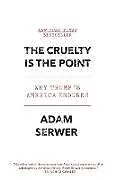
The Cruelty Is the Point
Beschreibung
Informationen zum Autor Adam Serwer has been a staff writer for the Ideas section of The Atlantic since 2016, focusing on contemporary politics, often viewed through the lens of history. He is the recipient of the 2015 Sigma Delta Chi award for commentary, the...Format auswählen
- Kartonierter EinbandCHF 21.35

Wird oft zusammen gekauft
Andere Kunden kauften auch
Beschreibung
Informationen zum Autor Adam Serwer has been a staff writer for the Ideas section of The Atlantic since 2016, focusing on contemporary politics, often viewed through the lens of history. He is the recipient of the 2015 Sigma Delta Chi award for commentary, the 2019 Salute to Excellence award for commentary from the National Association of Black Journalists, and the 2019 Hillman Prize for opinion journalism. He lives in San Antonio, Texas, with his family. Klappentext NEW YORK TIMES BESTSELLER • From an award-winning journalist at The Atlantic , these searing essays make a powerful case that real hope lies not in a sunny nostalgia for American greatness but in seeing this history plainin all of its brutality, unadorned by euphemism ( The New York Times ). NAMED ONE OF THE BEST BOOKS OF THE YEAR BY NPR • No writer better demonstrates how American dreams are so often sabotaged by American history. Adam Serwer is essential.Ta-Nehisi Coates Featuring additional elements: essays on how the Supreme Court undermines justice, and a new epilogue that connects the post-reconstruction narrative with today's political discourse To many, our most shocking political crises appear unprecedentedun-American, even. But they are not, writes The Atlantic' s Adam Serwer in this prescient essay collection, which dissects the most devastating moments in recent memory to reveal deeply entrenched dynamics, patterns as old as the country itself. The January 6 insurrection, anti-immigrant sentiment, and American authoritarianism all have historic roots that explain their continued power with or without President Donald Trumpa fact borne out by what has happened since his departure from the White House. Serwer argues that Trump is not the cause, he is a symptom. Serwer's phrase the cruelty is the point became among the most-used descriptions of Trump's era, but as this book demonstrates, it resonates across centuries. The essays here combine revelatory reporting, searing analysis, and a clarity that's bracing. In this new, expanded version of his bestselling debut, Serwer elegantly dissects white supremacy's profound influence on our political system, looking at the persistence of the Lost Cause, the past and present of police unions, the mythology of migration, and the many faces of anti-Semitism. In so doing, he offers abundant proof that our past is present and demonstrates the devastating costs of continuing to pretend it's not. The Cruelty Is the Point dares us, the reader, to not look away. Leseprobe The Cruelty of Backlash Many people woke up on November 9, 2016, feeling like their country hated them. Donald Trump had run a campaign that, from its inception, sought to blame those he defined as foreigners for the failures of modern society. He announced his campaign by declaring that Mexican immigrants were rapists bringing drugs and crime. He called for a total and complete shutdown of Muslims entering the United States and regaled campaign audiences with apocryphal tales of how dipping bullets in pigs' blood had helped Americans suppress a Muslim insurgency in the Philippines. He decried the war on police, calling for nationwide stop and frisk and comparing black American neighborhoods unfavorably to war zones. Every one of these problems, Trump assured his supporters, could be solved with the ruthless application of state force: arrest, execution, exclusion, or expulsion. And then just short of a majority of 2016 voters, more than 60 million people, decided to put him in charge of the country. If you were part of, or related to, one of the groups Trump targeted so effectively, you woke up on November 9 with the knowledge that some, perhaps many, of your work colleagues, perhaps your friends and family members, chose a man who promised to use the violence of the...
Autorentext
Adam Serwer has been a staff writer for the Ideas section of The Atlantic since 2016, focusing on contemporary politics, often viewed through the lens of history. He is the recipient of the 2015 Sigma Delta Chi award for commentary, the 2019 Salute to Excellence award for commentary from the National Association of Black Journalists, and the 2019 Hillman Prize for opinion journalism. He lives in San Antonio, Texas, with his family.
Klappentext
NEW YORK TIMES BESTSELLER • From an award-winning journalist at The Atlantic, these searing essays make a powerful case that “real hope lies not in a sunny nostalgia for American greatness but in seeing this history plain—in all of its brutality, unadorned by euphemism” (The New York Times).
**
NAMED ONE OF THE BEST BOOKS OF THE YEAR BY NPR • “No writer better demonstrates how American dreams are so often sabotaged by American history. Adam Serwer is essential.”—Ta-Nehisi Coates**
Featuring additional elements: essays on how the Supreme Court undermines justice, and a new epilogue that connects the post-reconstruction narrative with today’s political discourse
To many, our most shocking political crises appear unprecedented—un-American, even. But they are not, writes *The Atlantic’*s Adam Serwer in this prescient essay collection, which dissects the most devastating moments in recent memory to reveal deeply entrenched dynamics, patterns as old as the country itself. The January 6 insurrection, anti-immigrant sentiment, and American authoritarianism all have historic roots that explain their continued power with or without President Donald Trump—a fact borne out by what has happened since his departure from the White House.
Serwer argues that Trump is not the cause, he is a symptom. Serwer’s phrase “the cruelty is the point” became among the most-used descriptions of Trump’s era, but as this book demonstrates, it resonates across centuries. The essays here combine revelatory reporting, searing analysis, and a clarity that’s bracing. In this new, expanded version of his bestselling debut, Serwer elegantly dissects white supremacy’s profound influence on our political system, looking at the persistence of the Lost Cause, the past and present of police unions, the mythology of migration, and the many faces of anti-Semitism. In so doing, he offers abundant proof that our past is present and demonstrates the devastating costs of continuing to pretend it’s not. The Cruelty Is the Point dares us, the reader, to not look away.