Beschreibung
Power engineering has become a multidisciplinary field ranging from linear algebra, electronics, signal processing to artificial intelligence including recent trends like bio-inspired computation, lateral computing and so on. In this book, Ukil builds the bri...
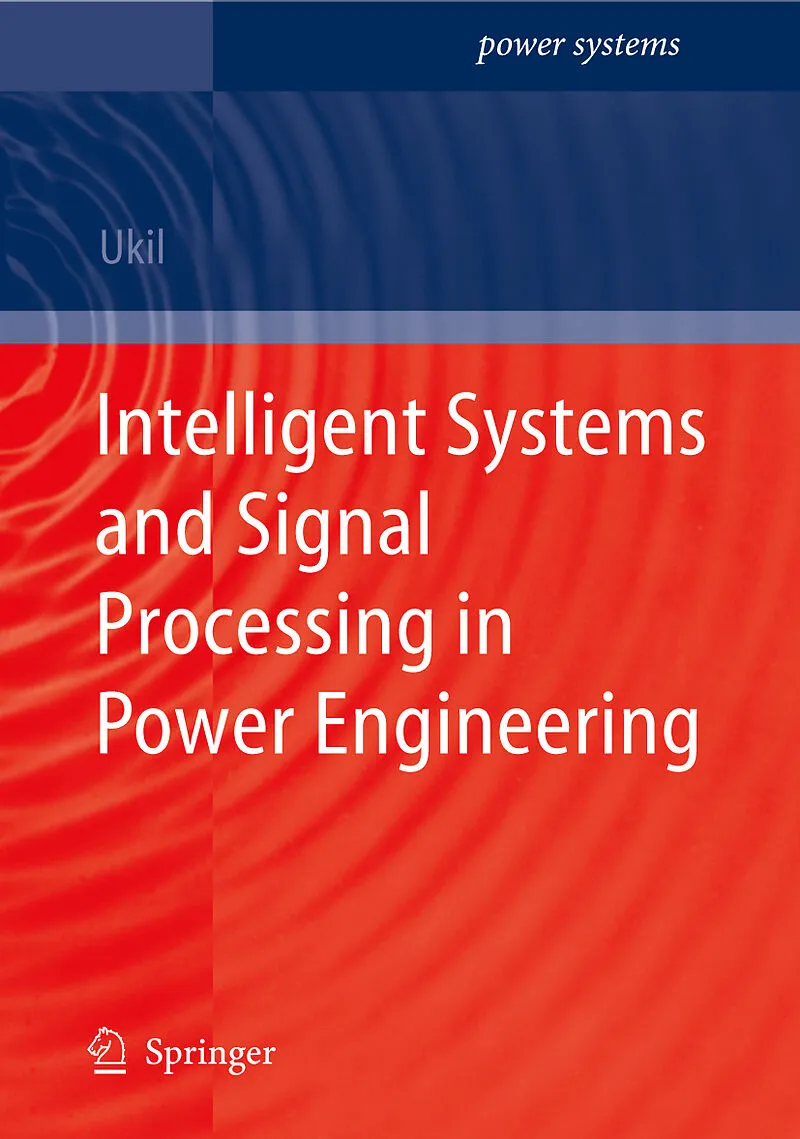
Power engineering has become a multidisciplinary field ranging from linear algebra, electronics, signal processing to artificial intelligence including recent trends like bio-inspired computation, lateral computing and so on. In this book, Ukil builds the bridge between these inter-disciplinary power engineering practices. The book looks into two major fields used in modern power systems: intelligent systems and the signal processing.
The intelligent systems section comprises of fuzzy logic, neural network and support vector machine. The author looks at relevant theories on the topics without assuming much particular background. Following the theoretical basics, he studies their applications in various problems in power engineering, like, load forecasting, phase balancing, or disturbance analysis. These application studies are of two types: full application studies explained like in-depth case-studies, and semi-developed application ideas with scope for further extension. This is followed by pointers to further research information.
In the second part, the book leads into the signal processing from the basics of the system theory, followed by fundamentals of different signal processing transforms with examples. A section follows about the sampling technique and the digital filters which are the ultimate processing tools. The theoretical basics are substantiated by some of the applications in power engineering, both in-depth and semi-developed as before. This also ends up with pointers to further research information.
Intelligent Systems and Signal Processing in Power Engineering is helpful for students, researchers and engineers, trying to solve power engineering problems using intelligent systems and signal processing, or seeking applications of intelligent systems and signal processing in power engineering.
Multi-subject theoretical reference Comprehensive guidebook for various inter-disciplinary power engineering applications and future projects Self-contained reference Includes supplementary material: sn.pub/extras
Autorentext
Abhisek Ukil received his B.Eng. degree in Electrical Engineering from Jadavpur University, Kolkata, India, in 2000, and his M.S. degree from the University of Bolton, UK, in 2004. He completed his Ph.D. degree at Pretoria (Tshwane) University of Technology, South Africa, where he worked on automated disturbance analysis in power systems, in 2006. Currently, he is an Associate Professor at the Department of Electrical, Computer and Software Engineering, University of Auckland, New Zealand. From 2013-2017, he was an Assistant Professor at the School of EEE, Nanyang Technological University, Singapore. From 2006-2013, he was Principal Scientist at the ABB Corporate Research Center, Baden-Daettwil, Switzerland. He holds 11 patents and is the author of more than 180 peer-reviewed papers, a monograph, and two book chapters. He is a Senior Member of the IEEE (USA) and a Registered Chartered Engineer (C.Eng.), UK. He is an Associate Editor of IEEE Transactions on Industrial Informatics and Electrical Engineering, published by Springer. His research interests include smart grids, DC grids, energy efficiency, renewable energy, energy storage, and condition monitoring. Yeap Yew Ming received his B.Eng. degree in Electrical Engineering from the University of Malaya, Kuala Lumpur, Malaysia, in 2013. He received his Ph.D. degree from Nanyang Technological University, Singapore, where he worked on fault detection in High-Voltage Direct Current (HVDC) systems, in 2018. Currently, he is a Scientist at the Institute for Infocomm Research (I2R), Singapore, and is leading an industry project on EV as Co-Principal Investigator. He is the author of more than 20 peer-reviewed papers, and a reviewer for the journals IEEE Transactions on Industrial Electronics and Industrial Informatics. His research interests include smart grids, DC grids, power electronics & control, and energy storage for EV. Kuntal Satpathi received his B.Tech. degree in Electrical Engineering from the Haldia Institute of Technology, India, in 2011. He received his Ph.D. degree from Nanyang Technological University, Singapore, where he worked on the operation and fault management of DC marine power systems, in 2019. From 2011-2014, he was with Jindal Power Limited, Raigarh, India, specializing in thermal power plant operations. Currently, he is a Research Fellow at Nanyang Technological University, Singapore. He is the author of nearly 20 peer-reviewed papers. His research interests include the modeling, control and protection of AC/DC grids.
Inhalt
Fuzzy Logic.- Neural Network.- Support Vector Machine.- Signal Processing.