
IHR WARENKORB IST AKTUELL LEER.
Haben Sie noch nichts passendes gefunden? Stöbern Sie durch unser komplettes Sortiment.
Oder melden Sie sich an bzw. registrieren Sie sich.
- Kostenlose Lieferung
- Kauf auf Rechnung
- Ex Libris Tiefpreis
- Filiallieferung und 650+ Abholorte
- Rabatt-Bons als Club-Mitglied
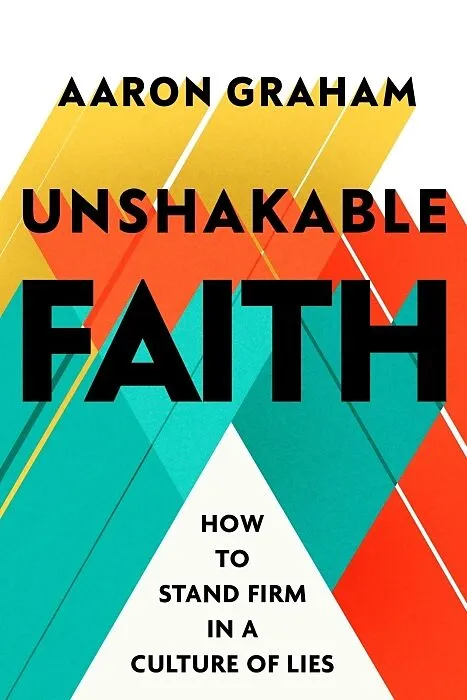
Unshakable Faith
Beschreibung
As millions walk away from faith and countless others water down biblical truth to fit cultural preferences, pastor Aaron Graham exposes seven pervasive lies threatening Christian faith today and how to maintain authentic faith without compromising conviction....Format auswählen
- Livre ReliéCHF 26.80

Wird oft zusammen gekauft
Andere Kunden kauften auch
Beschreibung
As millions walk away from faith and countless others water down biblical truth to fit cultural preferences, pastor Aaron Graham exposes seven pervasive lies threatening Christian faith today and how to maintain authentic faith without compromising conviction. Few people know exactly what to believe anymore. "Speak your truth" has overtaken "speak the Truth." Christians today find themselves torn between defending Christianity as an institution and reshaping biblical truth to fit cultural preferences. Both paths lead away from authentic faith. Graham addresses common lies Christians are confronted with today such as: Drawing from his experience as an urban pastor ministering at the intersection of faith and culture, Graham offers a better way forward: a path that holds fast to biblical truth while engaging the world with Christ-like love. Through practical wisdom and historic Christian practices, readers will discover how to discern truth from half-truth, maintain vibrant faith in a secular age, and become part of a new generation of believers who approach the world as Jesus did--with unwavering truth and unflinching love.
Autorentext
Aaron Graham
Klappentext
**Learn to recognize seven pervasive lies threatening Christian faith today—and discover how to maintain authentic faith without compromising conviction.
**
“A prophetic summons for the church in our time.”—Jon Tyson
“Feels like standing at the intersection of C. S. Lewis, John Perkins, and Tim Keller.”—Derwin L. Gray
“A road map for anyone who wants an authentic, resilient faith.”—Dharius Daniels
Many Christians feel it—but don’t know how to name it. Their faith isn’t gone, but it’s not as strong as it once was. Convictions feel harder to hold. Cultural pressure feels harder to resist. And slowly, almost imperceptibly, belief begins to drift.
You don’t want a watered-down faith. You want a faith that is real, resilient, and rooted in truth.
In Unshakable Faith, pastor and author Aaron Graham exposes the seven subtle lies reshaping Christianity from within. He shows how to build a faith that can withstand a culture of confusion without losing conviction or compassion.
Drawing from years of ministry in Washington, DC, one of the most influential and secular cities in the world, Graham brings clarity to the tension many believers feel every day: how to stay faithful to Jesus without retreating from culture or conforming to it.
He identifies the lies many Christians have come to accept:
- Faith is private
- Church is optional
- The Bible is outdated
- Enemies must be canceled
And he offers something more than critique: a way forward.
This book will help you:
- Discern how cultural lies subtly reshape your beliefs
- Rebuild your faith through time-tested Christian practices
- Stand firm in truth without becoming rigid or combative
- Engage culture with both conviction and Christlike love
- Develop a faith that not only survives but thrives
Written with pastoral honesty and cultural insight, Unshakable Faith is both a warning and a roadmap for anyone who feels their faith slipping and for those determined to see it grow stronger than ever.
This isn’t a call to fear culture. And it isn’t a call to conform to it. It’s a call to become unshakable.
Leseprobe
1
When Devotion Drifts
From Self-Centered Faith to God-Centered Worship
The best thing, where it is possible, is to keep the patient from the serious intention of praying altogether . . . the simplest is to turn their gaze away from Him towards themselves. —The Screwtape Letters, Letter 4
In 2008, I had the privilege of sitting down with Dr. James Lawson, one of the chief architects of the Civil Rights Movement.
Dr. Lawson founded the Student Nonviolent Coordinating Committee (SNCC) and championed the nonviolent protesting technique to Martin Luther King, Jr. I hung on his every word.
As we talked, he shared something that has shaped my life since: “Injustice is always justified with a big lie. The prophetic task of the church is to discern the lie and expose it.”
He explained how he, Dr. King, Ella Baker, and others used to go into communities and conduct interviews to discern the root of racial injustice in our country. The first question they would ask was:
“What is the lie most people in this community believe?”
Gradually, they uncovered the big lie at the root of racial injustice: Some people’s lives are worth more than others.
But underneath that belief was a deeper distortion—the age-old tendency to place self at the center, above others and even above God.
Self-centered faith leads to compromised worship.
Racial injustice is rooted in self-centeredness—a sinful belief that my life, my comfort, and my advancement matter more than yours. It’s the elevation of self over neighbor. And that’s why addressing it required more than policy change—it required spiritual awakening.
So, Dr. Lawson and the others began asking a second critical question in those communities: “What is the spiritual solution to that lie?”
What they discovered was both theologically profound and nationally resonant. The antidote to the big lie of racial injustice was a foundational truth—one rooted in Genesis 1 and reflected in the best ideals of the U.S. Constitution.
The truth: All people are created equal.
From the opening pages of Scripture, we see that every human being is made in the image of God—the imago Dei—and therefore carries equal worth, dignity, and value. This truth, enshrined in the Constitution, became the moral and spiritual imperative behind the Civil Rights Movement.
Pastors and organizers addressed the foundational lie by appealing to two powerful sources of authority: Scripture and the Constitution. And in doing so, they reminded the nation that true justice begins with true worship—putting God, not self, at the center.
Sin runs rampant when lies pervade. Freedom and justice reign when we overcome lies with truth.
When we planted The District Church, we followed a similar playbook. We were not just starting a weekly service; we were seeking to build a church for the city. A church that would address the real, often unspoken, spiritual lies shaping people’s lives. So we hit the streets and asked more than two hundred people two simple but revealing questions:
What is the lie most people in our city believe?
What is the spiritual solution to that lie?
What we heard back was incredibly consistent. The lie wasn’t loud or obvious—but it was everywhere. It went something like this:
You can change the world on your own.
The problem facing our church was not that people were opposed to community. But there was a pervasive sense that community was optional. That what really mattered was individual effort—earning the right degrees, building the perfect résumé, making the right connections. Then, and only then, could you make a difference.
At first, this way of thinking sounded noble. Ambitious. Even inspiring. But as we considered it more deeply, we realized the problem wasn’t just disconnection from others. The problem was a deeper spiritual drift—one that placed the self, rather than God, at the center.
That’s the danger of unexamined cultural lies: they often sound like truth. But over time, they quietly reshape what we believe about purpose, success, and even God. And if we’re not careful, they begin to inform not only how we live but…