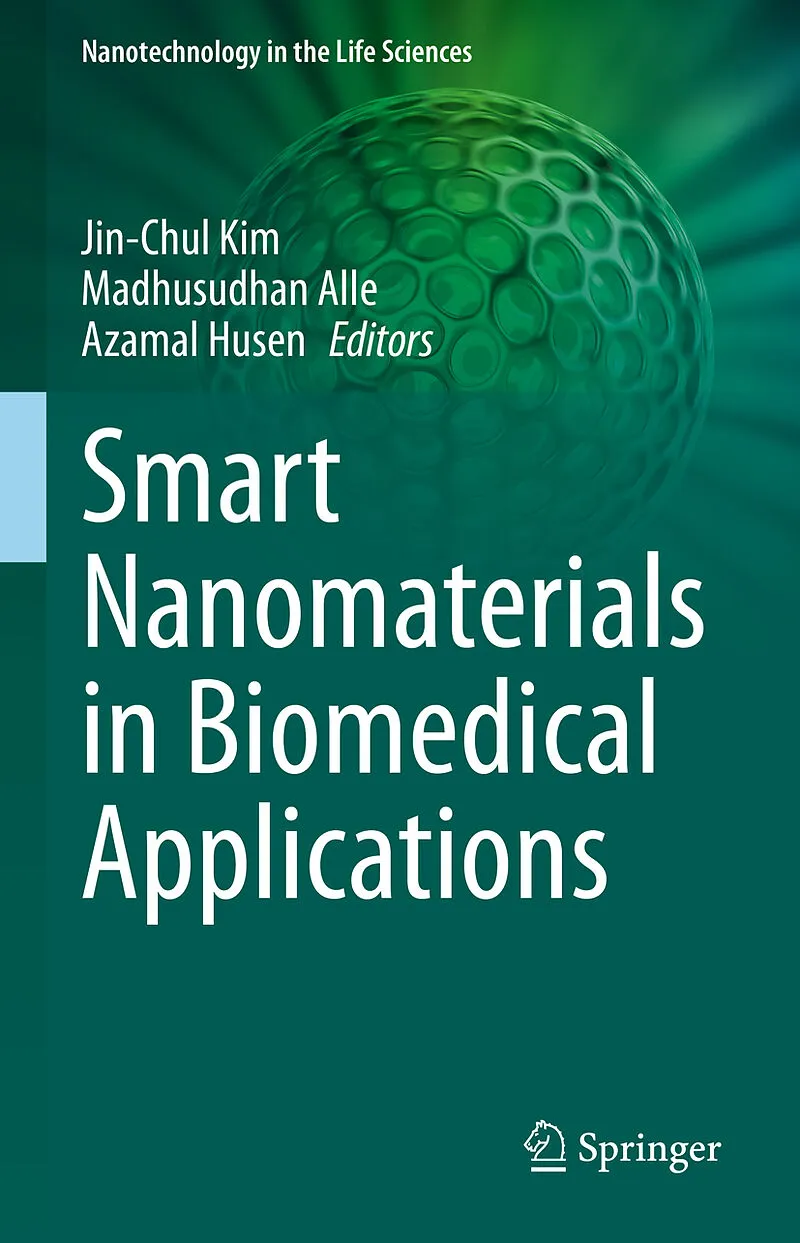
Smart Nanomaterials in Biomedical Applications
Beschreibung
With the start of 2020, the wrath of pandemic challenged the scientific community to develop more advanced drug delivery approaches for biomedical applications, endowing conventional drugs with additional therapeutic benefits and minimum side effects. Althoug...Format auswählen
- E-Book (pdf)CHF 165.90
- Fester EinbandCHF 156.40
- Kartonierter EinbandCHF 156.40

Wird oft zusammen gekauft
Andere Kunden kauften auch
Beschreibung
With the start of 2020, the wrath of pandemic challenged the scientific community to develop more advanced drug delivery approaches for biomedical applications, endowing conventional drugs with additional therapeutic benefits and minimum side effects. Although significant advancements have been done in the field of drug delivery, there is a need to focus towards strategizing novel and improved drug delivery systems that should be convenient and cost-effective to the patients, and simultaneously they should also provide financial benefits to pharmaceutical companies. Controlled drug delivery technology offers ample opportunities and scope for improvising the therapeutic efficacy of drugs via optimizing thedrug release rate and time. For this endeavour, smart nanomaterials have served as remarkable candidates for biomedical applications, owing to their ground-breaking properties and design. The development of such nanomaterials requires a broad knowledge related to their physio-chemical properties, molecular structure, mechanisms by which the nanomaterials interact with the cells, and methods by which drugs are released at the site of action. This knowledge must also be allied with the knowledge of signaling crosstalk mechanisms that are modulated by the nanomaterial-drugs composite. It can be anticipated that these emerging drug delivery technologies can facilitate the world to successfully encounter such pandemic outbursts in the future in a cost-effective and time-effective manner. The chapters in this book deal with the advanced technologies and approaches that can benefit advanced students, researchers, and industry experts in developing smart and intelligent nanomaterials for future biomedical applications, and development, manufacturing, and commercialization for controlled and targeted drug delivery.
Autorentext
Professor Jin-Chul Kim is currently working as a Professor at Department of Biomedical Science & Institute of Bioscience and Biotechnology, Kangwon National University, South Korea, since 2003. Earlier he worked as a senior researcher at LG Household & healthcare, Republic of Korea (1999 2003). He completed his Post-doctoral research at Department of Industrial and Physical Pharmacy (IPPH), Purdue University, USA (1997 1998). He received his Master's and Doctorate degree from Department of Chemical Engineering, Korea Advanced Institute of Science and Technology (KAIST), Republic of Korea (1991 1997) and his Bachelor's degree from Department of Chemical Engineering, Yonsei University, Republic of Korea (1987-1991). He has more than 25 years of experience in teaching and research in both academia and industry. He has published more than 300 scientific papers in SCI/SCIE-grade journals as a lead author/corresponding author. He has many awards to his credit, to name a few, Outstanding Teacher Award (Kangwon National University, 2014), Teaching Award (Kangwon National University, 2008), Outstanding Researcher Award (LG household & healthcare, 2001), Patent Award (LG household & healthcare, 2001), Patent Award (LG Chem., 2000), and Award in championship Transport Phenomenon Competition for University Student (Korean Chemical Engineering Society, 1990). He was the leader of a team, named Education and research team for cultivation of graduate students talented with development of drug carriers for biopharmaceuticals delivery, under BK21 PLUS (2016-2020). He is leading a research part Development of biomedical materials based on nanocellulose of the Priority Research Centers Program of the National Research Foundation of Korea (NRF) funded by the Ministry of Education (2018-2027). He is the leader of a team, named Education and research team for cultivation of graduate students globally and convergently talented with development of drug carriers for biopharmaceuticals delivery, under BK21 FOUR (2020-2027). His current research interests include drug delivery systems, colloid & interfaces science, and polymer science.
Dr. Madhusudhan Alle is currently working as a Research Professor at Department of Biomedical Science & Institute of Bioscience and Biotechnology, Kangwon National University, South Korea (since 2018). Earlier he has worked as an Associate Professor at Department of Chemistry, Gondar University, Gondar, Ethiopia (2014-2018). During this period he also served as a Coordinator of MSc (Chemistry) Programs and as the Head of the Chemistry Department. Four students submitted their master's thesis under his supervision. He received his doctorate from Department of Chemistry, Osmania University, India (2013), where he worked on the research projects sponsored by University Grants Commission, India. He has more than 18 years of experience in teaching and research in both academia and industry. He has published more than 50 scientific papers in SCI/SCIE-grade journals as a first and corresponding author and also published 4 book chapters (Springer and Elsevier). He is also listed as a potential reviewer for many reputed international journals. He is also a member of Ethiopian chemical society and Indian chemical society. He has presented his work in several national and international conferences in India, Ethiopia, and South Korea. He has conducted two research projects sponsored by University Grants Commission (UGC), New Delhi, India. His current research interests include biosciences, polymeric nano-drug delivery systems, cancer biology, biomaterials for sustainability and catalysis. Extraction and chemical modification of nanocellulose from lignocellulosic biomass, green synthesis of metal and metal oxide nanoparticles on nanocellulose support and their novel applications in biomedicine, biosensors and catalysis.
Professor Azamal Husen (BSc from Shri Murli Manohar Town Post Graduate College, Ballia, UP, MSc from Hamdard University, New Delhi, and PhD from Forest Research Institute, Dehra Dun, India) is a Foreign Delegate at Wolaita Sodo University, Wolaita, Ethiopia. He has served the University of Gondar, Ethiopia, as a Full Professor of Biology, and also worked as the Coordinator of the MSc Program and as the Head, Department of Biology. He was a Visiting Faculty of the Forest Research Institute, and the Doon College of Agriculture and Forest at Dehra Dun, India. He has more than 20 years' experience of teaching, research, and administration. Dr Husen specializes in biogenic nanomaterial fabrication and their application, plant responses to nanomaterials, plant production and adaptation to harsh environments at the physiological, biochemical, and molecular levels, herbal medicine, and clonal propagation and improvement of tree species. He has conduc...
Inhalt
FOREWORDProf. G. Veerabhadram
****PREFACE
Chapter 1: Introduction to active smart nanomaterials for biomedical applicationsJin-Chul KimKangwon National University, Chuncheon, South Korea
Chapter 2: Cancer cell sensing and therapy using affinity tag-conjugated gold nanoparticlesAlle MadhusudhanKangwon National University, Chuncheon, South Korea
Chapter 3: Gold nanoparticles enlighten the future of cancer theranosticsJianfeng GuoSchool of Pharmaceutical Sciences, Jilin University, 1266, Fujin Road, Changchun 130021, China
**Chapter 4: Recent advances in hydrogels smart drug delivery systems **Sharif AhmadDepartment of Pharmacology, All India Institute of Medical Sciences, India Chapter 5: Carbon-based nanomaterials for biomedical applicationsKai YangState Key Laboratory of Radiation Medicine and Protection, School of Radiation Medicine and Protection, School for Radiological and Interdisciplinary Sciences (RAD-X), Collaborative Innovation Center of Radiation Medicine of Jiangsu Higher Education Institutions, Soochow University, Suzhou, China Chapter 6: A new era of cancer treatment: carbon nanotubes as drug delivery toolsAlexander M Seifa…


