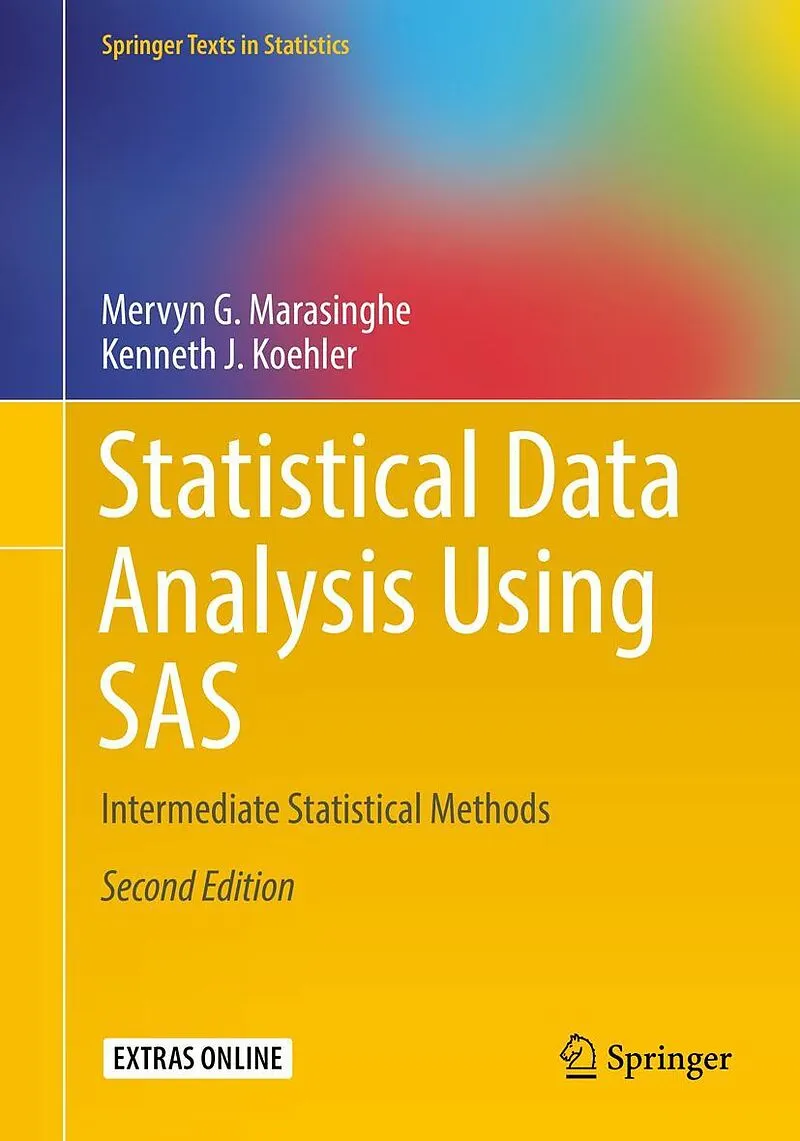
Statistical Data Analysis Using SAS
Beschreibung
Integrates SAS programming with complex data analysis applications Focuses on using SAS and statistical aspects of models and methods of analysis Introduction to SAS - beyond the basics and illustrated with numerous worked examples Advanced material suitable ...Format auswählen
- E-Book (pdf)CHF 166.90
- Fester EinbandCHF 58.10
- Kartonierter EinbandCHF 79.20
- Kartonierter EinbandCHF 157.20

Wird oft zusammen gekauft
Andere Kunden kauften auch
Beschreibung
Integrates SAS programming with complex data analysis applications
Focuses on using SAS and statistical aspects of models and methods of analysis
Introduction to SAS - beyond the basics and illustrated with numerous worked examples
Advanced material suitable for a second course in applied statistics with every method explained using a SAS analysis to illustrate a real-world problem
15-20 problems in every chapter
End of chapter exercises
Solutions to exercises
Downloadable SAS code and data sets
Autorentext
Mervyn G. Marasinghe, PhD, is Associate Professor Emeritus of Statistics at Iowa State University, where he has taught courses in statistical methods and statistical computing. He has taught a data analysis course based on SAS for over 35 years and offered workshops and short-courses on various aspects of SAS including traditional SAS programming, SAS Enterprise Guide, SAS Enterprise Miner, and JMP for many years to both university audiences and non-academic participants.
Kenneth J. Koehler, PhD, is University Professor of Statistics at Iowa State University, where he teaches courses in statistical methodology at both graduate and undergraduate levels and primarily uses SAS to supplement his teaching.
Klappentext
The aim of this textbook (previously titled SAS for Data Analytics) is to teach the use of SAS for statistical analysis of data for advanced undergraduate and graduate students in statistics, data science, and disciplines involving analyzing data.
The book begins with an introduction beyond the basics of SAS, illustrated with non-trivial, real-world, worked examples. It proceeds to SAS programming and applications, SAS graphics, statistical analysis of regression models, analysis of variance models, analysis of variance with random and mixed effects models, and then takes the discussion beyond regression and analysis of variance to conclude.
Pedagogically, the authors introduce theory and methodological basis topic by topic, present a problem as an application, followed by a SAS analysis of the data provided and a discussion of results. The text focuses on applied statistical problems and methods. Key features include: end of chapter exercises, downloadable SAS code and data sets, and advanced material suitable for a second course in applied statistics with every method explained using SAS analysis to illustrate a real-world problem.
New to this edition:
. Covers SAS v9.2 and incorporates new commands
. Uses SAS ODS (output delivery system) for reproduction of tables and graphics output
. Presents new commands needed to produce ODS output
. All chapters rewritten for clarity
. New and updated examples throughout
. All SAS outputs are new and updated, including graphics
. More exercises and problems
. Completely new chapter on analysis of nonlinear and generalized linear models
. Completely new appendix
Mervyn G. Marasinghe, PhD, is Associate Professor Emeritus of Statistics at Iowa State University, where he has taught courses in statistical methods and statistical computing.
Kenneth J. Koehler, PhD, is University Professor of Statistics at Iowa State University, where he teaches courses in statistical methodology at both graduate and undergraduate levels and primarily uses SAS to supplement his teaching.
Inhalt
Introduction to the SAS Language1.1 Introduction SAS Example A1 1.2 Basic Language: Rules and SyntaxData Values SAS Data SetsVariablesObservationsSAS Names SAS Variable ListsSAS StatementsSyntax of SAS Statements Missing ValuesSAS Programming Statements1.3 Creating SAS Data SetsSAS Example A2SAS Example A31.4 The INPUT StatementList InputFormatted Input Column INPUTCombining INPUT Styles1.5 SAS Data Step Programming Statements and Their UsesAssignment StatementsExample 1.5.1SAS Functions: Conditional ExecutionExample 1.5.2 Example 1.5.3Example 1.5.4Example 1.5.5Example 1.5.6SAS Example A4 Repetitive ComputationExample 1.5.7Example 1.5.8Example 1.5.9Example 1.5.101.6 Data Step Processing SAS Example A5SAS Example A6 SAS Example A71.7 More on INPUT Statement1.7.1 Use of pointer controls1.7.2 The trailing @ line-hold specifier SAS Example A8 1.7.3 The trailing @@ line-hold specifierExample 1.7.11.7.4 Use of RETAIN statement SAS Example A9 1.7.5 The use of line pointer controlsExample 1.7.2 1.8 Using SAS ProceduresThe Proc StepSpecifying Options in the PROC StatementProcedure Information Statements Example 1.8.1Output 1Output 2 Variable Attribute StatementsThe FORMAT statementThe LABEL statementThe LENGTH statementSAS Example A10SAS Example A111.9 Exercises 2 More on SAS Programming and Some Applications2.1 More on the DATA and PROC Steps2.1.1 Reading data from _lesThe INFILE StatementThe FILENAME StatementExample 2.1.1Some In_le Statement Options 2.1.2 Combining SAS data setsSAS Example B1The SET Statement2.1.3 Saving and retrieving permanent SAS data setsSAS Example B2SAS Example B3 2.1.4 User-defined informats and formatsExample 2.1.2SAS Example B4 Example 2.1.3 2.1.5 Creating SAS data sets in procedure stepsSAS Example B5SAS Example B6 SAS Example B72.2.1 The UNIVARIATE procedure Some PROC Statement OptionsSome CLASS Statement OptionsSAS Example B8 2.2.2 The FREQ procedureSome TABLES Statement Options SAS Example B9Phi coefficientContingency coefficient, CCramer's VGamma , Kendall's tau-b, Somers' D Proportional Reduction in Error (PRE) MeasuresPearson correlation coefficient, r2 and Spearman rank-order correlation coefficientSAS Example B102.3 Some Useful Base SAS Procedures2.3.1 The TABULATE procedure SAS Example B11SAS Example B122.3.2 The REPORT procedureSAS Example B13SAS Example B14 SAS Example B152.4 Exercises 3 Introduction to SAS Graphics3.1 Introduction Template-based graphics (ODS graphics) ODS Statistical Graphics proceduresSAS Example C1Traditional SAS graphics via SAS/GRAPH 3.2 Template-based graphics (SAS/ODS graphics)SAS Example C2SAS Example C3SAS Example C43.3 SAS Statistical Graphics procedures3.3.1 The SGPLOT procedureSome SCATTER Statement OptionsSome ELLIPSE Statement OptionsSAS Example C5 Some HISTOGRAM Statement Options Some DENSITY Statement OptionsSAS Example C6Some VBOX Statement Options SAS Example C7Some VLINE Statement OptionsSAS Example C83.3.2 The SGPANEL procedureSome PANELBY Statement OptionsSAS Example C9 Some VBAR Statement OptionsSAS Example C10Some DOT Statement OptionsSAS Example C113.3.3 The SGSCATTER procedureSome MATRIX Statement OptionsSAS Example C12 Attribute Map Data Sets3.4 ODS Graphics from other SAS procedures SAS Example C13SAS Example C14 SAS Example C15SAS Example C163.5 Exercises 4 Statistical Analysis of Regression Models4.1 An Introduction to Simple Linear RegressionEstimation of ParametersStatistical Inference 4.1.1 Simple linear regression using PROC REGSAS Example D14.1.2 Lack of t testSAS Example D24.1.3 Diagnostic use of case statisticsSAS Example D34.1.4 Prediction of new y values using regression SAS Example D44.2 An Introduction to Multiple Regression AnalysisMultiple Regression Model Estimation of ParametersMatrix Notation4.2.1 Multiple regression analysis using PROC REG SAS Example D5 4.2.2 Case statistics and residual analysisResiduals Hat Matrix Con_dence Interval for the Mean E(yi) Prediction Interval for yiStudentized Residuals Externally Studentized Residuals LeverageInuence Statistics:Cook's DInuence Statistics:DFFITSInuence Statistics:DFBETAS SAS Example D5 (continued) 4.2.3 Residual plotsSAS Example D6 4.2.4 Examining relationships among regression variablesMulticollinearity SAS Example D7 4.3 Types of Sums of Squares Computed in PROC REG4.3.1 Model comparison technique and extra sum of squaresReduction Notation4.3.2 Types of sums of squares in SASDefinition: Type I (or Sequential) Sums of Squares Definition: Type II (or Partial) Sum of Squares Type I and Type II Sums of Squares in Reduction NotationSAS Example D8 Interactive Model Fitting …


