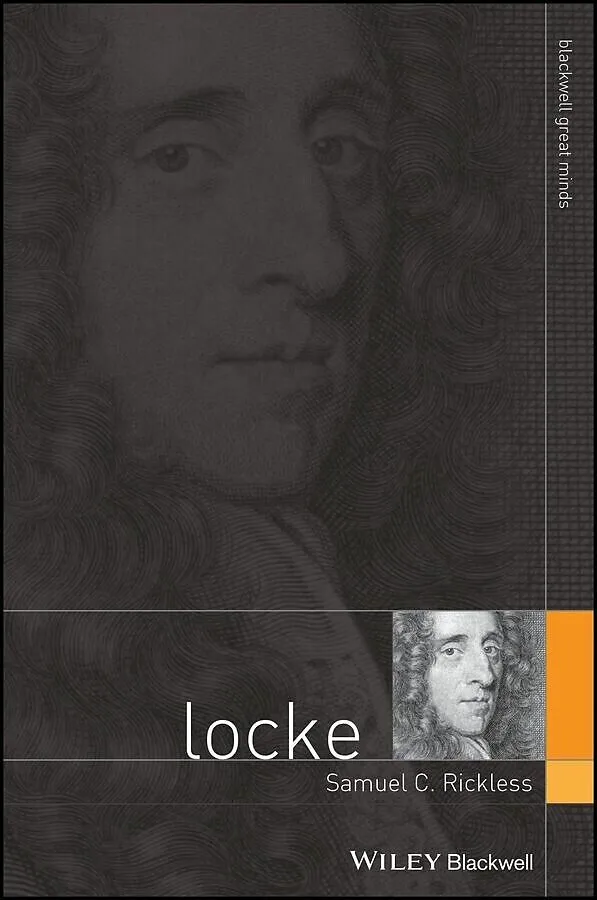
Locke
Beschreibung
In a focused assessment of one of the founding members of the liberal tradition in philosophy and a self-proclaimed "Under-Labourer" working to support the scientific revolution of the seventeenth century, the author maps the full range of John Locke's highly...Format auswählen
- E-Book (pdf)CHF 71.00
Wird oft zusammen gekauft
Andere Kunden kauften auch
Beschreibung
In a focused assessment of one of the founding members of the
liberal tradition in philosophy and a self-proclaimed
"Under-Labourer" working to support the scientific
revolution of the seventeenth century, the author maps the full
range of John Locke's highly influential ideas, which even
today remain at the heart of debates about the nature of reality
and our knowledge of it, as well as our moral and political rights
and duties.
Comprehensive introduction to the full range of Locke's
ideas, providing an up-to-date account that acknowledges issues
raised by recent scholarship over the past decadeA well-rounded perspective on one of the intellectual giants of
the western philosophical traditionProvides detailed coverage of Locke's two key works,
An Essay Concerning Human Understanding and The Two
Treatises of Government.A sophisticated analysis by a highly respected academic
A vital addition to the Blackwell Great Minds
seriesAutorentext
Samuel C. Rickless is Professor of Philosophy at the University of California, San Diego, USA. He earned his Ph.D. in 1996 from the University of California, Los Angeles, before beginning his teaching career at Florida State University. The author of two books, Plato's Forms in Transition: A Reading of the Parmenides (2007), and Berkeley's Argument for Idealism (2013), Professor Rickless has published numerous scholarly articles on a variety of topics in the history of philosophy, writing on key figures including Plato, Descartes, Berkeley, Hume, and Kant, in addition to Locke. His research interests include normative ethics, constitutional law, and the philosophy of language.
Klappentext
This latest addition to the Blackwell Great Minds series outlines the fundamental principles of Locke's highly influential contributions to philosophy, paying special attention to his two major works, An Essay Concerning Human Understanding and The Two Treatises of Government. Its aim is to give readers a solid understanding of one of the giants of western thought, who, with Descartes, set the terms of philosophical debate that remain live to this day, and whose refutation of divinely sanctioned patriarchal rule made him the most illustrious proponent of civil and political self-determination.
This concise assessment of Locke's philosophy discusses his opposition to innate ideas and principles; his positive theory of simple and complex ideas; his metaphysics of material substance, primary, and secondary qualities; and his notions of personal identity. It explains his views on free will and his theory of knowledge and belief, particularly as applied to the concept of skepticism about the external world and matters of religion. The author's authoritative treatment also covers Locke's ideas about morality and political philosophy, paying special attention to property, the social contract, and toleration.
Zusammenfassung
In a focused assessment of one of the founding members of the liberal tradition in philosophy and a self-proclaimed Under-Labourer working to support the scientific revolution of the seventeenth century, the author maps the full range of John Locke's highly influential ideas, which even today remain at the heart of debates about the nature of reality and our knowledge of it, as well as our moral and political rights and duties.
- Comprehensive introduction to the full range of Locke's ideas, providing an up-to-date account that acknowledges issues raised by recent scholarship over the past decade
- A well-rounded perspective on one of the intellectual giants of the western philosophical tradition
- Provides detailed coverage of Locke's two key works, An Essay Concerning Human Understanding and The Two Treatises of Government.
- A sophisticated analysis by a highly respected academic
A vital addition to the Blackwell Great Minds series
Inhalt
preface ix abbreviations xi1 locke's life 1
2 the nature and role of ideas 13
3 the negative project: against innatism 23
4 the positive project: ideational empiricism 39
4.1 simple ideas 40
4.2 sensation and reflection 43
4.3 complex ideas 46
4.4 abstract ideas 56
4.5 challenges to ideational empiricism: the ideas of infinity and substratum 61
5 substances 70
5.1 body, matter, space, and vacuum 70
5.2 spirit 75
6 qualities 83
7 mental operations 98
7.1 actions and passions 98
7.2 will and willing 101
7.3 voluntariness and involuntariness 103
7.4 freedom, necessity, and determination of the will 104
7.5 a problem 110
8 relations 113
8.1 identity and diversity 114
8.2 moral relations 128
9 language 133
9.1 language and meaning 134
9.2 the imperfections and abuses of language 140
9.3 nominal essence, real essence, and classification 143
10 knowledge and belief 152
10.1 the official account of knowledge 152
10.2 the degrees of knowledge 156
10.3 anti-dogmatism and anti-skepticism 159
10.4 faith and religious enthusiasm 164
11 moral philosophy 169
11.1 morality and God's will 169
11.2 natural law 172
11.3 punishment and slavery 176
11.4 property 180
11.5 family 187
12 political philosophy 195
12.1 political society 196
12.2 legitimate rule 197
12.3 varieties of illegitimate rule 207
12.4 toleration 209
index 215