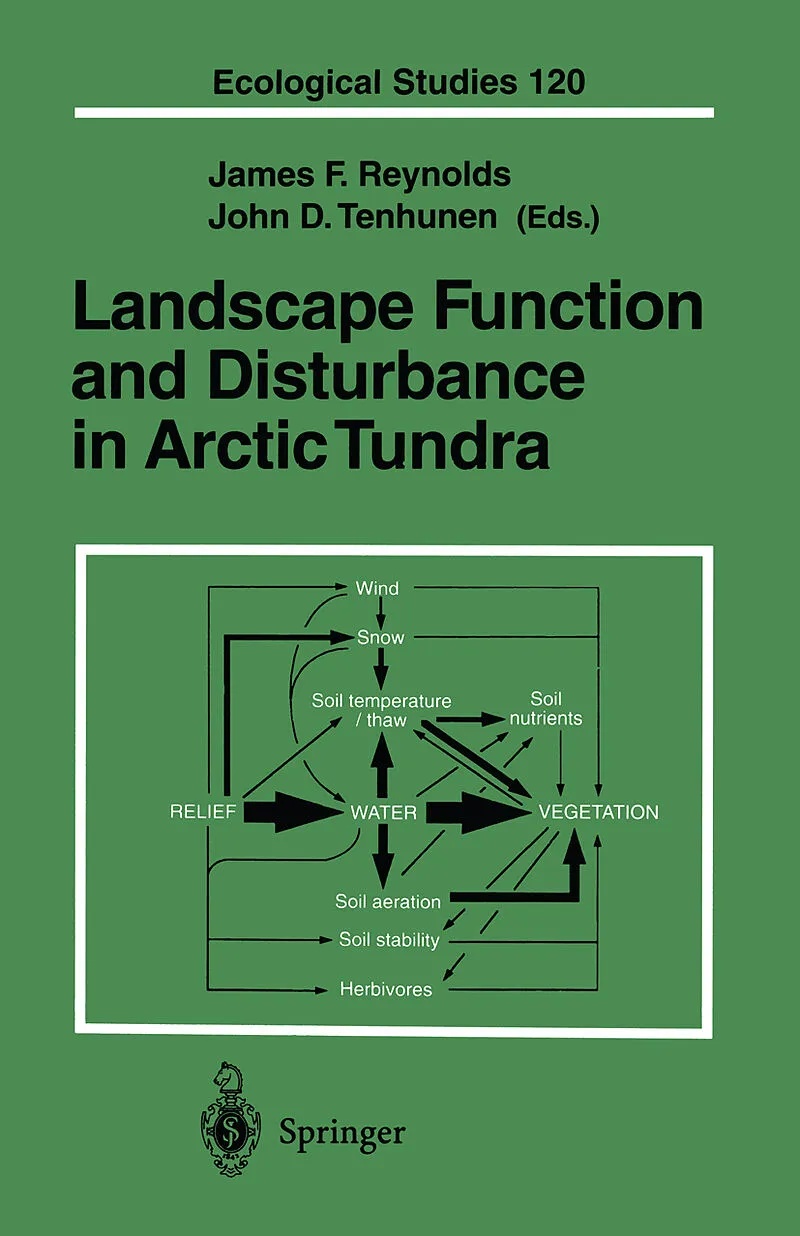
Landscape Function and Disturbance in Arctic Tundra
Beschreibung
The discovery of large petroleum reserves in northern Alaska prompted the US National Research Council to recommend priorities for ecological research on disturbance effects in the Arctic. Subsequently, this led to the implementation of a field study by the D...Format auswählen
- E-Book (pdf)CHF 59.90
- Kartonierter EinbandCHF 116.00

Wird oft zusammen gekauft
Andere Kunden kauften auch
Beschreibung
The discovery of large petroleum reserves in northern Alaska prompted the US National Research Council to recommend priorities for ecological research on disturbance effects in the Arctic. Subsequently, this led to the implementation of a field study by the Department of Energy, based in a small watershed on the North Slope of Alaska. This volume describes results by a research team charged with seeking answers to a number of questions related to disturbance in tundra regions: Will short-term disturbances have long-term ecological consequences? Will localized effects be transferred to adjacent systems, e.g., from terrestrial to aquatic? Is it possible to extrapolate understanding of impacts from one landscape to another? The results reported in this volume are an important contribution towards the goal of implementing ecosystem-based management in arctic tundra landscapes.
Landscape Function and Disturbance in Arctic Tundra covers a broad array of topics, from ecosystem physiology to landscape modeling. It is an important resource for researchers and students interested in arctic ecology, as well as for environmental managers concerned with practical issues of disturbance.
Klappentext
Following the discovery of large petroleum reserves in northern Alaska, the US Department of Energy implemented an integrated field and modeling study to help define potential impacts of energy-related disturbances on tundra ecosystems. This volume presents the major findings from this study, ranging from ecosystem physiology and biogeochemistry to landscape models that quantify the impact of road-building. An important resource for researchers and students interested in arctic ecology, as well as for environmental managers concerned with practical issues of disturbances.
Inhalt
I Introduction.- 1 Ecosystem Response, Resistance, Resilience, and Recovery in Arctic Landscapes: Introduction.- 1.1 Introduction.- 1.2 NRC Committee Report.- 1.3 The R4D Program.- 1.3.1 Objectives and Conceptual Framework.- 1.3.2 Program Implementation.- 1.3.3 Landscape Function.- 1.4 Summary.- References.- 2 Integrated Ecosystem Research in Northern Alaska, 1947-1994.- 2.1 Introduction.- 2.2 Early Days at NARL.- 2.3 The U. S. Tundra Biome Program.- 2.4 The Meade River RATE Program.- 2.5 Eagle Creek and Eagle Summit.- 2.6 The Arctic LIER Program at Toolik Lake.- 2.7 Other Studies In Alaska and Elsewhere.- 2.8 Summary and Prospects.- References.- 3 Disturbance and Recovery of Arctic Alaskan Vegetation.- 3.1 Introduction.- 3.2 Disturbance and Recovery.- 3.3 Typical Disturbance and Recovery Patterns.- 3.3.1 Small Disturbed Patches.- 3.3.2 Contaminants.- 3.3.2.1 Hydrocarbon Spills.- 3.3.2.2 Seawater and Reserve-Pit Spills.- 3.3.3 Fire.- 3.3.4 Transportation Corridors.- 3.3.4.1 Bulldozed Tundra and Related Disturbances.- 3.3.4.2 Off-Road Vehicle Trails.- 3.3.4.2.1 Summer Travel.- 3.3.4.2.2 Winter Travel.- 3.3.4.3 Permanent Roads and Pads.- 3.3.4.4 Gravel Mines.- 3.3.4.5 Native Species in Revegetation of Gravel Pads and Mines.- 3.3.4.6 Road Dust.- 3.3.4.7 Roadside Impoundments.- 3.3.5 Cumulative Impacts.- 3.4 Conclusions.- References.- 4 Terrain and Vegetation of the Imnavait Creek Watershed.- 4.1 Introduction.- 4.2 Terrain.- 4.2.1 Glacial Deposits.- 4.2.2 Retransported Hillslope Deposits.- 4.2.3 Colluvial Basin Deposits.- 4.2.4 Floodplain Deposits.- 4.3 Vegetation.- 4.3.1 Flora.- 4.3.2 Vegetation Types.- 4.3.2.1 Lichen-Covered Rocks.- 4.3.2.2 Dry Heath.- 4.3.2.2.1 Exposed Sites.- 4.3.2.2.2 Snowbeds.- 4.3.2.3 Tussock Tundra.- 4.3.2.4 Riparian Areas.- 4.3.2.5 Mires.- 4.3.2.6 Beaded Ponds.- 4.4 West-Facing Toposequence.- 4.5 Terrain Sensitivity to Disturbance.- 4.6 Conclusions.- Appendix A. List of Plants for Imnavait Creek, Alaska.- References.- 5 Vegetation Structure and Aboveground Carbon and Nutrient Pools in the Imnavait Creek Watershed.- 5.1 Introduction.- 5.2 Description of Vegetation.- 5.3 Sampling Methods.- 5.3.1 Cover.- 5.3.2 Biomass and Nutrient Pools.- 5.4 Cover.- 5.5 Aboveground Biomass.- 5.5.1 Live Biomass.- 5.5.2 Photosynthetic Biomass.- 5.5.3 Lichen Biomass.- 5.5.4 Organic Litter.- 5.5.5 Watershed Patterns.- 5.6 Nutrient Pools.- 5.6.1 N and P in Heath Cryptogams.- 5.6.2 N and P in Communities.- 5.7 Discussion and Conclusions.- References.- II Physical Environment, Hydrology, and Transport.- 6 Energy Balance and Hydrological Processes in an Arctic Watershed.- 6.1 Introduction.- 6.2 Radiation and Thermal Regimes.- 6.2.1 Surface Energy Balance.- 6.2.2 Snow Cover and Soil Thermal Regime.- 6.3 Hydrological Processes.- 6.3.1 Snowmelt.- 6.3.2 Plot and Basin Water Balance.- 6.3.3 Runoff and Basin Discharge.- 6.3.4 Precipitation, Evaporation, and Evapotranspiration.- 6.4 Energy Balance and Hydrology Models.- 6.4.1 Simulation of the Thermal Regime.- 6.4.2 Simulation of Snowmelt.- 6.4.3 Simulation of Catchment Runoff.- 6.5 Conclusions.- References.- 7 Shortwave Reflectance Properties of Arctic Tundra Landscapes.- 7.1 Introduction.- 7.2 Shortwave Reflectance Studies in Arctic Environments.- 7.2.1 Environmental Considerations.- 7.2.2 Radiometric Data.- 7.2.3 Image Data.- 7.3 Spectral Reflectance.- 7.3.1 Aboveground Biomass.- 7.3.2 Vegetation Composition.- 7.3.3 Landscape Patterns.- 7.3.4 Effects of Dust Deposition.- 7.4 Albedo.- 7.4.1 Undisturbed Tussock Tundra.- 7.4.2 Effects of Dust Deposition.- 7.5 Conclusions.- References.- 8 Isotopic Tracers for Investigating Hydrological Processes.- 8.1 Introduction.- 8.1.1 Units.- 8.1.2 Conservative vs Nonconservative Isotopes.- 8.2 Nonconservative Tracers.- 8.3 Sulfur-35.- 8.4 Oxygen-18.- 8.4.1 Oxygen-18 Content of Snowpack.- 8.4.2 Oxygen-18 Content of Imnavait Creek.- 8.4.3 Oxygen-18 Content of Soil Moisture.- 8.4.4 Covariance of Oxygen-18 and Deuterium in Watershed Compartments.- 8.4.5 Covariance of Oxygen-18 and Deuterium in Plant Water.- 8.5 Long-Lived Radioisotopes: Lead-210 and Cesium-137.- 8.5.1 Distribution of 137Cs on Tundra and in Lake Sediments.- 8.5.2 Cycling of 137Cs in Annual Berries.- 8.5.3 Distribution of 210Pb in Tundra.- 8.6 Conclusions.- References.- III Nutrient and Carbon Fluxes.- 9 Surface Water Chemistry and Hydrology of a Small Arctic Drainage Basin.- 9.1 Introduction.- 9.2 Watershed Instrumentation.- 9.3 Snowmelt Period.- 9.3.1 Snowmelt Hydrology.- 9.3.2 Snowmelt Chemistry.- 9.3.2.1 Overland Flow.- 9.3.2.2 Water Track Flow.- 9.3.2.3 Imnavait Creek Flow.- 9.4 Post Snowmelt Period.- 9.4.1 Atmospheric Inputs.- 9.4.1.1 Rainfall.- 9.4.1.2 Dry Deposition.- 9.4.1.3 Rime.- 9.4.2 Water Chemistry.- 9.4.2.1 Overland Flow.- 9.4.2.2 Active Layer Flow.- 9.4.2.3 Imnavait Creek Flow.- 9.5 Conclusions.- References.- 10 Nutrient Availability and Uptake by Tundra Plants.- 10.1 Introduction.- 10.2 Controls on Mineralization and Nutrient Supply.- 10.2.1 Patterns of Nutrient Supply in the Soil.- 10.2.2 Patterns of Mineralization.- 10.2.3 Controls on N and P Mineralization.- 10.2.4 Controls on Decomposition and Mineralization.- 10.2.4.1 Temperature.- 10.2.4.1.1 Enzyme Activities.- 10.2.4.1.2 Microbial Activity at Low Temperatures.- 10.2.4.1.3 Freeze-Thaw Events.- 10.2.4.2 Effects of Low Oxygen on Microbial Activity and Mineralization.- 10.2.4.3 Substrate Quality.- 10.3 Fate of Available Nutrients.- 10.3.1 Microbial Nutrient Uptake and Competition with Plants.- 10.3.2 Plant Uptake.- 10.3.2.1 Soil Factors Controlling Nutrient Absorption.- 10.3.2.2 Rooting Strategies.- 10.3.2.3 Uptake Characteristics of Tundra Plants.- 10.3.2.4 Retranslocation vs Current Uptake.- 10.4 Disturbances.- 10.4.1 Vehicle Tracks.- 10.4.2 Road Dust.- 10.4.3 Gray Water.- 10.4.4 Climate Change.- References.- 11 Landscape Patterns of Carbon Dioxide Exchange in Tundra Ecosytems.- 11.1 Introduction.- 11.2 Methods.- 11.2.1 Community Types.- 11.2.2 Leaf Photosynthesis.- 11.2.3 Ecosystem Efflux.- 11.2.4 Ecosystem Net CO2 Exchange.- 11.3 CO2 Uptake.- 11.3.1 Factors Affecting CO2 Uptake.- 11.3.1.1 Light.- 11.3.1.2 Temperature.- 11.3.1.3 Phenology.- 11.3.1.4…
Produktinformationen
Weitere Bände aus der Buchreihe "Ecological Studies"

- Landscape Function and Disturbance in Arctic Tundra


- Marine Benthic Vegetation

- The Central Amazon Floodplain