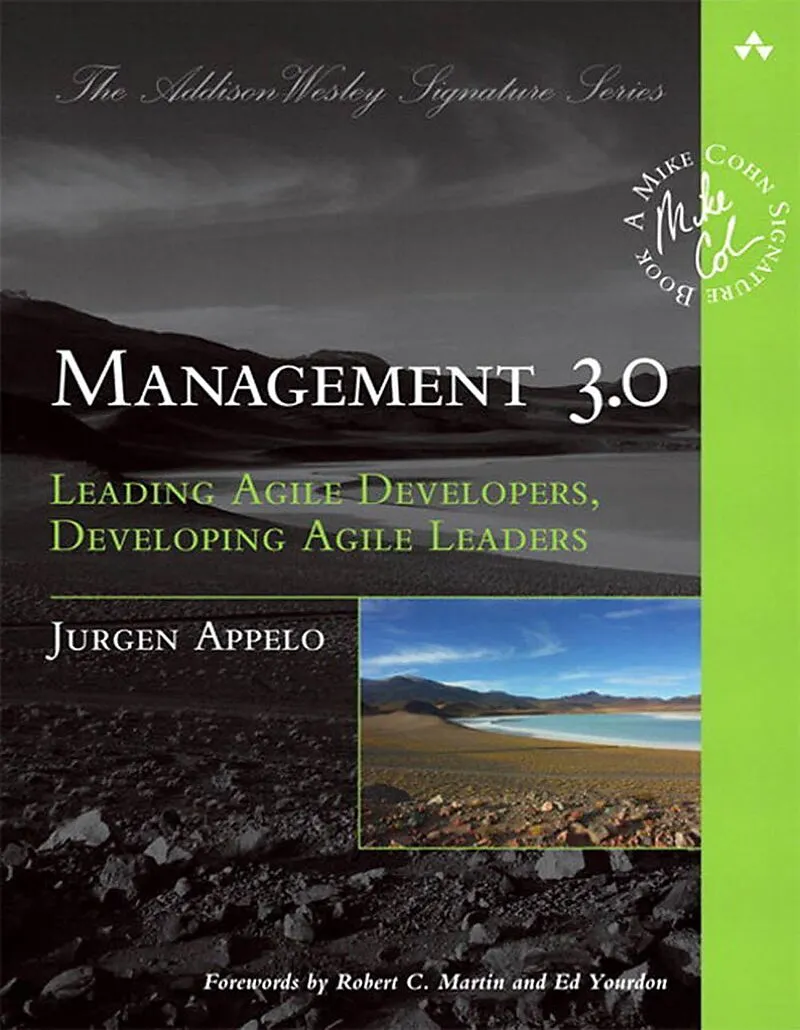
Management 3.0
Beschreibung
In many organizations, management is the biggest obstacle to successful Agile development. Unfortunately, reliable guidance on Agile management has been scarce indeed. Now, leading Agile manager Jurgen Appelo fills that gap, introducing a realistic approach t...Format auswählen
- E-Book (pdf)CHF 46.90
- Kartonierter EinbandCHF 43.10
- ePUBCHF 46.90

Wird oft zusammen gekauft
Andere Kunden kauften auch
Beschreibung
In many organizations, management is the biggest obstacle to successful Agile development. Unfortunately, reliable guidance on Agile management has been scarce indeed. Now, leading Agile manager Jurgen Appelo fills that gap, introducing a realistic approach to leading, managing, and growing your Agile team or organization.
Writing for current managers and developers moving into management, Appelo shares insights that are grounded in modern complex systems theory, reflecting the intense complexity of modern software development. Appelo's Management 3.0 model recognizes that today's organizations are living, networked systems; and that management is primarily about people and relationships.
Management 3.0 doesn't offer mere checklists or prescriptions to follow slavishly; rather, it deepens your understanding of how organizations and Agile teams work and gives you tools to solve your own problems. Drawing on his extensive experience as an Agile manager, the author identifies the most important practices of Agile management and helps you improve each of them.
Coverage includes
. Getting beyond "Management 1.0" control and "Management 2.0" fads
. Understanding how complexity affects your organization
. Keeping your people active, creative, innovative, and motivated
. Giving teams the care and authority they need to grow on their own
. Defining boundaries so teams can succeed in alignment with business goals
. Sowing the seeds for a culture of software craftsmanship
. Crafting an organizational network that promotes success
. Implementing continuous improvement that actually works
Thoroughly pragmatic-and never trendy-Jurgen Appelo's Management 3.0 helps you bring greater agility to any software organization, team, or project.
Autorentext
Jurgen Appelo is a writer, speaker, trainer, developer, entrepreneur, manager, blogger, reader, dreamer, leader, and freethinker. And he's Dutch, which explains his talent for being weird.
After studying software engineering at the Delft University of Technology, and earning his Master's degree in 1994, Jurgen busied himself either starting up or leading a variety of Dutch businesses, always in the position of team leader, manager, or executive.
Jurgen's most recent occupation was CIO at ISM eCompany, one of the largest e-business solution providers in The Netherlands. As a manager, Jurgen has experience in leading software developers, development managers, project managers, quality managers, service managers, and kangaroos, some of which he hired accidentally.
He is primarily interested in software development and complexity theory, from a manager's perspective. As a writer, he has published papers and articles in many magazines, and he maintains a blog at www.noop.nl. As a speaker, he is regularly invited to talk at seminars and conferences.
Last but not least, Jurgen is a trainer, with workshops based on the Management 3.0 model. His materials address the topics of energizing people, empowering teams, aligning constraints, developing competence, growing structure, and improving everything.
However, sometimes he puts all writing, speaking, and training aside to do some programming himself, or to spend time on his ever-growing collection of science fiction and fantasy literature, which he stacks in a self-designed book case that is four meters high.
Jurgen lives in Rotterdam (The Netherlands)-and sometimes in Brussels (Belgium)-with his partner Raoul. He has two kids and an imaginary hamster called George.
Inhalt
Forewords xix
Acknowledgments xxv
About the Author xxvii
Preface xxix
1 Why Things Are Not That Simple 1
Causality 2
Complexity 3
Our Linear Minds 5
Reductionism 7
Holism 8
Hierarchical Management 9
Agile Management 11
My Theory of Everything 12
The Book and the Model 13
Summary 14
Reflection and Action 14
2 Agile Software Development 17
Prelude to Agile 17
The Book of Agile 19
The Fundamentals of Agile 22
The Competition of Agile 24
The Obstacle to Agile 28
Line Management versus Project Management 28
Summary 30
Reflection and Action 31
3 Complex Systems Theory 33
Cross-Functional Science 34
General Systems Theory 35
Cybernetics 36
Dynamical Systems Theory 37
Game Theory 37
Evolutionary Theory 38
Chaos Theory 38
The Body of Knowledge of Systems 39
Simplicity: A New Model 41
Revisiting Simplification 44
Nonadaptive versus Adaptive 45
Are We Abusing Science? 46
A New Era: Complexity Thinking 48
Summary 50
Reflection and Action 50
4 The Information-Innovation System 51
Innovation Is the Key to Survival 52
Knowledge 54
Creativity 56
Motivation 58
Diversity 60
Personality 62
Only People Are Qualified for Control 64
From Ideas to Implementation 65
Summary 66
Reflection and Action 67
5 How to Energize People 69
Creative Phases 69
Manage a Creative Environment 72
Creative Techniques 74
Extrinsic Motivation 75
Intrinsic Motivation 78
Demotivation 79
Ten Desires of Team Members 80
What Motivates People: Find the Balance 83
Make Your Rewards Intrinsic 86
Diversity? You Mean Connectivity! 87
Personality Assessments 89
Four Steps toward Team Personality Assessment 90
Do-It-Yourself Team Values 92
Define Your Personal Values 94
The No Door Policy 95
Summary 97
Reflection and Action 97
6 The Basics of Self-Organization 99
Self-Organization within a Context 99
Self-Organization toward Value 101
Self-Organization versus Anarchy 102
Self-Organization versus Emergence 104
Emergence in Teams 106
Self-Organization versus Self-Direction
versus Self-Selection 107
Darkness Principle 108
Conant-Ashby Theorem 110
Distributed Control 111
Empowerment as a Concept 112
Empowerment as a Necessity 113
You Are (Like) a Gardener 115
Summary 117
Reflection and Action 118
7 How to Empower Teams 119
Don't Create Motivational Debt 119
Wear a Wizard's Hat 121
Pick a Wizard, Not a Politician 122
Empowerment versus Delegation 123
Reduce Your Fear, Increase Your Status 124
Choose the Right Maturity Level 125
Pick the Right Authority Level 127
Assign Teams or Individuals 131
The Delegation Checklist 132
If You Want Something Done, Practice Your Patience 133
Resist Your Manager's Resistance 134
Address People's Ten Intrinsic Desires 136
Gently Massage the Environment 136
Trust 138
Respect 141
Summary 144
Reflection and Action 144
8 Leading and Ruling on Purpose 147
Game of Life 147
Universality Classes 149
False Metaphor 150
You're Not a Game Designer 151
But...Self-Organization Is Not Enough 152
Manage the System, Not the People 154
Managers or Leaders? 156
Right Distinction: Leadership versus Governance 156
Meaning of Life 158
Purpose of a Team 160
Assigning an Extrinsic Purpose 163
Summary 164
Reflection and Action 165
9 How to Align Constraints 167
Give People a Shared Goal 167
Checklist for Agile Goals 170
Communicate Your Goal 172
Vision versus Mission 174
Examples of Organizational Goals 176
Allow Your Team an Autonomous Goal 177
Compromise on Your Goal and Your Team's Goal 178
Create a Boundary List of Authority 179
Choose the Proper Management Angle 180
Protect People 181
Protect Shared Resources 183
Constrain Quality 185
Create a Social Contract 186
Summary 188
Reflection and Action 188
10 The Craft of Rulemaking 191
Learning Systems 191
Rules versus Constraints 193
The Agile Blind Spot 196
What's Important: Craftsmanship 198
Positive Feedback Loops 200
Negative Feedback Loops 201
Discipline * Skill = Competence 204
Diversity of Rules 206
Subsidiarity Principle 208
Risk Perception and False Security 209
Memetics 211
Broken Windows 215
Summary 216
Reflection and Action 217
11 How to Develop Competence 219
Seven Approaches to …