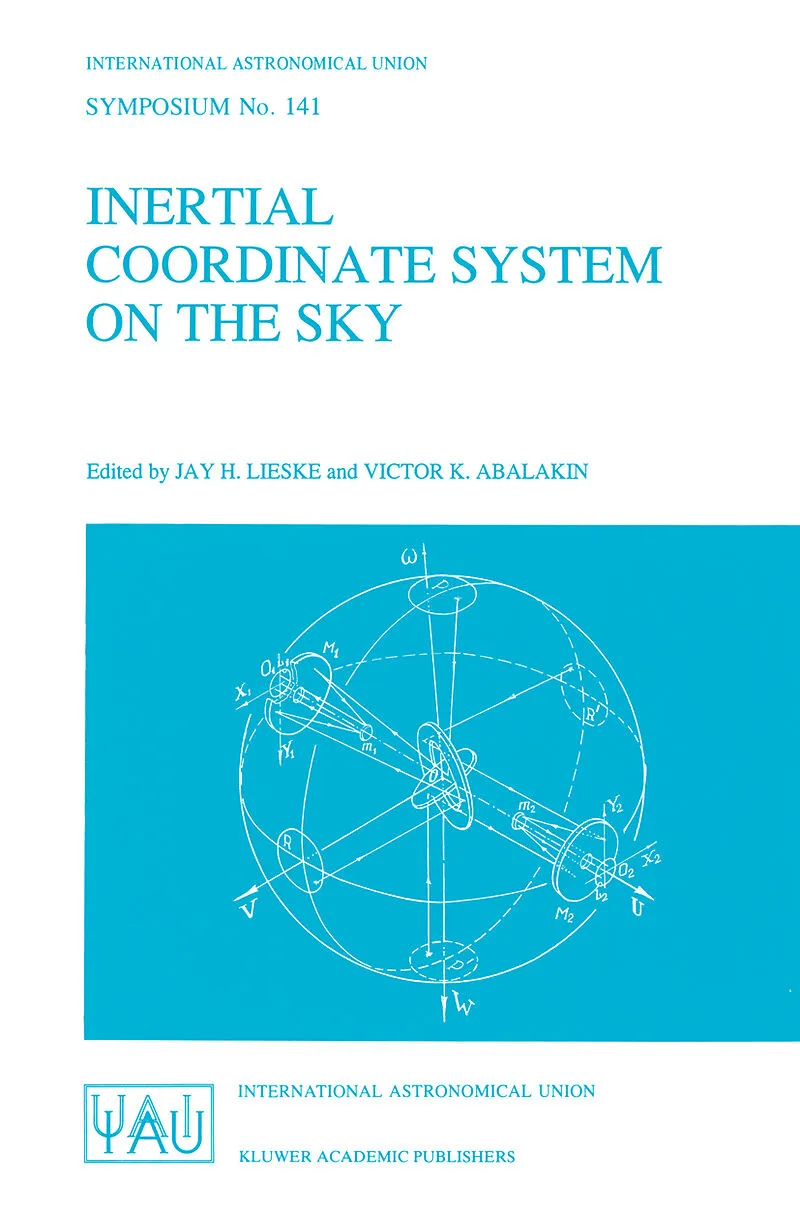
Inertial Coordinate System on the Sky
Beschreibung
IA U Symposium Number 141 "Inertial Coordinate System on the Sky" was held in Leningrad, USSR from 17-21 October 1989. The symposium also commemorated the 150th anniversary of the founding of Pulkovo Observatory. The scientific program was presented in ten ha...Format auswählen
- E-Book (pdf)CHF 47.90
- Kartonierter EinbandCHF 79.20

Wird oft zusammen gekauft
Andere Kunden kauften auch
Beschreibung
IA U Symposium Number 141 "Inertial Coordinate System on the Sky" was held in Leningrad, USSR from 17-21 October 1989. The symposium also commemorated the 150th anniversary of the founding of Pulkovo Observatory. The scientific program was presented in ten half-day sessions. Most sessions were held at the Pulkovskaya Hotel, but one session which highlighted Pulkovo's current programs was held at Pulkovo Observatory. The sessions were organized into general categories pertaining to the legacy of Pulkovo for inertial systems; current programs at Pulkovo Observatory; concepts, definitions and models; and the realization and comparision of reference frames. More than 140 scientific papers were presented, either orally or in poster form. Extensive use was made of electronic mail and computer-readable communications, and more than two-thirds of the authors made use of the opportunity to submit papers for formatting by the editors. The meeting was truly a symposium in the Greek sense of the word-a free-flowing exchange of ideas and opinions. The final two papers presented at the symposium by Wilkins and by Westerhout are presented at an eady stage in the published proceedings, in order to help focus the reader's attention on the concepts and problems explored in subsequent papers. As pointed out by G.
Inhalt
1 The legacy of Pulkovo for inertial systems and reference frames.- Introductory Remarks.- Concluding Remarks.- The Legacy of the Struves for the Establishment of an Inertial Coordinate System on the Sky.- Pulkovo Observatory's Status in 19th Century Positional Astronomy.- The Longest Geodetic ARC: Delisle, the Struves and Pulkovo Observatory.- Pulkovo Observatory and the National Observatory Movement: An Historical Overview.- The Past, Present and Future of Reference Systems For Astronomy and Geodesy.- The IAU Working Group on Reference Systems.- The Origin of Celestial Coordinates.- 2 Pulkovo today.- The Pulkovo Programme for the Study of Visual Double Stars.- On the Use of Statistical Parallaxes for the Proper Motion Reduction.- Absolute Determinations of Star Declinations from Pole to Pole.- On the Photographic Vertical Catalog.- On the Programme of Ground-Based Observations of Bright Selected Minor Planets for 1991-2000.- Complex Geodynamical Investigations in the Area of the USSR Academy of Sciences Central Astronomical Observatory at Pulkovo.- Pulkovo Programme for the Photographic Observations of Satellites of Planets.- Confor: A New Program for Determining the Connection between Radio and Optical Reference Frames.- A Proposal for Astrometric Observations from Space.- On the Creation of a New Catalogue for USSR Time Service.- On ??? Systematic Errors of the FK5.- On the Organization of Absolute Coordinate Determination of the FK5 Stars.- The FK4 Orientation Parameters Derived from Photographic and VLBI Observations of Radio / Optical Objects.- Equator and Ecliptic FK5 Positions on the Basis of Sun and Planets Observations by the Ertel-Struve Vertical Circle at the Kislovodsk Mount Station.- The Nikolaev Axial Meridian Circle: The Present and Future Status.- On the Progress of the Construction of the Sukharev Meridian Automatic Horizontal Instrument (SMAHI).- Constructions of Astrometric Instrumentation at Pulkovo Observatory.- Positional Observations of Components of Triple Stars for the Hipparcos and HST Missions.- Problem of Using Lunar Positional Observations for Determination of Zero-Points of Fundamental Star Catalogues.- Density Function of the FK4 Systematic Errors.- On the Tie of Astrometric Radio Sources to the FK4 System with Zenith Telescope ZTL-180 Observations.- Circle Reading Device of the Meridian Instrument with a Self-Installed Zero-Point.- Modified Method of Krejnina-Murri for the Determination of Absolute Declination.- On the Definition of an "Inertial Coordinate System".- Contribution of Soviet-Bolivian Astronomical Observatory in the Construction of the Inertial Coordinate System.- The Problem of the Leveling of the Reserved Net of Arcs at the Celestial Sphere by the Construction of the Reference Coordinate System.- 3 Concepts, Definitions, Models.- The Celestial Reference System in Relativistic Framework.- General Relativistic Description of Celestial Reference Systems.- Relativistic Reference Frames of Local Observer and Space Radiointerferometer.- The Optimum Conventional Terrestrial System Determined by VLBI and SLR Stations.- The Celestial System of the International Earth Rotation Service.- A New Concept of Constructing an Accurate Coordinate System from Ground-Based Optical Observations.- Transformation of the Mean Place from FK4 to FK5.- The Computation of Mean Positions and Proper Motions.- Can We Dehne an Inertial Reference System?.- The Role of Observation with Horizontal Meridian Circle in China for Establishing an Inertial Frame.- On the Problem of the Development of Astronomical Refraction Methodology on the Basis of New Technology.- Determination of Refraction and Progress of Fundamental Astrometry.- Precision of Studies from Astrometric Observations: Recent Progress and Future Prospects.- Nutation Theory for a Non-Rigid Earth: Present Status and Future Prospects.- Proposals for an Improved Nutation Formula.- The Results of the Reconstruction of the Coefficients of the Nutation for the Rigid Earth Model and their Comparison with Numerical Integration.- The Determination of the Principal Nutation Terms from the Observations with ZTF-135 IN1948.7-1989.0.- Corrections to the IAU 1980 Nutation Series from LAGEOS Observations.- Oceanic Influences on the Angular Velocity of the Earth.- The Program Complex "Kiev-Geodynamic R1".- Current State of the Theory of Nutation.- The Study of the Structure of 142-Year Series of Pole Coordinates.- Determination of Nutation Based on Observations with the Pulkovo Polar Tube.- Can the Core-Mantle Boundary Topography Influence the Earth's Nutation?.- On the Calculation of Low Frequency Oscillations of the Earth's Core.- Mean Pole of the Moon's Rotational Axis and the General Selenocentric Coordinate System.- On the Astrometrical Methods.- Reference Surfaces and Global Figure Parameters of the Terrestrial Planetary Bodies.- Possible Contributions of Classical Astrometric Instrument to the Study of Geoscience and Requirements on Star Catalogues.- Dynamical Reference Frames in the Planetary and Earth-Moon Systems.- The Main Stages of the Construction of AE89- The Numerical Ephemerides of the Planets and the Moon.- Effect of the New Equinox Definition on the Zero-Point of Longitude of the Indian Calendar.- The Construction of a Frame of Homogeneous Accuracy Based on Space Observations.- High Accuracy Algorithms of Numerical Prediction of the Motion of Solar System Bodies.- On the Errors of the Ephemerides Derived from Optical Observations of Planets.- Differences between Dynamic and Stellar Reference Frames: Results Based on Astrometric Observations of Martian Satellites.- The Possibility to Link Radio and Optical Reference Frames with Artificial Satellites.- Ancient Chinese Astronomical Observations Related to the Stellar Background in the Sky.- Sidereal Years-Catalogue Uses in Archaeoastronomy.- Improved Method for Orbital Elements Differential Correction.- On the Lunar Secular Acceleration: A Possible Approach.- Fluctuations of the Earth's Rotation by Stellar Occultations.- Systematic Astrometric Errors in Pulsar Timing.- Pulsar Astrometry-Availabilities and Relativistic Aspects of a Pulsar Reference Frame.- Points: A Global Reference Frame Opportunity.- Relativistic Reduction of Astrometric Observations at Points Level of Accuracy.- Astrometric Interferometry- Can It Establish a Fundamental System?.- 4 Realization and comparison of reference frames.- The Definition and Stability of Local Inertial Reference Frames.- An Extragalactic Reference Frame from DSN VLBI Measurements - 1989.- Realization of an Inertial Reference Frame from Mark III VLBI.- A Progress Report …
Produktinformationen
Weitere Bände aus der Buchreihe "International Astronomical Union Symposia"

20%
- Inertial Coordinate System on the Sky



20%
- Galactic Bulges