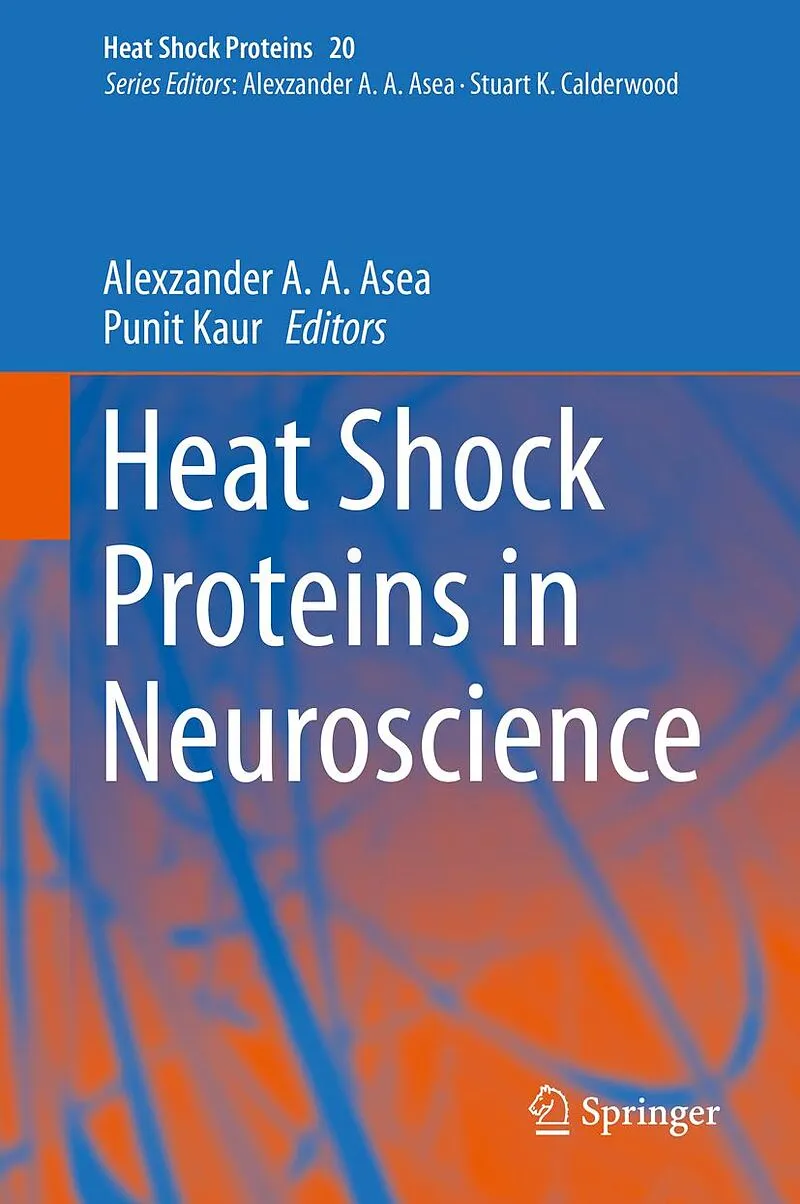
Heat Shock Proteins in Neuroscience
Beschreibung
The book Heat Shock Proteins in Neuroscience provides the most comprehensive review on contemporary knowledge on the role of HSP in signaling pathways relevant to a number of diseases. Using an integrative approach, the contributors provide a synopsis of nove...Format auswählen
- E-Book (pdf)CHF 118.90
- Fester EinbandCHF 169.60
- Kartonierter EinbandCHF 132.00

Wird oft zusammen gekauft
Andere Kunden kauften auch
Beschreibung
The book Heat Shock Proteins in Neuroscience provides the most comprehensive review on contemporary knowledge on the role of HSP in signaling pathways relevant to a number of diseases. Using an integrative approach, the contributors provide a synopsis of novel mechanisms, signal transduction pathways. To enhance the ease of reading and comprehension, this book has been subdivided into various section including; Section I, reviews current progress on our understanding of Neurological Aspects of HSP; Section II, focuses on Aspects of HSP in Neurodegenerative Diseases and Disorders, Section III, emphasizes the importance of HSP in Multiple Sclerosis; Section IV, reviews critical Aspects of HSP in Alzheimer's Disease and Section V, gives a comprehensive update of the Development of HSP-Based Therapies for Neurological Disorders.
Key basic and clinical research laboratories from major universities, academic medical hospitals, biotechnology and pharmaceutical laboratories around the world have contributed chapters that review present research activity and importantly project the field into the future. The book is a must read for starters and professionals in the fields of Neurology and Neurosciences, Translational Medicine, Clinical Research, Human Physiology, Biotechnology, Cell & Molecular Medicine, Pharmaceutical Scientists and Researchers involved in Drug Discovery.
Autorentext
**Prof. Dr. Alexzander A. A. Asea **is a highly innovative and accomplished world renowned clinical and basic research scientist and visionary executive leader who has exceptional experience spearheading clinical and basic science research, training, education, and commercialization initiatives within top ranked academic biomedical institutes. Prof. Dr. Asea's initial findings studying the effects of Hsp72 on human monocytes lead to the proposal of a novel paradigm that Hsp72, previously known to be an intracellular molecular chaperones, can be found in the extracellular milieu where it has regulatory effects on immuno-competent cells - a term now called chaperokine. Prof. Asea has authored over 255 scientific publications including peer-reviewed articles, reviews, books, book chapters, editorials, and news headliners in a wide range of biomedical-related disciplines. Prof. Asea is the series editor of the widely successful book series Heat Shock Proteins (Springer Nature Publishing) and is an editorial board member of numerous scientific peer-reviewed journals. Currently, Prof. Dr. Asea is at the University of Toledo College of Medicine and Life Sciences in Toledo, USA.
**Dr. Punit Kaur **is an expert in onco-proteogenomics, with extensive training and experience in quantitative mass spectrometry imaging, protein chemistry and biomarker discovery. Dr. Kaur's main research focus is on the use of heat-induced nanotechnology in combination with radiotherapy and chemotherapy in the cancer stem cell therapy. Dr. Kaur has published more than 40 scientific articles, book chapters, and reviews, and currently serves as editorial board member for the European *Journal of *Cancer Prevention and the Journal of Proteomics and Bioinformatics. Dr. Kaur is an editor of 9 books in the highly successful *Heat Shock Proteins *book series by Springer Nature Publishers. Currently, Dr. Kaur is a Visiting Scientist Professor at the University of Texas MD Anderson Cancer Center in Houston, USA.
Zusammenfassung
The book **Heat Shock Proteins in Neuroscience **provides the most comprehensive review on contemporary knowledge on the role of HSP in signaling pathways relevant to a number of diseases. Using an integrative approach, the contributors provide a synopsis of novel mechanisms, signal transduction pathways. To enhance the ease of reading and comprehension, this book has been subdivided into various section including; Section I, reviews current progress on our understanding of Neurological Aspects of HSP; Section II, focuses on Aspects of HSP in Neurodegenerative Diseases and Disorders, Section III, emphasizes the importance of HSP in Multiple Sclerosis; Section IV, reviews critical Aspects of HSP in Alzheimer's Disease and Section V, gives a comprehensive update of the Development of HSP-Based Therapies for Neurological Disorders.
Key basic and clinical research laboratories from major universities, academic medical hospitals, biotechnology and pharmaceutical laboratories around the world have contributed chapters that review present research activity and importantly project the field into the future. The book is a must read for starters and professionals in the fields of Neurology and Neurosciences, Translational Medicine, Clinical Research, Human Physiology, Biotechnology, Cell & Molecular Medicine, Pharmaceutical Scientists and Researchers involved in Drug Discovery.
Inhalt
Section I: Neurological Aspects of HSP
Chapter 1. Hsp60 Friend And Foe Of The Nervous System
Antonella Marino Gammazza, Celeste Caruso Bavisotto, Francesca Rappa, Federica Scalia, Everly Conway de Macario, Alberto JL Macario and Francesco Cappello
Department of Experimental Biomedicine and Clinical Neurosciences
University of Palermo
Palermo, Italy
Chapter 2. Role Of Heat Shock Proteins In Brain Tumors
George A. Alexiou
Department of Neurosurgery
University Hospital of Ioannina
Ioannina, Greece
Chapter 3. Body Temperature Regulation Determines Immune Reactions And Species Longevity
Ian James Martins
School of Medical Sciences
Edith Cowan University
Western Australia, Australia
Chapter 4. Interaction Between Heat Shock Proteins And Components Of The Plasminogen Activator System In The Central Nervous System
Mario Gonzalez-Gronow and Salvatore V.P izzo
Department of Biological Sciences, Laboratory of Environmental Neurotoxicology
Universidad Católica del Norte
Coquimbo, Chile
And
Department of Pathology
Duke University Medical Center
Durham, USA
Chapter 5. Role Of HSP70 In Plasticity And Memory
Rossana Rosa Porto and Lucas De Oliveira Alvares
Neurobiology of Memory Laboratory
Biophysics Department
Biosciences Institute
Chapter 6. Role Of Heat Shock Proteins (HSP) In Neuroprotection For Ischemic Stroke
Jong Youl Kim, Jong Eun Lee and Midori A. Yenari
Department of Neurology University of California, San Francisco & the San Francisco Veterans Affairs Medical Center
San Francisco, USA
Section II: Aspects of HSP in Neurodegenerative Diseases and Disorders
Chapter 7. Dysregulation Of Heat Shock Proteins In Neurodegenerative Diseases: Restorative Roles Of Small Molecules And Natural Compounds Panchanan Maiti and Jayeeta Manna
Department of Psychology
Central Michigan University
Mt. Pleasant, USA
Chapter 8. Molecular Chaperones And Protein Quality Control System In The Canine Model Of Brain Aging And Neurodegenerative Diseases
Romanucci Mariarita and Leonardo Della Salda
Veterinary Pathology Unit, Faculty of Veterinary Medicine
University of Teramo
Teramo, Italy
Chapter 9. Role Of Hsp90 Interacting Molecular Chaperones On Tau And Aß Processing In Alzheimer's Disease Liam Gracia, Gabriella Lora and Umesh K. Jinwal
Department of Pharmaceutical Sciences
Byrd Alzheimer's Institute, College of Pharmacy
University of South Florida-Health Tampa, USA
Section III: Aspects of HSP in Multiple Sclerosis
Chapter 10. Role Of Hsp70 In Multiple Sclerosis: An Overview
Maria Magdalena Barreca and Fabiana Geraci
Department of Biological, Chemical and Pharmaceutical Sciences and Technologies
University of Palermo
Palermo, Italy
Chapter 11. Protective Role Of Glial Heat Shock Proteins In Amyotrophic Lateral Sclerosis Benjamin E. Clarke, Bernadett Kalmar and Linda Greensmith
UCL Queen Square Institute of Neurology
London, UK
Section IV: Developme…