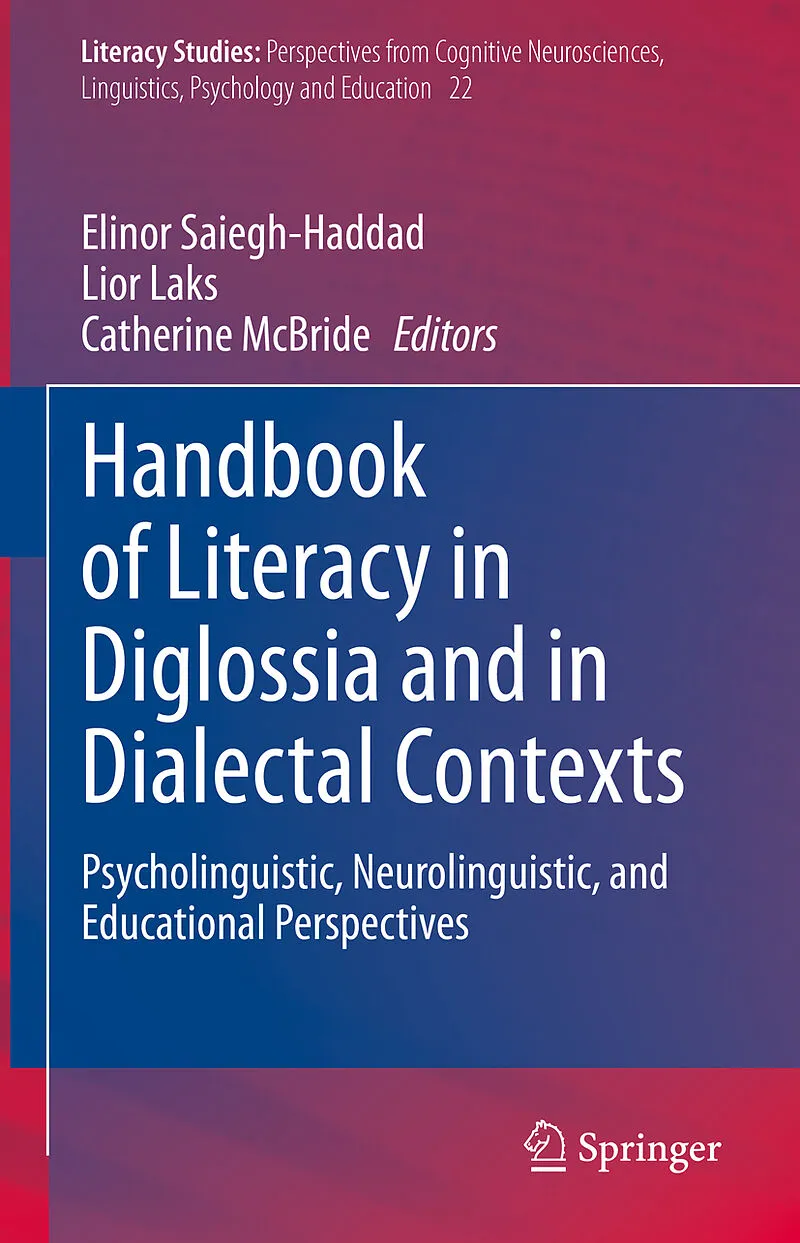
Handbook of Literacy in Diglossia and in Dialectal Contexts
Beschreibung
This volume is the first published collection of papers on the impact of diglossia and dialectal variations on language and literacy acquisition, impairment, and education. The authors are pioneering in this field and are leading researchers with substantial ...Format auswählen
- E-Book (pdf)CHF 189.90
- Fester EinbandCHF 172.40
- Kartonierter EinbandCHF 172.40

Wird oft zusammen gekauft
Andere Kunden kauften auch
Beschreibung
This volume is the first published collection of papers on the impact of diglossia and dialectal variations on language and literacy acquisition, impairment, and education. The authors are pioneering in this field and are leading researchers with substantial experience in conducting research in this area. A wide range of areas and languages are covered, including the US, South Africa, Israel, and various European countries. The chapters present novel data and insights regarding the role of dialectal variations on language and literacy, from a wide range of countries and perspectives. These insights have significant theoretical and practical implications. A majority of literacy learners worldwide are taught to read and write in a language variety or a dialect that is not the same as their spoken language. Not only is this the global norm, but it is probably also the greatest obstacle to literacy learning. This volume is the first published collection of papers on therole of dialect in language and literacy acquisition, impairment, and education in a variety of languages and situations across Europe, the Middle East, North America, Africa, and Asia.The authors are pioneers in this field.
Autorentext
Elinor E. Saiegh-Haddad, PhD, Professor of Linguistics at the English Literature and Linguistics Department, Bar-Ilan University, Israel. She completed her graduate studies at Reading University, England (MA) and Bar-Ilan University, Israel (PhD). In her graduate work she focused on assessment of reading in L1 and in L2. She conducted her postdoctoral research at OISE, University of Toronto, Canada, where she investigated reading development in bilingual English-Arabic children. Since then, she has engaged in intensive research on the acquisition of reading in Arabic and specifically on the role of diglossia laying down the theoretical foundations and the methodological grounds of this new field of research. She has published numerous research articles and book chapters on this topic and has co-edited (with Malt Joshi) the first Handbook of Arabic Literacy entitled Handbook of Arabic Literacy: Insights and Perspectives (Springer 2014). Saiegh-Haddad has also been actively involved in curriculum development and educational materials writing for Arabic native speaking children. She is advisor to the Israel Ministry of Education and the National Authority for Testing and Evaluation, as well as the Israel Centre for Educational Technology. She is a member of the editorial boards of leading journals in the field of language and reading development such as Scientific Studies of Reading, Reading & Writing: An Interdisciplinary Journal*, and Applied Psycholinguistics*.
Catherine McBride, Ph.D. is the Choh-Ming Li Professor of Psychology at The Chinese University of Hong Kong. She is a developmental psychologist who focuses on reading development and impairment across languages, scripts, and cultures. McBride has published two single authored books on literacy and has co-edited three other volumes. She has served as president of two international organizations, namely, the Society for the Scientific Study of Reading and the Association of Reading and Writing in Asia. She also designed a massive open online course (MOOC) with NGO World Learning entitled "Teaching Struggling Readers around the World," which was viewed by over 10,000 people across 100 countries.
Dr. Lior Laks, PhD, is a senior lecturer of Linguistics at the Department of English Literature and Linguistics, Bar-Ilan University, Israel. He graduated from Tel-Aviv University, where he completed his doctoral dissertation entitled "Morpho-phonological and morpho-thematic relations in Hebrew and Arabic verb formation", under the supervision of Prof. Outi-Bat-El and Prof. Tal Siloni. He joined Bar-Ilan University in 2011. Dr. Laks specializes in morphology and its interface with other components of the grammar: phonology, semantics and syntax. He examines word formation processes while relating to different types of criteria that play a role is the selection of morphological forms, productivity of word formation and the absence of possible words that conceptually could be formed. His studies also focus on language contact, variation and change. Dr. Laks also works on diglossia in Arabic and the grammatical differences between Modern Standard and Colloquial Arabic and the effects of diglossia on language development and change, as an issue with a first degree importance in the system of education. Dr. Laks was a visiting researcher in The ATILF Scientific Institute ("Analyse et Traitements Informatiques de la Langue Française", UMR 7118), and University of Lorraine, Nancy, France, as part of the Chateaubriand Fellowship Program of the French Embassy in Israel, where he in engaged in a research project entitled "A cross-linguistic comparison of word formation in Romance and Semitic languages".
Inhalt
Preface: Bernard Spolsky, Bar-Ilan University, Israel
Introduction: Elinor Saiegh-Haddad, & Cammie McBride, Bar-Ilan University and the Chinese University of Hong Kong.
Literacy in Diglossia and Dialectal Contexts: Current questions and future directions
Part One: Language and Literacy Acquisition in Diglossic Contexts
Chapter 1: Agnieszka Stpkowska, University of Szczecin, Poland
The land of diglossia: Ferguson and Fishman meet in Switzerland
Chapter 2: Kleanthes Grohmann, University of Cyprus
The gradience of multilingualism in a diglossic context: Language development in Cyprus
Chapter 3: Urs Maurer & Jessica Buhler, The Chinese University of Hong Kong, University of Zurich, Neuroscience Center Zurich, Switzerland.
Influence of dialect use on early reading and spelling acquisition in German-speaking children
Chapter 4: Lior Laks & Elinor Saiegh-Haddad, Bar-Ilan University, Israel
Between varieties and modalities in the production of narrative texts in Arabic
Chapter 5: Rama Novogrodsky, University of Haifa
Language learning in naturalistic versus structured settings comparing the stories of children with hearing-impairment in Colloquial-Arabic and Standard-Arabic
Chapter 6: Asaid Khatib, Haifa University
Language processing in diglossia is modality specific
Chapter 7*: *Zohar Eviatar, Zohar Eviatar, Raphiq Ibrahim, Lateefeh Maroun, & Aula Khatib Abu-Leil, Haifa University
Reading in multiple Arabics
Part Two: Language and Literacy Acquisition in Standard-with-Dialect Contexts
Chapter 8: Mark Seidenberg, University of Wisconsin-Madison
Language variation and dialect: Challenges for beginning readers and educators
Chapter 9: Julie Washington, Georgia State University**
Conceptualizing linguistic variation on a continuum: Impact on the growth of language and reading of African American children
Chapter 10: Ryan Lee-James, Adelphi University; Lakeisha Johnson, University of the District of Columbia
Impact of Nonmainstream Dialect Use in Language Assessment: Evidence from African American English-Speaking Children
Chapter 11: Nicole Patton Terry, Florida State University; Brandy Gatlin, University of California-Irvine.
Contrasting Theory-Based Approaches to Language Instruction for Poor Readers who Speak Nonmainstream American English
Chapter 12: Roumans, Romy, Leonie Cornips, Jetske Klatter-Folmer and Trudie Schils, Radboud University, Meertens Instituut (KNAW), Maastricht University.
Literacy skills of bidialectal primary school children compared to their Dutch speaking peers in Dutch Limburg: Spelling and reading proficiencies
Chapter 13: Hristo Kyuchukov, University of Silesia, Katowice, Poland
Socio-cognitive factors in the literacy process of Roma speaking children.
Chapter 14: Cammie McBride, The Chinese University of Hong Kong
Diglossia in Chinese? It's complicated
Part Three: Language and Literacy Acquisition in Multilectal Africa
Chapter 15: Michelle Pascoe…


