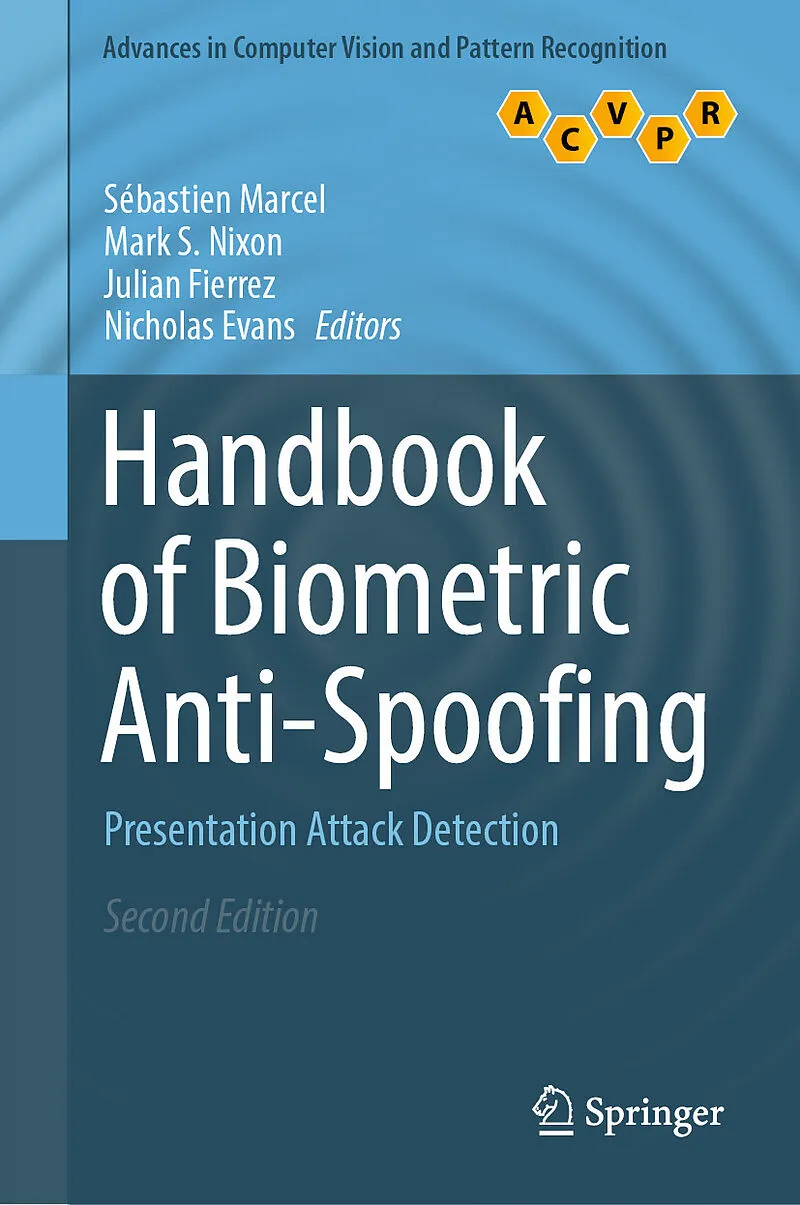
Handbook of Biometric Anti-Spoofing
Beschreibung
This authoritative and comprehensive handbook is the definitive work on the current state of the art of Biometric Presentation Attack Detection (PAD) - also known as Biometric Anti-Spoofing. Building on the success of the previous, pioneering edition, this th...
Format auswählen
- E-Book (pdf)CHF 177.90

Wird oft zusammen gekauft
Andere Kunden kauften auch
Beschreibung
This authoritative and comprehensive handbook is the definitive work on the current state of the art of Biometric Presentation Attack Detection (PAD) - also known as Biometric Anti-Spoofing. Building on the success of the previous, pioneering edition, this thoroughly updated second edition has been considerably expanded to provide even greater coverage of PAD methods, spanning biometrics systems based on face, fingerprint, iris, voice, vein, and signature recognition. New material is also included on major PAD competitions, important databases for research, and on the impact of recent international legislation. Valuable insights are supplied by a selection of leading experts in the field, complete with results from reproducible research, supported by source code and further information available at an associated website. Topics and features: reviews the latest developments in PAD for fingerprint biometrics, covering optical coherence tomography (OCT) technology, and issues of interoperability; examines methods for PAD in iris recognition systems, and the application of stimulated pupillary light reflex for this purpose; discusses advancements in PAD methods for face recognition-based biometrics, such as research on 3D facial masks and remote photoplethysmography (rPPG); presents a survey of PAD for automatic speaker recognition (ASV), including the use of convolutional neural networks (CNNs), and an overview of relevant databases; describes the results yielded by key competitions on fingerprint liveness detection, iris liveness detection, and software-based face anti-spoofing; provides analyses of PAD in fingervein recognition, online handwritten signature verification, and in biometric technologies on mobile devicesincludes coverage of international standards, the E.U. PSDII and GDPR directives, and on different perspectives on presentation attack evaluation.
This text/reference is essential reading for anyone involved in biometric identity verification, be they students, researchers, practitioners, engineers, or technology consultants. Those new to the field will also benefit from a number of introductory chapters, outlining the basics for the most important biometrics.
Dr. Sébastien Marcel is a Senior Researcher and Head of the Biometrics Security and Privacy Group at the Idiap Research Institute, Martigny, Switzerland. He was the Project Coordinator of the EC-funded TABULA RASA (Trusted Biometrics under Spoofing Attacks) and BEAT (Biometrics Evaluation and Testing) projects. He is also the Director of the Swiss Center for Biometrics Research and Testing, a Lecturer at École polytechnique fédérale de Lausanne (EPFL) and Université de Lausanne (UNIL) and Vice-President Conferences of the IEEE Biometrics Council.
Prof. Mark S. Nixon is a Professor of Computer Vision in the School of Electronics and Computer Science at the University of Southampton, UK. He is a co-author of the Springer book Human Identification Based on Gait. He pioneered gait as a biometric, and later joined the pioneers of ear and of soft biometrics. He has worked with many international projects and conferences. He is the current President of the IEEE Biometrics Council, Vice Chair IEEE PSPB, and a member of IAPR TC4 Biometrics.
Prof. Julian Fierrez is an Associate Professor in the School of Engineering (EPS) at the Autonomous University of Madrid (UAM), Spain. He is Vice-Chair of the IAPR Technical Committee on Biometrics (TC4), has participated in large EU projects focused on biometrics since 2003 (most notably BIOSEC, BIOSECURE, TABULA RASA, and BEAT), and has received a number of best paper awards and other prestigious research distinctions, including the IAPR Young Biometrics Investigator Award 2017.
Prof. Nicholas Evans is an Associate Professor at EURECOM, Biot, France where he heads research in Speech and Audio Processing with the Digital Security Department. He led or co-led a number of recent special issues related to anti-spoofing, participated in the EU BIOSECURE, TABULA RASA and OCTAVE projects and is among the co-founders of the ASVspoof initiative and challenge series.
Autorentext
Dr. Sébastien Marcel is a Senior Researcher and Head of the Biometrics Security and Privacy Group at the Idiap Research Institute, Martigny, Switzerland. He was the Project Coordinator of the EC-funded TABULA RASA (Trusted Biometrics under Spoofing Attacks) and BEAT (Biometrics Evaluation and Testing) projects. He is also the Director of the Swiss Center for Biometrics Research and Testing, a Lecturer at École polytechnique fédérale de Lausanne (EPFL) and Université de Lausanne (UNIL) and Vice-President Conferences of the IEEE Biometrics Council.
Prof. Mark S. Nixon is a Professor of Computer Vision in the School of Electronics and Computer Science at the University of Southampton, UK. He is a co-author of the Springer book Human Identification Based on Gait. He pioneered gait as a biometric, and later joined the pioneers of ear and of soft biometrics. He has worked with many international projects and conferences. He is the current President of the IEEE Biometrics Council, Vice Chair IEEE PSPB, and a member of IAPR TC4 Biometrics.
Prof. Julian Fierrez is an Associate Professor in the School of Engineering (EPS) at the Autonomous University of Madrid (UAM), Spain. He is Vice-Chair of the IAPR Technical Committee on Biometrics (TC4), has participated in large EU projects focused on biometrics since 2003 (most notably BIOSEC, BIOSECURE, TABULA RASA, and BEAT), and has received a number of best paper awards and other prestigious research distinctions, including the IAPR Young Biometrics Investigator Award 2017.
Prof. Nicholas Evans is an Associate Professor at EURECOM, Biot, France where he heads research in Speech and Audio Processing with the Digital Security Department. He led or co-led a number of recent special issues related to anti-spoofing, participated in the EU BIOSECURE, TABULA RASA and OCTAVE projects and is among the co-founders of the ASVspoof initiative and challenge series.
Zusammenfassung
As the plethora of approaches to biometrics and their deployment continues to grow, so too does the need to combat the techniques used to subvert the aim of such biometric systems.
Presenting the first definitive study of the subject, this Handbook of Biometric Anti-Spoofing reviews the state of the art in covert attacks against biometric systems, and in deriving countermeasures to these attacks. Across a range of common biometrics, including face, iris, fingerprint, speaker and gait, the book describes spoofing methods and examines the vulnerabilities of biometric systems to these attacks. Novel theoretical methods are also introduced to evaluate the various possible countermeasures.
Topics and features: provides a detailed introduction to the field of biometric anti-spoofing and a thorough review of the associated literature; examines spoofing attacks against five biometric modalities, namely, fingerprints, face, iris, speaker and gait; discusses anti-spoofing measures for multi-model biometric systems; reviews evaluation methodologies, international standards, and legal and ethical issues; describes current challenges and suggests directions for future research; presents the latest work from a global selection of experts in the field, including members of the TABULA RASA project.
This comprehensive text/reference is truly essential reading for all biometric researchers and practitioners in industry and academia. Graduate students of computer science and electronic engineering will also find the book to be a useful supplementary reference for courses on biometrics.
Inhalt
An Introduction to Fingerprint Presentation Attack Detection
Julian Fierrez, Javier Galbally, Raffaele Cappelli, and Arun Ross
A Study of Hand-Crafted and Naturally-Learned F…


