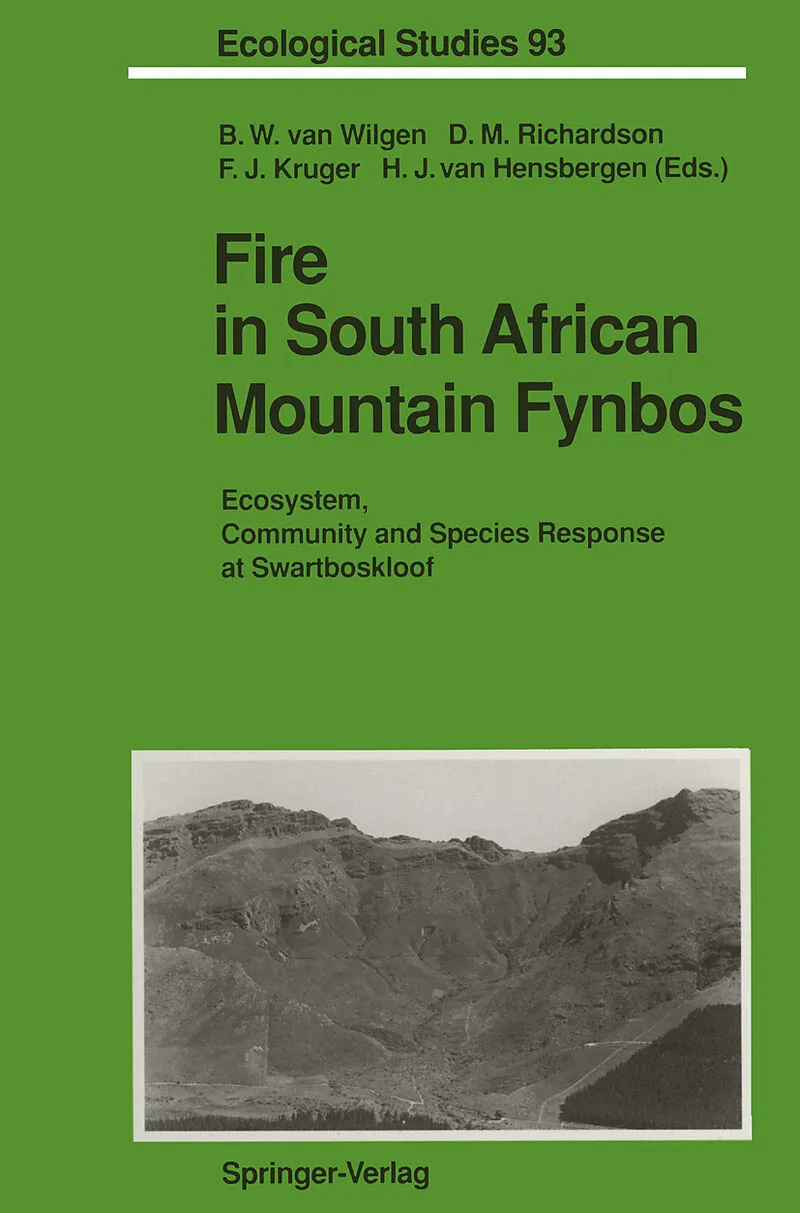
Fire in South African Mountain Fynbos
Beschreibung
Ecologists are increasingly being drawn into the task of addressing problems of environmental degradation. They are expected to find solutions that will lead to sustainable resource use throughout the world. In doing so, the robustness of the science becomes ...Format auswählen
- E-Book (pdf)CHF 118.90

Wird oft zusammen gekauft
Andere Kunden kauften auch
Beschreibung
Ecologists are increasingly being drawn into the task of addressing problems of environmental degradation. They are expected to find solutions that will lead to sustainable resource use throughout the world. In doing so, the robustness of the science becomes increasingly important, and the problem of extrapolating the results of research conducted within what is usually a relatively limited geographical scope is increasingly highlighted. One approach to developing a globally robust ecology involves more or less formal intercontinental comparative studies, usually focused on the question of ecological convergence. These studies are directed at testing the prediction that similar physical and other environmental factors in different parts of the world, through their selective influences, will give rise to ecosystems which share com mon structural and functional features. Should this be true, the predictive power of ecology developed within such a framework should be sufficient to solve similar problems elsewhere in such biomes. There is a long history of such an approach in mediterranean type ecosystems, documented in a series of volumes and their accompanying scientific papers beginning with that of Di Castri and Mooney (1973).
Inhalt
1 The Swartboskloof Experimental Site.- 1.1 Introduction.- 1.2 Location and Physical Site Description.- 1.3 Land-Use History.- 1.4 The Vegetation of Swartboskloof.- 1.4.1 Specialized Hygrophilous Communities.- 1.4.2 Short to Tall Proteoid Shrublands.- 1.4.3 Ericoid-Restioid Shrublands.- 1.4.4 Short Riparian Forest Communities.- 1.4.5 Tall Forests.- 1.5 Fauna.- 1.6 Research Rationale and Design.- 1.7 The Fire of March 1987.- Acknowledgements.- 2 The Climate of Swartboskloof.- 2.1 Introduction.- 2.2 The Climate of Swartboskloof in a Mediterranean-Climate Context.- 2.3 Important Climatic Parameters.- 2.3.1 Rainfall.- 2.3.2 Temperature and Vapour Pressure Deficit.- 2.3.3 Radiation.- 2.3.4 Evaporation.- 2.3.5 Wind.- 2.3.6 Periods of Drought.- 2.4 The Influence of Climate on Fire.- 2.4.1 Lightning as an Ignition Source.- 2.4.2 Climate and the Probability of Fire.- 2.5 Conclusions.- Acknowledgements.- 3 Fuel Properties of Vegetation in Swartboskloof.- 3.1 Introduction.- 3.2 The Description of Vegetation as Fuel.- 3.2.1 Subdivision of Biomass into Fuel Classes.- 3.2.2 Fuel Arrangement.- 3.2.3 Fuel Energy Contents.- 3.2.4 Fuel Models.- 3.2.5 Fuel Buildup and Decay.- 3.3 The Fuel Properties of Vegetation in Swartboskloof.- 3.3.1 Fuel Loads, Fuel Buildup and the Probability of Fire.- 3.3.2 Fuel Arrangement.- 3.3.3 Seasonal Trends in Fuel Moisture Content.- 3.3.4 Live Plants.- 3.3.5 Dead Fuel Moisture.- 3.3.6 Energy and Crude Fat Contents of Selected Species..- 3.4 Fire in Fynbos and Forest Patches in Swartboskloof..- 3.5 The Effects of Invasion by Alien Trees and Shrubs on Fuel Properties.- 3.6 Fuel in Swartboskloof and Other Ecosystems.- 3.7 Conclusions.- 4 Regeneration Strategies in Fynbos Plants and Their Influence on the Stability of Community Boundaries After Fire.- 4.1 Introduction.- 4.2 Survival Mechanisms and Vital Attributes of Species.- 4.2.1 Systems for the Classification of Species.- 4.2.2 Selection and Characterization of Species.- 4.3 Results and Discussion.- 4.3.1 Spectra of Fire Response and Vital Attribute Types..- 4.3.2 Age at Maturity.- 4.3.3 Longevity of Individuals and Seed Banks.- 4.3.4 The Timing of Critical Life History Events.- 4.3.5 Differences Between Communities.- 4.3.6 Fire and the Stability of Community Boundaries.- 4.3.7 Comparison to Other Fire-Prone Shrublands.- 4.3.8 Fire, Resilience and Dynamics in Fynbos.- Acknowledgements.- 5 Is Fynbos a Stage in Succession to Forest? Analysis of the Perceived Ecological Distinction Between Two Communities.- 5.1 Introduction.- 5.2 Fire and the Stability of Forest/Fynbos Boundaries.- 5.2.1 The Effects of Fire on Forest Boundaries in Swartboskloof.- 5.2.2 Soil Seed Banks.- 5.3 Colonization of Fynbos by Forest Species.- 5.3.1 Post-Fire Seed Deposition.- 5.3.2 Germination Requirements.- 5.3.3 Development of Forest in Fynbos Between Fires.- 5.4 Factors Influencing Forest Development.- 5.4.1 The Role of Nutrients in Forest Development.- 5.4.2 Soil Moisture.- 5.4.3 Historical Factors.- 5.5 Synthesis.- 5.5.1 Fynbos Succession.- 5.5.2 Determinants of the Rate of Succession.- Acknowledgements.- 6 Coexistence of Seeders and Sprouters in a Fire-Prone Environment: the Role of Ecophysiology and Soil Moisture.- 6.1 Introduction.- 6.2 Ecophysiological Characteristics of Seeders and Sprouters in Swartboskloof.- 6.3 Comparison of Swartboskloof with Other Regions.- 6.3.1 Other Fynbos Areas.- 6.3.2 Californian Chaparral.- 6.3.3 Australian Kwongan.- 6.4 Community Composition Along a Moisture Gradient.- 6.5 Conclusions.- Acknowledgements.- 7 The Relative Advantages of Seeding and Sprouting in Fire-Prone Environments: a Comparison of Life Histories of Protea neriifolia and Protea nitida.- 7.1 Introduction.- 7.1.1 Evolution of Seed Regeneration in Mediterranean Shrublands.- 7.1.2 Trade-Offs Linked to Seeding and Sprouting.- 7.1.3 Hypotheses.- 7.2 Population Growth after Fire.- 7.3 Mortality Rates.- 7.3.1 Protea neriifolia.- 7.3.2 Protea nitida.- 7.4 Age at Maturity.- 7.5 Seed Production and Seed Banks.- 7.5.1 Protea neriifolia.- 7.5.2 Protea nitida.- 7.6 Seed Germination.- 7.7 Recruitment Between Fires.- 7.8 Effects of Fire Frequency.- 7.9 Coexistence of Seeders and Sprouters.- 7.10 Implications for Management.- 7.11 Conclusions.- Acknowledgements.- 8 Life Cycles and Fire-Stimulated Flowering in Geophytes.- 8.1 Introduction.- 8.1.1 Factors that Stimulate Flowering After Fires.- 8.1.2 Factors Favouring the Evolution of Fire-Stimulated Flowering.- 8.2 The Life Cycle of Watsonia borbonica (Iridaceae).- 8.3 The Life Cycle of Cyrtanthus ventricosus (Amaryllidaceae).- 8.4 Fire Season and the Flowering Response of Watsonia borbonica.- 8.5 Proximate Cues for Flowering.- 8.6 Factors Favouring the Evolution of Fire-Stimulated Flowering.- 8.7 Geophyte Life Cycles and the Type of Flowering Response.- 8.8 Effect of Frequent Fires on Watsonia borbonica.- 8.9 Conclusions.- Acknowledgements.- 9 Why Is Mountain Fynbos Invasible and Which Species Invade?.- 9.1 Introduction.- 9.2 What Makes Terrestrial Plant Communities Invasible?.- 9.3 Plant Invasions in Mountain Fynbos: Why and How?.- 9.3.1 Invasions by Trees and Shrubs.- 9.3.2 Why is Mountain Fynbos Invasible?.- 9.3.3 How is Mountain Fynbos Invaded?.- 9.4 Which Species Invade?.- 9.4.1 Describing a Good Invader.- 9.4.2 Those That Have Made It: Pines and Hakeas.- 9.5 Conclusions.- Acknowledgements.- 10 Do Small Mammals Govern Vegetation Recovery After Fire in Fynbos?.- 10.1 Introduction.- 10.2 Methods.- 10.2.1 Factors Affecting the Distribution and Size of Small Mammal Populations.- 10.2.2 Vegetation Factors Affecting Habitat Selection by Small Mammals.- 10.2.3 The Effect of Small Mammals on Plant Regeneration.- 10.2.3.1 Factors Affecting Plant Establishment in Mature Fynbos.- 10.2.3.2 Factors Affecting Plant Establishment After Fire in Fynbos.- 10.3 Results.- 10.3.1 Post-Fire Development of Small Mammal Communities.- 10.3.2 Vegetation Factors Affecting Habitat Selection by Small Mammals.- 10.3.2.1 The Relationship Between Floristic Communities and Small Mammal Occurrence.- 10.3.2.2 The Relationship Between Structure of the Vegetation and Small Mammal Densities.- 10.3.2.3 Survival and Recolonization Strategies of Small Mammals.- 10.3.3 The Effect of Small Mammals on Plant Regeneration.- 10.3.3.1 Factors Affecting Plant Establishment in Mature Fynbos.- 10.3.3.2 Factors Affecting Plant Establishment in Burnt Fynbos.- 10.4 Discussion.- 10.4.1 Post-Fire Development of Small Mammal Communities.- 10.4.2 Factors Affecting Habitat Selection by Small Mammals.- 10.4.3 Do Small Mammals Limit Protea Regeneration from Seed?.- 10.5 Conclusions.- Acknowledgements.- 11 The Influence of Fire, Vegetation Age and Argentine Ants (Iridomyrmex humilis) on…


