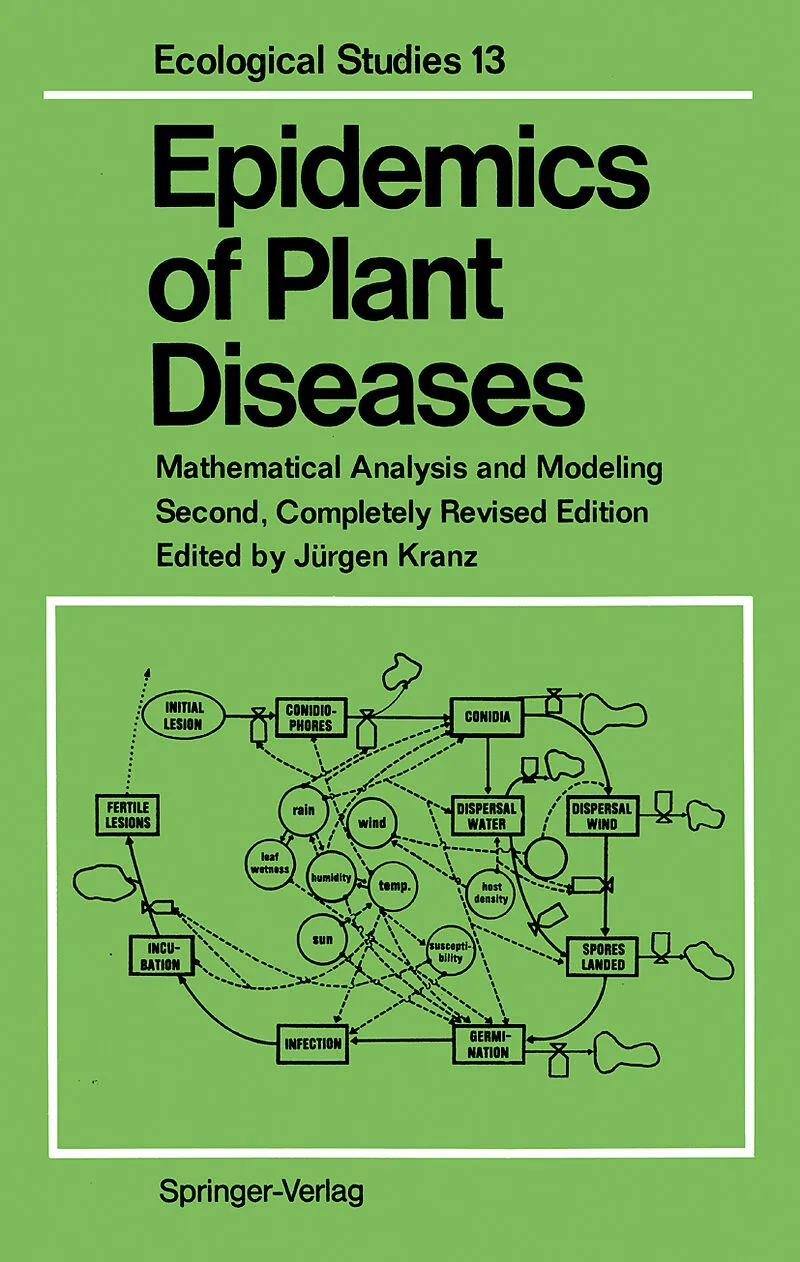
Epidemics of Plant Diseases
Beschreibung
In this volume experts present the latest status of mathematical and statistical methods in use for the analysis and modeling of plant disease epidemics. Topics treated are - methods in multivariate analyses, ordination and classification, - modeling of tempo...Format auswählen
- E-Book (pdf)CHF 118.90

Wird oft zusammen gekauft
Andere Kunden kauften auch
Beschreibung
In this volume experts present the latest status of mathematical and statistical methods in use for the analysis and modeling of plant disease epidemics. Topics treated are - methods in multivariate analyses, ordination and classification, - modeling of temporal and spatial aspects of air- and soilborne diseases, - methods to analyse and describe competition among subpopulations, e.g. pathogen races and - their interaction with resistance genes of host plants - assemblage and use of models - mathematical simulation of epidemics. New chapters on the modeling of the spreading of diseases in air and in soil are included in this second edition.
Inhalt
I Epidemics, Their Mathematical Analysis and Modeling: An Introduction.- 1. Concepts and Scope of Epidemiology.- 2. Mathematics in Epidemiology.- 3. Models and Their Role in Epidemiology.- 4. Mathematical Analysis of Epidemics.- 5. Models as Synoptics Tools.- 6. Outlook.- 7. References.- II Mathematics and Statistics for Analysis in Epidemiology.- 1. Introduction.- 2. Experimentation in Epidemiology.- 2.1 Kind of Experiments.- 2.1.1 Field Experiments.- 2.1.2 Growth Chamber Experiments.- 2.1.3 Combination of Field and Growth Chamber Experiments.- 2.2 Measurements in Epidemiology.- 2.2.1 Measurement of the Pathogen.- 2.2.2 Measurement of the Host.- 2.2.3 Measurement of the Disease.- 2.2.4 Measurement of the Environment.- 3. Common Mathematical Analyses.- 3.1 Analysis of Variance.- 3.2 Linear Regression Analysis.- 3.3 PathAnalysis.- 3.4 Nonlinear Regression Analysis.- 4. Multivariate Analyses.- 4.1 Classification.- 4.1.1 Discriminant Analysis.- 4.1.2 Cluster Analysis.- 4.2 Ordination.- 4.2.1 Principal Component Analysis.- 4.2.2 Factor Analysis.- 4.2.3 Canonical Correlation Analysis.- 5. Other Mathematical Methods.- 5.1 Analysis of the Diversity of Populations.- 5.2 Analysis of the Fitness of Competing Subpopulations.- 5.3 Models for the Buildup of Fungicide-Resistant Subpopulations.- 5.4 Modeling the Effects of Cultivar Mixtures and Multilines.- 6. Concluding Remarks.- References.- III Mathematical Analysis and Modeling of Spatial Aspects of Plant Disease Epidemics.- 1. Introduction.- 2. Populations Changing in Space.- 2.1 Host Plant Populations.- 2.2 Pathogen Populations.- 2.3 Spatial Patterns of Disease.- 2.4 Comparing Spatial Patterns of Inoculum and Disease.- 2.5 Environmental and Genetic Spatial Variability.- 3. Population Models of Spatial Change.- 3.1 Airborne Dispersal of Fungal Spores.- 3.1.1 Long-Distance Transport.- 3.1.2 Within-Canopy Transport.- 3.1.3 Splash and Other Short-Range Dispersal.- 3.2 Soilborne Dispersal of Fungal Propagules.- 3.2.1 Models of Root Growth.- 3.2.2 Models of Pathogen Growth.- 3.3 Vector Dispersal.- 3.4 Dispersal Gradients.- 3.5 Disease Gradients.- 4. Spatial and Temporal Spread of Disease.- 4.1 Statistical Models.- 4.2 Population Dynamic Models.- 4.3 A Generalization of Disease Gradients.- 4.4 Theoretical Models of Focus Expansion.- 4.5 Prospect.- References.- IV Mathematical Modeling and Analysis of Soilborne Pathogens.- 1. Introduction.- 2. Conceptual Models for Subterranean Epidemics.- 2.1 Importance of Inoculum and Related Concepts.- 2.2 Models for Disease Progress.- 2.2.1 Generalized Models.- 2.2.2 Introduction on Inoculum into Models.- 2.2.3 Shapes of Inoculum Decay Curves.- 2.2.4 Introduction of Host Growth into Models.- 2.2.5 Non-Monotonic Models.- 2.2.6 Introduction of Growth of Infections and Lesions into Models.- 2.2.7 Discrete Recurrence Models.- 2.3 Parameters from Conceptual Models.- 3. Analysis of Subterranean Epidemics.- 3.1 Problems in Analysis of Field Epidemics.- 3.2 Selection of Random Variables for Inoculum, Infection, Disease and Host Growth.- 3.3 Sampling Method and Spatial Pattern.- 3.3.1 Random Versus Systematic Sampling.- 3.3.2 Control of Precision.- 3.4 Temporal Analysis.- 3.4.1 Use of Conceptual Models.- 3.4.2 Use of Empirical Statistical Models.- References.- V Multiple Regression Analysis in the Epidemiology of Plant Diseases.- 1. Introduction.- 2. The Nature of Multiple Regression Analysis in Epidemiology.- 3. The Execution of Multiple Regression Analysis.- 3.1 Some Problems with the Data.- 3.2 Assembling a Multiple Regression Equation.- 4. The Interpretation of Relationships Exposed by Multiple Regression Analysis.- 5. The Applications of Multiple Regression Analysis in Epidemiology.- 5.1 Progress of the Epidemic.- 5.2 The Rate of Disease Increase.- 5.3 Disease Severity.- 5.4 Events in the Disease Cycle.- 5.5 Crop Loss.- 6. Conclusions: The Place of Multiple Regression in CurrentApproaches to Epidemic Analysis.- References.- VI Nonlinear Disease Progress Curves.- 1. Introduction.- 2. Linear and Nonlinear Models.- 2.1 Basic Concepts.- 2.2 Statistical Models and Regression Analysis.- 2.3 Model Evaluation.- 2.4 Temporal Autocorrelation.- 3. Models of Disease Progression.- 3.1 Models with Three or Fewer Parameters.- 3.1.1 Exponential.- 3.1.2 Monomolecular.- 3.1.3 Logistic.- 3.1.4 Gompertz.- 3.1.5 Log-logistic.- 3.2 Models with Shape Parameters.- 3.2.1 Von Bertalanffy-Richards.- 3.2.2 Turner's Generic Model.- 3.3 Probability Density Functions and Cumulative Distributions.- 3.3.1 Normal.- 3.3.2 Weibull.- 3.4 Polynomials.- 4. Model Selection and Parameter Estimation.- 4.1 Graphical Techniques.- 4.2 Parameter Estimation.- 4.2.1 Nonlinear Regression Analysis.- 4.2.2 Linear Regression Analysis.- 4.3 Discussion.- 5. Model Extensions.- 5.1 Variable Host.- 5.2 Changing r.- 5.3 Multiple Diseases.- 5.4 Spatial Aspects.- 5.5 Disease Components.- 6. Discussion.- References.- VII Assembling and Using Models of Epidemics.- 1. Introduction.- 2. The Classes of Models.- 2.1 Form.- 2.2 Form and Function Mixed.- 2.3 Function.- 3. Accuracy of Models.- 3.1 Introduction.- 3.2 How Inaccurate Can a Profitable Forecast Be?.- 3.2.1 How Decisions Are Made.- 3.2.2 An Example.- 4. Summaries by Regression Equations.- 4.1 Multiple Linear Regression.- 4.2 Law of the Minimum.- 4.3 Various Purposes.- 5. Analytic Equations.- 5.1 Their Form and Use in Fitting Courses of x.- 5.2 Analysis by Differential Equations.- 6. Simulators of Disease.- 6.1 Distinctive Characteristics.- 6.2 A Difference Between Models of Crops and Pests.- 6.3 Models of Development.- 6.4 Entire Simulators.- 7. Dispersal.- 7.1 Analytic Equations and Dispersal.- 7.2 Gradients.- 7.3 Simulators.- 8. Models of Crops and Pests.- 8.1 Coupling Models with Caution.- 8.2 Regressions of Yield on Disease.- 8.3 Differential Equations.- 8.4 Simulator.- 8.5 Summary Model.- References.
Produktinformationen
Weitere Bände aus der Buchreihe "Ecological Studies"

- Epidemics of Plant Diseases


