Crassulacean Acid Metabolism
Beschreibung
Crassulacean acid metabolism (CAM) represents one of the best-studied metabolic examples of an ecological adaptation to environmental stress. Well over 5 % of all vascular plant species engage in this water-conserving photosynthetic pathway. Intensified resea...Format auswählen
- E-Book (pdf)CHF 118.90

Wird oft zusammen gekauft
Andere Kunden kauften auch
Beschreibung
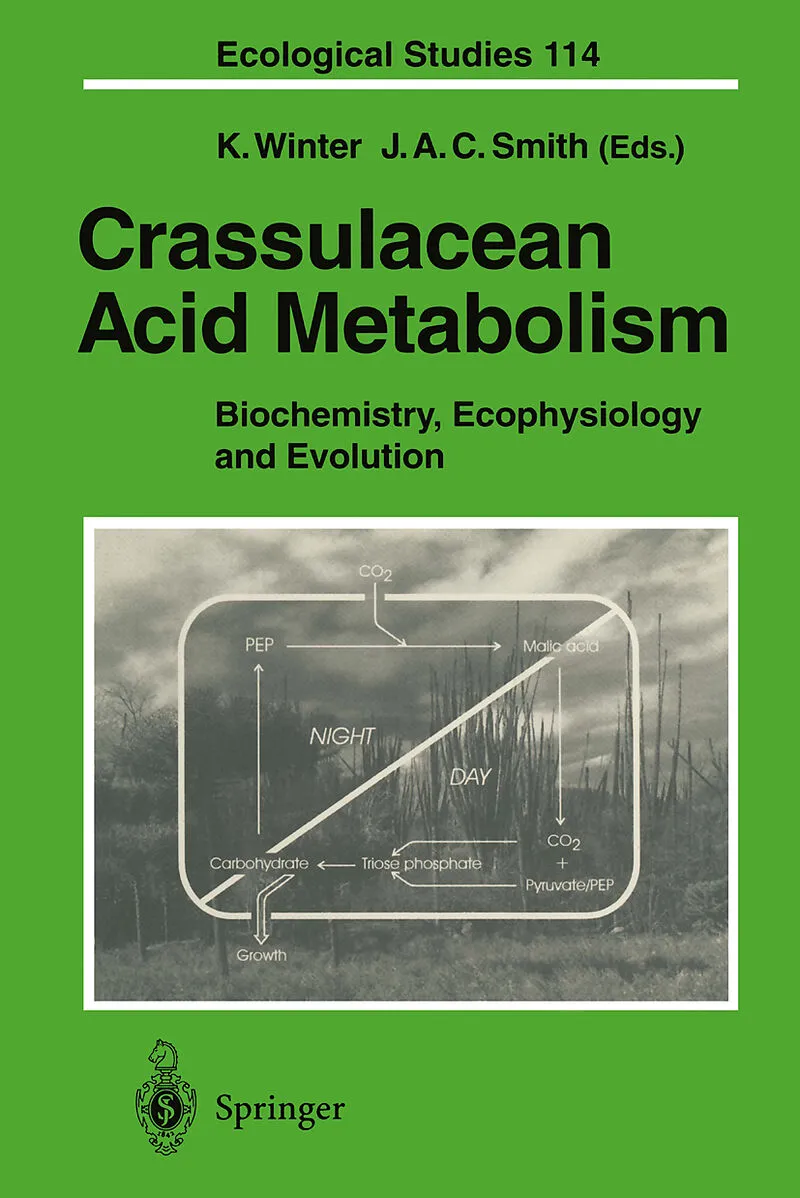
Crassulacean acid metabolism (CAM) represents one of the best-studied metabolic examples of an ecological adaptation to environmental stress. Well over 5 % of all vascular plant species engage in this water-conserving photosynthetic pathway. Intensified research activities over the last 10 years have led to major advances in understanding the biology of CAM plants.
New areas of research reviewed in detail in this book include regulation of gene expression and the molecular basis of CAM, the ecophysiology of CAM plants from tropical environments, the productivity of agronomically important cacti and agaves, the ecophysiology of CAM in submerged aquatic plants, and the taxonomic diversity and evolutionary origins of CAM.
Inhalt
An Introduction to Crassulacean Acid Metabolism. Biochemical Principles and Ecological Diversity.- Discovery of Dark CO2 Fixation.- Biochemistry.- Phenotypic Plasticity.- Ecophysiology and Species Diversity.- Conclusions.- References.- A: Biochemistry of Carbon Flow During Crassulacean Acid Metabolism: Preface.- 1 Stoichiometric Nightmares: Studies of Photosynthetic O2 and CO2 Exchanges in CAM Plants.- 1.1 Introduction.- 1.2 Simultaneous Measurements of O2 and CO2Exchange Using an O2/CO2 Electrode System.- 1.3 Photosynthetic O2/CO2 Stoichiometry During C3 Photosynthesis in Phase IV.- 1.4 Photosynthetic O2/CO2 Exchanges During Deacidification in Phase III.- 1.5 Photosynthetic O2/CO2 Exchanges During Acidification in Phase I.- 1.6 Conclusions.- References.- 2 Alternative Carbohydrate Reserves Usedin the Daily Cycle of Crassulacean Acid Metabolism.- 2.1 Introduction.- 2.2 The Division of CAM Plants into Two Metabolic Groups.- 2.3 The Use of Soluble Sugars Versus Polysaccharides as a Carbohydrate Reserve.- 2.4 Sequences of Biochemical Reactions in the Daily Use of Hexoses Versus Starch in CAM.- 2.5 Bioenergetics in Different Groups of CAM Plants.- 2.6 Conclusions.- References.- 3 Roles of Circadian Rhythms, Light and Temperature in the Regulation of Phosphoenolpyruvate Carboxylase in Crassulacean Acid Metabolism.- 3.1 Introduction.- 3.2 Phosphorylation of PEPC in Intact Tissue.- 3.3 Properties and Regulation of PEPC Kinase and Phosphatase.- 3.4 Effects of Light and Temperature on PEPC-Kinase Activity.- 3.5 Conclusions.- References.- 4 Transport Across the Vacuolar Membrane in CAM Plants.- 4.1 Introduction.- 4.2 Osmotic and Ionic Relations of the Vacuole.- 4.2.1 Osmotic Characteristics.- 4.2.2 Ionic Characteristics.- 4.3 Malic Acid Accumulation in the Vacuole.- 4.3.1 Primary Active H+ Transport.- 4.3.2 Malate Transport into the Vacuole.- 4.3.3 Sodium Chloride Accumulation.- 4.4 Malic Acid Remobilization from the Vacuole.- References.- 5 The Tonoplast as a Target of Temperature Effects in Crassulacean Acid Metabolism.- 5.1 Introduction.- 5.2 Possible Implications of the Temperature-Dependent Phase Behaviour of Tonoplast Lipids for CAM.- 5.3 Experimental Approaches.- 5.4 Outlook.- References.- 6 Regulation of Crassulacean Acid Metabolism in Kalanchoe pinnata as Studied by Gas Exchange and Measurements of Chlorophyll Fluorescence.- 6.1 Introduction.- 6.2 Control of Photosystem II and of Linear Electron Transport.- 6.3 Malate Decarboxylation.- 6.4 Photorespiration.- 6.5 pH-Sensitivity of Photosynthesis.- 6.6 Proton Transport Across the Tonoplast.- 6.7 Light-Dependent Cytosolic Alkalinization.- 6.8 Metabolic Regulation of CAM.- 6.9 Conclusions.- References.- 7 Energy Dissipation and the Xanthophyll Cycle in CAM Plants.- 7.1 Introduction.- 7.2 Energy Dissipation and the Xanthophyll Cycle.- 7.2.1 Relationship Between Zeaxanthin Accumulation and Energy Dissipation.- 7.2.2 Evidence in Support of Zeaxanthin's Role in Energy Dissipation.- 7.2.2.1 Dithiothreitol, an Inhibitor of Violaxanthin De-Epoxidase.- 7.2.2.2 Energy Dissipation in Lichens.- 7.2.2.3 The Reduction State of Photosystem II.- 7.2.2.4 Energy Dissipation in the Absence of Excess Energy.- 7.3 The Xanthophyll Cycle and the Light Environment.- 7.3.1 Diurnal Changes Under Natural Conditions.- 7.3.2 Acclimation to Different Light Environments.- 7.4 Evidence from CAM Plants.- 7.4.1 Energy Dissipation in the Field.- 7.4.2 Acclimation.- 7.4.2.1 Low Light Versus High Light.- 7.4.2.2 Within a Leaf.- 7.4.3 Photoinhibition.- 7.5 Conclusions.- References.- B: Environmental and Developmental Control of Crassulacean Acid Metabolism: Preface.- 8 Factors Affecting the Induction of Crassulacean Acid Metabolism in Mesembryanthemum crystallinum.- 8.1 Introduction.- 8.2 Discovery of Induction of CAM in Mesembryanthemum crystallinum by Water Stress in Controlled Environments.- 8.3 Induction of CAM in a Natural Habitat.- 8.4 Acceleration of Vegetative and Reproductive Growth Under Long Days.- 8.5 Effect of Growth Conditions on Induction of CAM by High Salinity.- 8.6 O2 Evolution from Photosystem II and Net Rates of CO2 Uptake Before and After Induction of CAM.- 8.7 Eventual Induction of CAM Under Well-Watered Conditions.- 8.8 Conditions Resulting in Induction of Phosphoenolpyruvate Carboxylase in the Absence of CAM.- 8.9 Conditions Resulting in Malate Synthesis in the Light in the Absence of CAM.- 8.10 Induction of CAM by Growth Regulators.- References.- 9 Transcriptional Activation of CAM Genes During Development and Environmental Stress.- 9.1 Introduction.- 9.2 CAM Evolution.- 9.3 Life Cycle of Mesembryanthemum crystallinum.- 9.4 Requisites for Environmental Stress Tolerance.- 9.4.1 Maintaining a Functional Chloroplast.- 9.4.2 Osmotic Adjustment.- 9.4.3 Magnitude of Stress-Induced Gene Expression.- 9.5. Regulation of CAM Gene Expression.- 9.5.1 Transcript Amounts.- 9.5.2 Transcription of CAM Genes.- 9.5.3 Analysis of Transcription Control.- 9.5.4 Transcription and mRNA Stability.- 9.6 Transduction Mechanisms of Environmental Stress.- 9.7 Genetics and Transformation of Mesembryanthemum crystallinum.- 9.8 Perspectives.- References.- 10 Environmental Control of CAM Induction in Mesembryanthemum crystallinum - a Role for Cytokinin, Abscisic Acid and Jasmonate?.- 10.1 Introduction.- 10.2 The Concept of Stress.- 10.3 Environmental or Developmental Control of CAM Induction?.- 10.3.1 CAM Induction in Well-Watered Plants.- 10.3.2 Relief from Stress.- 10.3.3 Leaf Water Content.- 10.3.4 The Role of the Roots.- 10.4 Modulation of PEPC and CAM Induction by Gowth Regulators.- 10.4.1 Abscisic Acid (ABA).- 10.4.2 Cytokinin.- 10.4.2.1 Cytokinin Treatment of Shoots.- 10.4.2.2 Cytokinin Treatment of Roots.- 10.4.3 Jasmonate.- 10.4.4 Combinations of Growth Regulators.- References.- 11 Regulation of Crassulacean Acid Metabolism by Water Status in the C3/CAM Intermediate Sedum telephium.- 11.1 Introduction.- 11.2 Characteristics of the C3-CAM Switch in Sedum telephium.- 11.3 Regulation of Malate Accumulation by Water Status in Sedum telephium.- 11.3.1 Relationship Between Water Status and Malate Accumulation.- 11.3.2 Effect of Water Deficit on PEPC and Malic Enzyme Capacity.- 11.3.3 Effect of Water Deficit on the Properties of PEPC.- 11.4 Conclusions and Speculations.- References.- 12 Putative Causes and Consequences of Recycling CO2 via Crassulacean Acid Metabolism.- 12.1 Introduction.- 12.2 Recycling of Respiratory CO2 During CAM in Tillandsia.- 12.3 Recycling of Respiratory CO2 During CAM-Cycling in Talinum.- 12.4 Concluding Remarks.- References.- 13 Ontogenetic Development of Crassulacean Acid Metabolism as Modified by Water Stress in Peperomia.- 13.1 Introduction.- 13.2 Experimental Plant Material.- 13.3 CAM in Peperomia.- 13.3.1 Distribution Among Species.- 13.3.2 Ontogenetic Expression of CAM.- 13.3.3 Modification of CAM Expression by Water Stress.- 13.3.4 Recovery of Full CAM Expression After Rewatering.- 13.4 Discussion of Water-Stress-Induced CAM Expression.- 13.4.1 General Effects.- 13.4.2 PEPC mRNA.- 13.4.3 PEPC Activity.- 13.4.4 Reversibility of the Water-Stress Response.- 13.5 Concluding Remarks.- References.- 14 Crassulacean Acid Metabolism in Leaves and Stems of Cissus quadrangularis.- …
Produktinformationen
Weitere Bände aus der Buchreihe "Ecological Studies"

- Crassulacean Acid Metabolism

- Islands


